
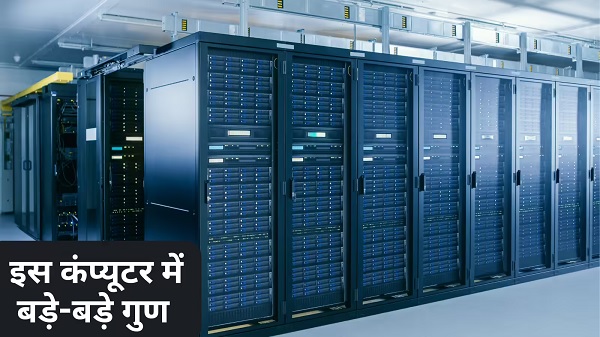
China wins in supercomputing, ‘Lineshine’ becomes the world’s most powerful supercomputer

Beijing. In the global technological competition, China has achieved a major achievement and has left America behind in the field of supercomputing (Lineshine). Supercomputer based in Shenzhen, China ‘Lineshine’ has secured first place in the prestigious Top-500 ranking of the world’s most powerful supercomputers. Along with this, America’s El Capitan Supercomputer has reached second place. This is the first time since 2017 that a Chinese supercomputer has topped the list.
The Top-500 ranking is considered the standard of the world’s fastest and most powerful supercomputers. This list is also considered an important indicator of the scientific and technological capability of a country. Lineshine, which has been included for the first time in the latest ranking released recently, has attracted the attention of experts by directly occupying the top position.
This supercomputer installed at the National Supercomputing Center in Shenzhen has a performance capacity of 2.198 exaflops. This means that it is capable of performing more than 2 quintillion (2 followed by 18 zeros) calculations in one second. Such huge processing capacity can play an important role in scientific research, weather forecasting, artificial intelligence and complex defense related calculations.
America’s top supercomputer so far El Capitan It is installed at Lawrence Livermore National Laboratory in California. After the new results he had to be content with second place. Apart from this, two other supercomputers of America, which are operated in the national laboratories of Tennessee and Illinois, remain in third and fourth place respectively.
Germany’s supercomputer Jupiter Now it has reached fifth place. Currently there are only five supercomputers in the world that have been officially placed in the exascale category, which is considered the most advanced category of supercomputing.
The most special thing about Lineshine is its technical structure. While most modern supercomputers use GPU (graphics processing unit) based architectures for high performance, Lineshine is primarily based on traditional CPU technology. Despite this, it has achieved the top position with exceptional performance.
However, such capacity also requires huge energy. According to TOP-500 data, Lineshine requires approximately 42.2 MW of electricity to operate. Nevertheless, this achievement reflects China’s growing technological capability and its strengthening position in the global supercomputing race.
China’s success in supercomputing comes at a time when competition among the world’s major powers over artificial intelligence, advanced chip manufacturing and high-performance computing is increasingly intense.

Comments are closed.