

New Delhi, July 5, 2026
Chinese nationals working in Pakistan continue to face persistent security threats despite extensive protection measures, with the challenge stemming from deeper political and strategic factors rather than shortcomings in physical security alone, according to a report.
The report published by the “Afghan Diaspora Network” argues that Chinese personnel have become “among the most consistently targeted foreign personnel in any of Beijing’s overseas investment corridors” since the launch of the China-Pakistan Economic Corridor (CPEC).
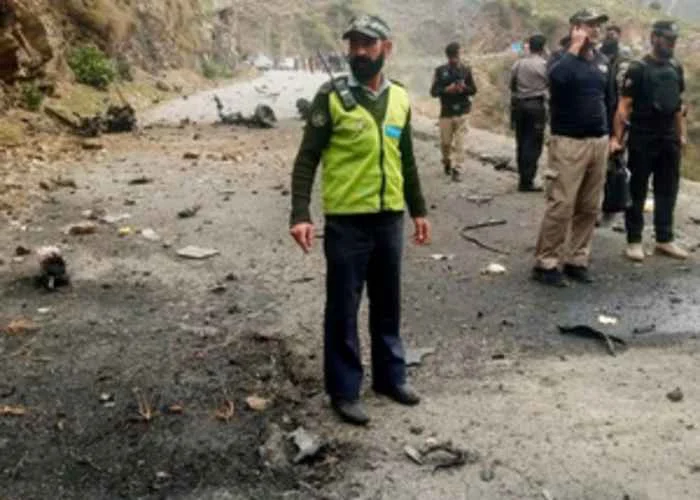
According to the report, repeated attacks on Chinese engineers, infrastructure projects and diplomatic interests have continued despite Pakistan introducing dedicated military deployments, specialized security units and nationwide counterterrorism operations to safeguard Chinese investments.
It states that “the persistence of these attacks suggests that the challenge extends well beyond deficiencies in physical protection.”
The report argues that “the continued targeting of Chinese personnel reflects a structural mismatch between the nature of the threat and the response it has generated.”
Reviewing major incidents over the past several years, the report cites the attack on the Chinese Consulate in Karachi in 2018, the Dasu hydropower bombing in 2021 that killed nine Chinese engineers, the suicide bombing at Karachi University’s Confucius Institute in 2022, the Shangla bombing in 2024, and the attack near Karachi airport later that year. It also notes that attacks claimed by the Baloch Liberation Army (BLA) in early 2026 prompted Pakistan to announce yet another specialized protection unit for Chinese nationals.
The report further states that militant organizations such as the Tehrik-i-Taliban Pakistan (TTP) and the Islamic State Khorasan Province (ISKP), despite their ideological differences, have increasingly viewed attacks on Chinese personnel as a means of exerting political pressure.
According to the report, “Chinese personnel have become deliberate instruments through which multiple militant actors seek to influence state behavior.”
The report also highlights Beijing’s expanding influence over Pakistan’s security architecture, saying successive attacks have encouraged greater Chinese involvement in security coordination, surveillance technologies and institutional cooperation.
Concluding its assessment, the “Afghan Diaspora Network” report says that unless security measures are complemented by a broader political strategy to reduce the incentives for militant attacks, China risks remaining trapped in “a cycle where every security failure will justify deeper protection mechanisms.”
Meanwhile, China has already involved itself in infrastructure projects under the ambitious Belt and Road Initiative (BRI) in Pakistan, Sri Lanka, Nepal, and Afghanistan in the region, where progress has been mixed. Beijing is facing credibility issues due to unfulfilled promises and local resistance.
The China-Myanmar-Bangladesh Economic Corridor (CMBC) has introduced another contention.
A recent article in Bangladesh’s The Daily Star newspaper has argued that the CMBC project looks attractive on paper, but may not be a possibility right now. It cited Foreign Minister Khalilur Rahman’s statement on June 27, when speaking to the media, that Bangladesh was “currently examining” the proposal and had “taken no position” on it.
The article noted that the core problem lies in Myanmar’s Rakhine State, where the junta has lost effective control. According to the analytical piece, the minister also said that any overland connectivity through Myanmar would remain explicitly conditional on the restoration of peace and stability in Rakhine State.(Agency)

Comments are closed.