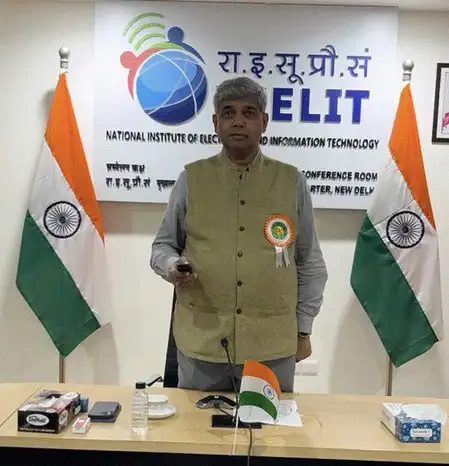
New Delhi, August 16 (IANS). National Institute of Electronics and Information Technology (NIELIT), functioning under the Ministry of Electronics and Information Technology, has launched 'Cyber Wrestling 2026'. It is a nationwide cyber security and artificial intelligence (AI) hackathon that aims to test participants' ability to not only identify vulnerabilities but also their human judgment during cyber security assessments. This was announced on Sunday.
'Cyber Kushti 2026' has been launched as the official parallel technical track of the 3rd National Conference on Cyber Security, Digital Forensics and Intelligence (NCCDFI 2026). This initiative is being organized in collaboration with the Information Sharing and Analysis Center under the National Security Database (NSD), with CERT-In playing the role of knowledge partner.
Registration for the competition has started from August 15 and will continue till September 10. It is completely free to participate and students and independent researchers can participate in teams of three. Unlike traditional cyber security competitions, which primarily focus on identifying vulnerabilities or 'Capture the Flag' (CTF) challenges, 'Cyber Kushti 2026' is designed to test participants' ability to evaluate and prioritize security risks.
Organizers said the competition is designed to address the growing need for professionals who can distinguish between false positives and real threats generated by automated systems.
As part of the competition format, all teams will be provided with an identical, intentionally incomplete 'Security Assessment Package'. This package will include content such as AI generated findings, source code, application logs, architecture documents, static analysis reports, dependency scans and secrets scans.
The Ministry of Electronics and Information Technology said that in order to test the analytical ability of the participants, the organizers have deliberately included some incorrect, duplicated and factual findings while also omitting some genuine weaknesses. Participants will be required to prepare a revised and priority-based security assessment report and provide clear justification for their findings and decisions.
According to the report, participants will be rewarded not only for identifying genuine security flaws, but also for correctly debunking false or misleading findings.
Speaking at the launch of the programme, Professor Tripathi said that the cyber security landscape is no longer limited to just identifying problems, but it has become more important to decide which vulnerabilities are most serious and which require immediate action. He said machines can generate security-related findings at scale, but human discretion and judgment are still indispensable to verify their authenticity and set priorities.
–IANS
PM