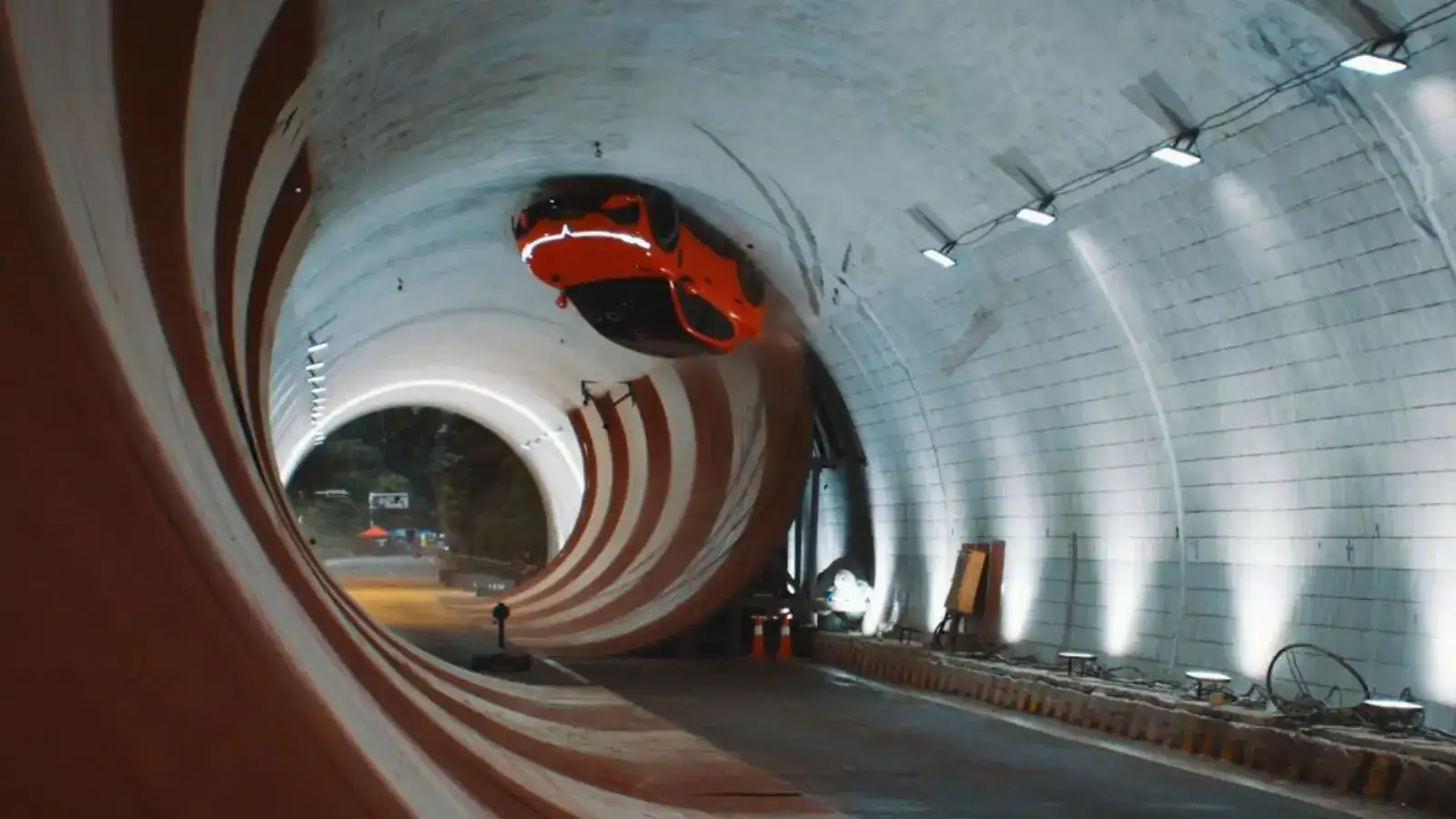
Nowadays, Chinese electric car companies are not only showcasing their cars with longer range and faster charging, but also their performance. Now, Voya, the premium electric brand from Chinese company Dongfeng, has pulled off a stunt that is reminiscent of a scene from the movie. The company's new electric SUV, Voya Passion S, did a complete 360-degree rotation inside a tunnel and was seen moving upside down on the roof of the tunnel for some time. The company claims that this car was not a custom-built stunt vehicle, but a production car. This stunt was completed at a speed of approximately 130 km/h.
How did the car go upside down in the tunnel?
A video is going viral on social media in which a Voya Passion S is seen entering a curved tunnel at high speed. At first the car moves normally on the road, but as the tunnel road turns upward, it starts climbing the wall along with it. Within a few moments, the car reaches a 90-degree angle and then moves towards the roof of the tunnel. The most shocking moment comes when the car is seen completely upside down and moving towards the roof of the tunnel.
Unique success in China: EV was driven upside down in the tunnel for testing
The car then returns to normal, completing the same winding path. This means that the car completed a full 360-degree loop on the inner surface of the tunnel. Through this stunt, the company tried to show that electric cars not only need fast acceleration, but also high-speed control and stability. In such a loop, the most important thing is the speed of the car. When a car travels up the road, gravity pulls it down. However, when a car travels at high speed on a winding road, a different force is applied to its wheels. This is the reason why the car can remain stuck on a curved surface even at high speed. According to Voyah, the speed of the Passion S reached about 130 km/h during this stunt. The angle at which the car entered the tunnel was also properly maintained, which was around 16 degrees. Any small mistake in speed or steering could spoil the balance of the car. So, it was not just a fast driving stunt, but it required perfect coordination between the driver, the car's steering, tire grip and the body dynamics of the vehicle.
Why did the car not fall even after overturning?
Simply put, when the car reaches the top of the loop, it remains upside down for a period of time. During this time, it is important to maintain sufficient speed to remain connected to the tunnel surface. The faster the car goes through the curve, the more likely it is to remain in contact with the surface. Therefore, sudden deceleration during this stunt could be very dangerous. If the car's speed were reduced too much, the required contact force between its tires and the tunnel surface could be reduced. On the other hand, steering too hard or in the wrong direction could cause the car to lose its way. Therefore, a speed of 130 km/h and an entry angle of approximately 16 degrees was considered necessary for this entire stunt.
Unique success in China: EV was driven upside down in the tunnel for testing
Voya claims that a production-spec Passion S was used for this stunt. According to the company, the car was not weight-reduced to make it a lightweight stunt car, nor was it designed as a dedicated racing machine. This makes this stunt even more fun.
How much power does the car produce?
The power of the car is also a big factor behind this stunt. The all-wheel-drive version of the Voya Passion S has a dual electric motor setup. According to current reports, both the motors together generate about 475 kW power, which is equivalent to about 646 PS. The biggest advantage of electric motors in electric cars is that they provide power and torque very quickly. While petrol or diesel engines may take time to reach a certain RPM, electric motors respond instantly from the start.