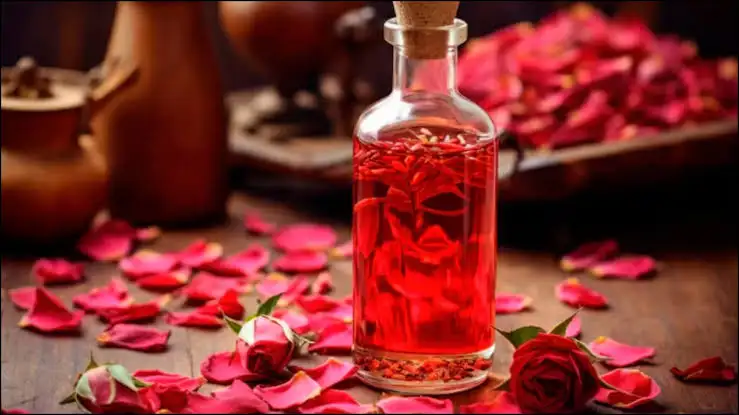
Rose water has been used for skin care for a long time. Many types of rose water are easily available in the market, but if you want to prepare rose water at home then it can be made in an easy way. While making it at home, it is most important that the rose flowers are free from chemicals and pesticide sprays.
Let us know the easy way to make rose water at home and what things should be kept in mind.
These things are needed to make rose water
You will not need many ingredients to prepare rose water at home. For this, you will need about 8 to 10 fresh roses, about 1 liter of water, a big and deep pan, a small steel or glass bowl, a lid and some ice cubes. Also keep a clean glass bottle to store the prepared rose water.
Keep in mind that the roses should be such that they have not been sprayed with any kind of chemical or spray. Flowers used in bouquets can often be treated with chemicals to keep them fresh for a longer period of time. Therefore, to make rose water at home, it would be better to take local and chemical-free roses.
First separate the rose petals
Wash the rose flowers thoroughly with clean water. After this separate their petals. Remove spoiled, dry or soggy petals and use only fresh petals.
After cleaning the petals, keep them aside.
Place a small bowl in the middle of the pan
Now place a small steel or glass bowl in the middle of the bottom of a deep pan or a big vessel. Make sure that the bowl remains stable and does not move. This bowl will later be used to collect the prepared rose water.
Put rose petals around the bowl. After this, add enough water that the petals get thoroughly soaked. Do not keep the quantity of water so much that it reaches inside the small bowl while boiling.
Prepare setup by placing the lid upside down
Now cover the pan with a lid whose middle part is slightly raised. Place the lid upside down, so that its center part is facing inside.
Keep the gas on low to medium flame. As the petals and water heat, steam will rise. This steam will hit the cold lid and start turning into water droplets and will gradually accumulate in the bowl placed below.
If there is a hole in the lid, it can be closed with a ball of dough, so that the steam does not escape.
put ice on top of the lid
Now put some ice cubes on the upside down lid. The ice will keep the lid cold and the hot steam will start turning into water droplets as soon as it comes in contact with it.
These drops collected in the middle of the lid will slowly fall into the bowl. Similarly, the water collected in the bowl will be your prepared rose water.
Let the process continue for about 25 minutes
Keep the gas flame low to medium during the entire process. Let the rose petals and water heat for about 25 minutes.
Using a flame that is too high can cause the water to evaporate quickly, while a flame that is too low will not produce enough steam. Therefore it is better to keep medium flame.
If the ice placed on top of the lid melts, you can carefully remove it and place new ice. During this time, avoid lifting the lid again and again, as this may cause steam to escape.
Turn off the gas after about 25 minutes. Instead of lifting the lid immediately, wait for a while, so that the remaining steam also accumulates in the bowl.
After it cools down, fill it in a bottle.
When the rose water cools down, carefully fill it in a clean and dry glass bottle. In this way the rose water prepared at home will be ready for use.
Keep these things in mind while making rose water
- Always use clean and chemical-free roses.
- Wash rose petals thoroughly before using.
- The pan, bowl and bottle should be completely clean.
- While making rose water, do not keep the flame very high.
- Do not lift the lid frequently to prevent steam from escaping.
- Keep the prepared rose water in a clean glass bottle.
- To prevent homemade rose water from getting spoiled, take special care of hygiene and it is better to make it in limited quantity rather than keeping it for a long time.
- Before using it on the skin for the first time, it is better to do a patch test by applying a little rose water. Do not use if you feel irritation or redness.