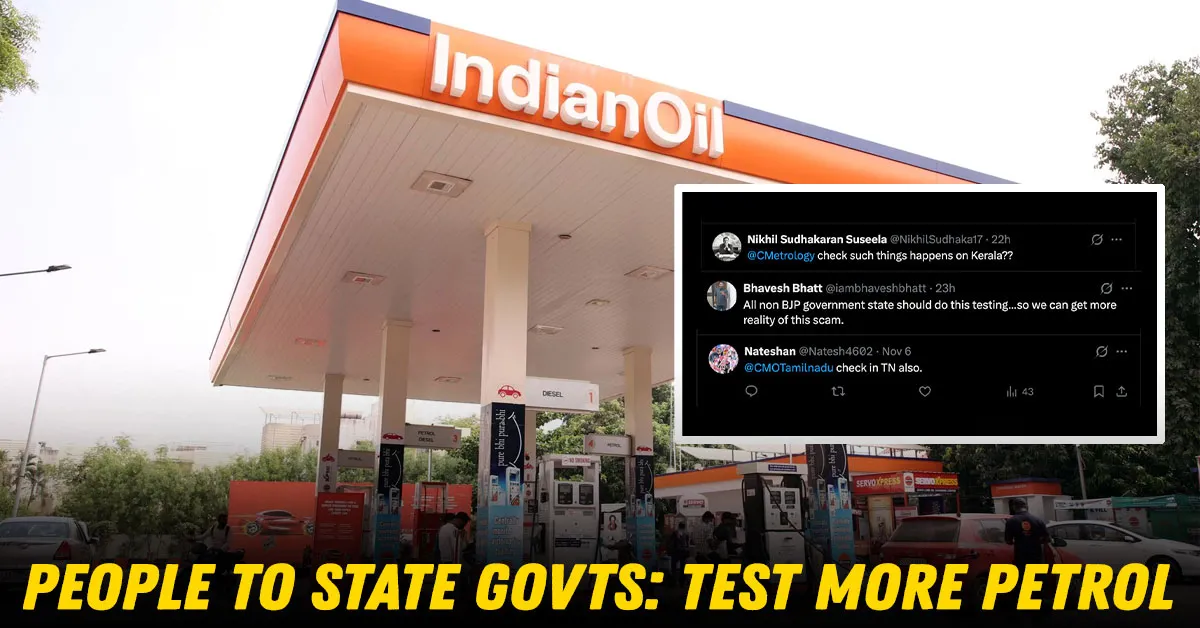
The recent press conference held by Karnataka’s Congress government has triggered massive agitation online. The state’s Food, Civil Supplies, Consumer Affairs and Legal Metrology Minister Rizwan Arshad recently released reports showing that petrol samples collected from several outlets in the states had higher ethanol content than the permitted 20% limit. An independent testing reportedly found ethanol content of up to 31.2% in one of those samples. Many publications including us carried this story and shared it on social media platforms. The news seems to have triggered strong reactions online. Many are now demanding to know whether petrol sold in their states also contains more than the prescribed 20% ethanol. If the issue gains further momentum, more state governments could come under pressure to test fuel samples and take action if violations are found.
Netizens are actively engaging with our editor Jayprashanth Mohanram’s X post (previously Twitter) voicing their anger, dissatisfaction, fear, and concern about the results put out by the Karnataka government. Some of the comments demand state-level tests to be conducted in more states, to determine the actual ethanol content in the petrol being sold there. They want to know if the fuel being sold at pumps in their regions actually meets the E20 specification.
The demand is understandable. E20 petrol is now part of India’s fuel supply system, and it is fair for motorists to want assurance that its ethanol content does not exceed the prescribed limit. Using high ethanol blends of petrol in regular vehicles can be very damaging in the long run. This is not just a question of a sharp drop in fuel efficiency alone. People seem to know this well. The Karnataka findings have raised questions that cannot be answered by relying on claims or in-house testing data released by oil companies. Consumers are calling for transparent independent testing and publicly available results.
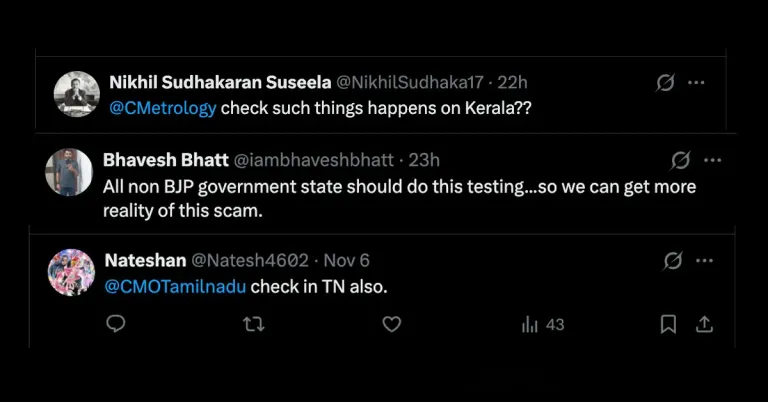
Here is a screenshot showing some of the comments calling for state-level testing. One user wants to know if ‘such things’ (blending beyond 20%) happen in Kerala. Another user commented: ‘ All non BJP government states should do this testing… so we can get more reality of this scam’. A third user mentioned the official handle of the Tamil Nadu Chief Minister and requested to conduct tests there as well. It is clear from the comments section that the protest wave is growing rapidly. Many have also mentioned Tehseen Poonawalla on the post, since he has been very active with protests against E20 rollout.
If more states oblige to public demand and do independent tests on petrol samples, we will get more clarity of the situation. If results of those tests are similar to Karnataka’s, it will probably expose the darkest side of the E20 program- one that we never wanted to exist! For now, things remain unclear, as three public sector oil companies- Bharat Petroleum, Indian Oil and HPCL have openly rejected the report put out by the Karnataka government.
The controversy began after Karnataka Food, Civil Supplies, Consumer Affairs and Legal Metrology Minister Rizwan Arshad presented test findings at a press conference. According to it, petrol samples collected from several locations contained ethanol levels well above the recommended 20% limit. The highest reported reading was 31.2% in a sample from an Indian Oil Corporation (IOCL) outlet.
The state government said the samples were collected from Bengaluru, Kolar, Chikkaballapura, Bengaluru Rural, Ramanagara, Mangaluru and Tumakuru. The findings raised concerns about the quality of E20 petrol being supplied to consumers.
The Karnataka government called for action against oil marketing companies found selling petrol with ethanol content above the prescribed limit.
Indian Oil Corporation, Bharat Petroleum Corporation and Hindustan Petroleum Corporation have jointly rejected the Karnataka government’s report. In a statement released on Friday, the three public sector oil marketing companies said the reported findings were not based on tests conducted under the prescribed statutory and technical procedures.
The companies maintained that E20 petrol supplied across India, including Karnataka, complies with IS 17021, the Bureau of Indian Standards specification for ethanol-blended motor gasoline. They also questioned the sampling process followed during the October 2026 testing exercise.
According to the oil companies, the sampling and testing are governed by the Motor Spirit and High Speed Diesel (Regulation of Supply, Distribution and Prevention of Malpractices) Order, 2005, issued under the Essential Commodities Act, 1955. The procedure also works alongside the Marketing Discipline Guidelines (MDG) 2024.
The prescribed process requires six one-litre samples to be collected from a petrol outlet. Two samples must be handed over to the dealer against acknowledgement. Two others must be retained by the oil company or the department, while the remaining two must be sent to a laboratory specified under Schedule III of the Control Order or notified in the Official Gazette.
The companies also said the sample labels must carry joint signatures. The test results must then be communicated to both the dealer and the oil company within the prescribed time.
However, the three companies alleged that Karnataka’s October 2026 sampling did not follow these requirements. They claimed that samples were collected without the participation of their representatives. They also said they had not received the retention samples, complete details of the petrol outlets or the laboratory reports. The companies said they had requested these documents and samples through the State Level Coordinator. But no information was reportedly provided.