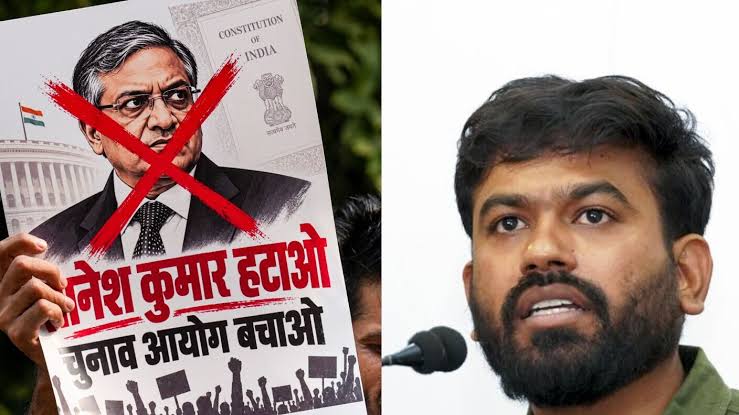
The Cockroach Janta Party (CJP) has threatened to launch nationwide protests from October 2 if Chief Election Commissioner Gyanesh Kumar does not resign, founder Abhijeet Dipke said on Friday.
Dipke said the protests would begin in Mumbai on Gandhi Jayanti and subsequently spread to cities across the country.
“If Gyanesh Kumar does not resign by tomorrow, CJP will begin its nationwide protest from Mumbai on 2 October, and take it to cities across India,” Dipke said, according to Hindustan Times.
CJP co-convener Ashutosh Ranka said October 2 was an appropriate date for the group’s proposed campaign, describing it as an occasion to “reclaim our Republic”.
CJP's allegations against Gyanesh Kumar
The announcement followed a press conference on Thursday during which Dipke, along with CJP leaders Saurav Das and Ranka, demanded Kumar’s resignation within 48 hours.
The group accused the Chief Election Commissioner of undermining the electoral process and raised allegations concerning the management of voter rolls. These claims were made by CJP and have not been established as facts.
Dipke also threatened what he described as a “Jantar Mantar 2.0” if Kumar did not step down.
Das alleged that young voters were being kept out of electoral rolls because of their presumed political preferences. The allegation was not independently established in the report.
Protest threat comes amid ECI controversy
The CJP’s announcement comes amid a separate controversy over the functioning of the Election Commission following an Indian Express investigation.
The investigation reported that Election Commissioners Sukhbir Singh Sandhu and Vivek Joshi had formally recorded objections at least 14 times over a 10-month period regarding decisions and orders of the poll panel. The reported objections concerned areas including voter registration, deletion and restoration of names, changes to Form 6 and access to electoral-roll databases.
The Election Commission has acknowledged the existence of internal notes but rejected suggestions of an institutional breakdown. It has maintained that differing views and written observations are part of deliberations within a multi-member constitutional body and that decisions taken by the Commission were unanimous.
Political demands over CEC’s role
The reported objections have triggered demands from several Opposition parties and groups for action against Kumar, while the Election Commission has defended its decision-making process.
The CJP’s proposed protest is therefore part of a wider political dispute over the functioning of the poll panel and the Special Intensive Revision of electoral rolls.
For now, the October 2 nationwide protest remains a stated plan by the CJP, conditional on its demand for Kumar’s resignation not being met.