With the nation’s right-wing commentariat haemorrhaging over Rahul Gandhi’s remarks on affection between his parents — ensuring that “love” remains a four-letter word in their lexicon — a significant “first” in Bengaluru went barely noticed.
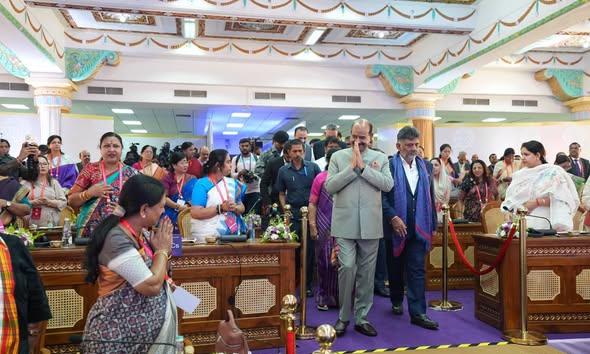
Over two days, on November 17 and 18, the Commonwealth Women Parliamentarians (CWP) met in the city for the first standalone conference of its kind. None of them could claim the privileged entry into politics by Sonia Gandhi in her time. And of course, neither she nor her daughter — parliamentarians both — could be present at this meeting, given pressing obligations to the book launch.
Yet the run-up to the conference and the way it was conducted ensured men stayed firmly in command, leaving women with no even symbolic space.
Also read: Sonia Gandhi’s memoir: What she reveals and what she leaves unsaid
Male gatekeeping
Given the dismal number of women parliamentarians in India — just 74 (under 14%) in the Lok Sabha and about 39 in the Rajya Sabha — the 150-strong audience had to be filled out with Indian MLCs (Members of the Legislative Council) and MLAs (Members of the Legislative Assembly) alongside delegates from other countries.
None of our more vocal women MPs — Mahua Moitra, Kanimozhi, Supriya Sule, Nirmala Sitharaman, or even the otherwise voluble Union Minister of State for Labour and Employment, Karnataka’s Shobha Karandlaje — was anywhere in evidence.
The large advertisements ahead of the event saw nothing out of place in featuring seven men and just two women. We are accustomed to the innumerable flex-boards that scar our pavements and exhaust our visual fields, routinely sprouting a hierarchy of moustachioed men commemorating heroes, celebrating festivals or their own birthdays.
But should even a meeting of Women Parliamentarians cede centre stage to the Lok Sabha Speaker, the Rajya Sabha Deputy Chairman, the Karnataka Chief Minister, the Deputy Chief Minister, and other men from the Karnataka assembly? Room was left for just two women on those posters — D Purandeswari, the CWP India Region Chairperson, and Umashree, the Deputy Speaker of the Karnataka Legislative Council — and rather grudgingly at that.
Also read: TVS family feud: India Inc’s patriarchal blind spot surfaces yet again
Sermons from the dais
This brazen occupation of space by men did not end with optics. Well-worn clichés about women’s empowerment and legislative representation were hurled from the dais at well-clad women politicians by the Chief Minister of Karnataka, the Speaker of the Indian Parliament, and eventually, the woman Governor of Karnataka.
To take just one example, Chief Minister DK Shivakumar sagely advised that “women must not only occupy the seats, they must influence decisions”, before promptly urging those seated to make sure they bought a Mysore silk saree on their way to Mysuru. The platitudes continued with Lok Sabha Speaker Om Birla, leaving Umashree to propose a vote of thanks to the men who had so graciously addressed the women.
Consequently, you would be hard-pressed to find a decent report on this event or the concerns it actually discussed (cyber-stalking and menopause; go figure). Missed was the opportunity for political “inheritors”— such as D Purandeswari, daughter of NT Rama Rao — to prove they are not mere “proxies” (just as not all proxies are inheritors). This trope, after all, remains the most enduring argument used to oppose women’s reservation in Parliament.
Gone, too, was the chance to debate the most urgent issue of the day: that reservations in Parliament and state assemblies must be firmly delinked from delimitation. More importantly, women could have pressed political parties to field far more female candidates, just as the Trinamool Congress (TMC) and the Biju Janata Dal (BJD) did in past parliamentary battles — to transformative effect.
Also read: Why backlash against ‘warrior Sita’ is telling of India’s discomfort with strong, independent women
The art of deferral
Instead, the Karnataka Chief Minister once again asserted that the Women’s Reservation Act — rightly described as a “post-dated cheque” — must be implemented to boost representation. Like his counterparts across most Indian parties, he reiterates the convenient belief that only a “handicap” shared equally by all parties (i.e. mandated reservations for women to Parliaments and Legislatures) will yield space for women.
He has mastered the art of deferral: appeasing the men yet to be accommodated in the current Congress government clearly outweighs any real commitment to women in political decision-making. Thoroughly inured to the irony, he speaks from forums like the CWP while remaining reluctant to bestow a ministerial berth on even one of the 10 women legislators in Karnataka (who constitute a paltry 4.5% of the 224-member assembly).
More shocking, however, was that the women in the audience played along, leaving behind a trail of comments about the hospitality and the “beauty” of the legislature building, and little else.
It takes us back at least a century, to the 1920s, when R Kalyanamma, editor of the Kannada women’s magazine Saraswathi, minced no words in publicly criticising the annual Congress gatherings of “women sipping tea in silk sarees.”
Perhaps Sonia Gandhi’s book should have been launched right there among her fellow parliamentarians, to force an urgent conversation on a meaningful politics of presence — one that has long struggled to separate itself from ‘inheritance’.
(The Federal seeks to present views and opinions from all sides of the spectrum. The information, ideas or opinions in the articles are of the author and do not necessarily reflect the views of The Federal.)