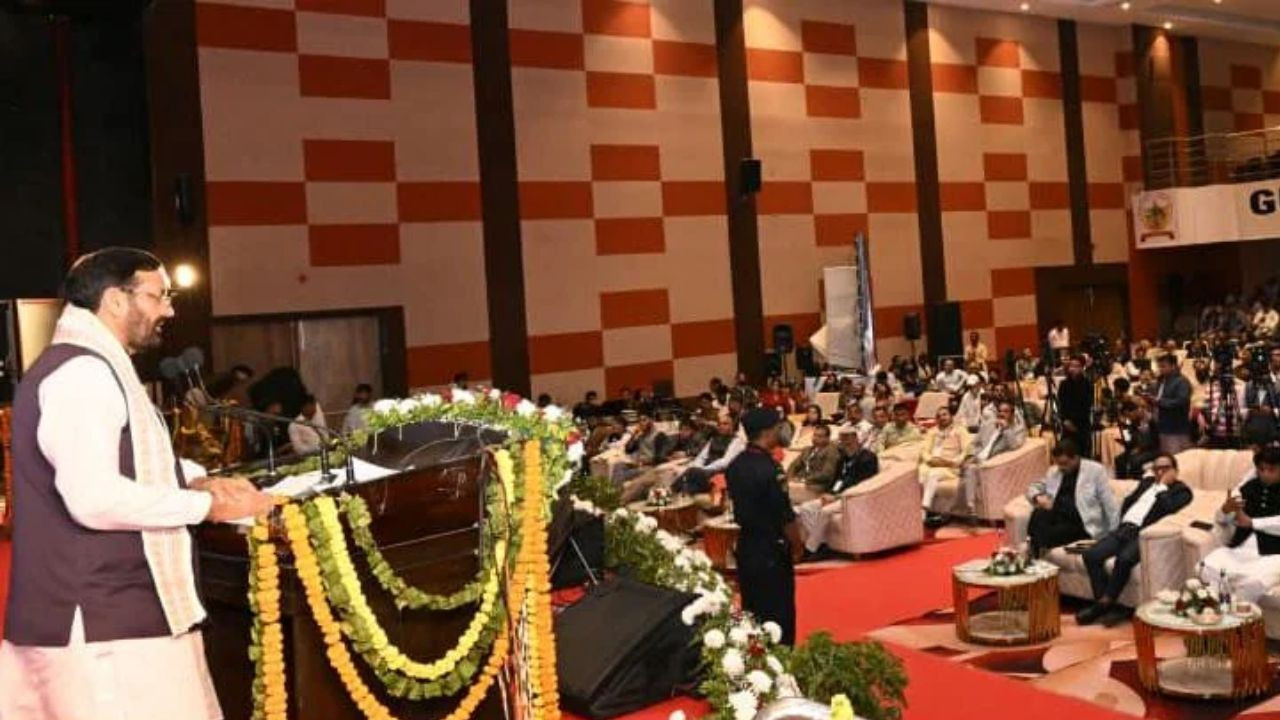
New Delhi: Haryana Chief Minister Shri Naib Singh Saini said that competent Panchayats and accountable municipalities are the strong foundation of developed Haryana. The aim of the Government is to develop local bodies into effective local governments with powers, capabilities and their own financial resources rather than reducing them to mere administrative units.
Chief Minister Shri Nayab Singh Saini was addressing the concluding ceremony of the two-day national conference organized on the subject of empowering Panchayats and Municipalities in Gurugram on Tuesday. Development and Panchayat Minister Shri Krishna Lal Panwar and Industry and Commerce Minister Rao Narbir Singh were also present on this occasion.
Chief Minister Shri Nayab Singh Saini said that in this conference, public representatives, experts and policy makers from different states of the country have shared their experiences, innovations and successful experiments. After two days of intensive discussions, a practical roadmap for strengthening local self-governance has been prepared. This conference will prove to be a milestone in strengthening the foundation of local self-governance.
The Chief Minister said that the real strength of democracy resides not in the files of secretariats, but in the streets of villages and neighborhoods of cities. Father of the Nation Mahatma Gandhi had dreamed of Gram Swaraj and Prime Minister Shri Narendra Modi has set before the country the grand goal of Developed India-2047. The path to achieving both these goals passes through the village chaupal and the city wards. The foundation of the grand building of developed India will be laid in the Panchayats and wards only. Prime Minister Shri Narendra Modi has brought 50 crore people of the country out of the poverty line through welfare schemes in the last 12 years, which is a record globally.
Financial self-sufficiency of local bodies is necessary:
The Chief Minister said that three important topics – revenue mobilization and financial self-reliance, autonomy and accountability and effective service delivery and inclusive participation – were discussed in detail in the conference. Accordingly, any government can take independent and effective decisions only when its financial base is strong.
He said that the Haryana government has made a transparent system of transferring financial resources directly to the Panchayats. Apart from this, regular income of Panchayats has been ensured from stamp duty and share of electricity consumption. To economically strengthen urban local bodies, capital value based property tax system has been implemented.
The Chief Minister called upon the Panchayat representatives to develop their common lands, ponds and community properties as sustainable sources of income. At the same time, municipalities should increase their financial capacity by adopting simple and effective tax collection system. He said that work is done with grants, but the future is built with one's own income.
Announcement of 2 percent additional 'matching grant' for local bodies:
The Chief Minister announced an additional fund of 2 per cent of the State's Own Tax Revenue (SOTR) as 'Matching Grant' to further strengthen the local bodies financially. He said that the local bodies and Panchayati Raj institutions of the cities will be able to avail the benefit of this additional funds in a competitive manner on the basis of their project proposals. Currently the state government is allocating 7 per cent of its own tax revenue to local bodies.
He said that to make local bodies self-reliant, it is necessary to develop their revenue sources. To encourage their efforts in this direction, the government has also decided to provide 'Matching Grant'. Under this, whichever local body raises additional financial resources at its own level, the state government will provide the same amount in the form of matching grant. This will add to the support of the government with every additional rupee raised by the local bodies and double the resources available for the development of the area.
The Chief Minister also announced that the local body leadership which is successful in earning maximum own revenue in its area will be specially honored and rewarded at the state level. He said that this award will encourage healthy competition, transparent governance and better financial management in local bodies.
Local bodies will get responsibilities of public services:
The Chief Minister said that the government is going to take a major policy step towards providing real rights and powers to the local bodies. Under this, important responsibilities like public health engineering, drinking water supply and fire services will be handed over to local bodies in a phased manner in the coming time. He said that this will increase the decision-making capacity of local bodies and they will be able to better manage public services as per the needs of their area.
Along with autonomy, accountability is also necessary:
The Chief Minister said that along with giving more financial and administrative powers to the local bodies, it is also necessary to ensure their accountability. Autonomy and accountability are two sides of the same coin. For this, transparency, accurate mapping of assets, timely audit and strong accounting system are essential. Technology and digitalization can play an important role in this direction.
He said that e-Gram Swaraj, digital property records and online grievance redressal systems are aimed at reducing paperwork and taking governance into the hands of the common citizen. Only when every penny of Panchayats and Municipalities is spent on development works with honesty and transparency, real good governance will be established.
Measurement of development: Positive change in the lives of common people:
The Chief Minister said that development figures are meaningful only when they bring positive changes in the standard of living of the common man. Clean drinking water, solid waste management, accessible roads, modern libraries and clean environment are the basic needs and rights of every citizen.
Shri Naib Singh Saini said that it is a matter of pride that initiatives like four big cluster projects of waste to energy in Haryana and 350 e-Atal libraries have been appreciated in the conference. Through these efforts, while waste will be used in energy production, new doors of digital knowledge will open in rural areas.
The Chief Minister said that the government has given representation to Backward Class-B in Panchayati Raj institutions through reservation. Apart from this, at least 50 percent participation of women has been ensured in village water and sewerage committees. This has increased participation of all sections of the society in local governance.
Haryana-specific reform roadmap will form the pivot of the action plan:
The Chief Minister said that the success of any conference is measured by what changes take place on the ground after it. He urged the public representatives to adopt at least one idea out of the hundred good ideas found in the conference as per their local needs and implement it on the ground. He told that senior officials of both the concerned departments and Professor V.N. The Haryana-specific reform roadmap presented under the leadership of Alok is not just a document, but an action resolution for the coming years. Instead of becoming a decoration of the cupboard, this roadmap will become the pivot of the government's action plan.
The Chief Minister directed the officials to seriously compile the concrete recommendations received from the conference and the feedback from the public representatives and prepare a time-bound action plan. These should be fully coordinated with Haryana Vision-2047 and Pradhan Mantri Vikas Gram Swaraj Yojana. He made it clear that every suggestion should be acted upon and every feedback should be accounted for.
Public representatives should live up to the public trust through their actions:
The Chief Minister told the Sarpanches, Panches, Councilors, Mayors and civic chairpersons that they are the real flag bearers of the democratic system. The public has elected him and entrusted him with the responsibility and now he has to prove through his actions that the public's decision was right.
He said that the government can provide resources and policies, but it is the responsibility of the public representatives to set priorities, get the right work done at the right place and complete it on time. Similarly, they also play an important role in extending the benefits of government schemes to every eligible person. Calling for making Gram Sabhas and Ward Committees active, he said that when Gram Sabhas become vibrant, the planning becomes not of the government but of the people. Empowerment of Panchayats and Municipalities is the biggest need of today's time. People remember those who do this for a long time.
The Chief Minister expressed his gratitude to the Golden Jubilee Haryana Institute of Financial Management, Gurugram University, related departments, subject experts and researchers for the successful and well-organized organization of the conference. He especially thanked the Union Minister Shri Manohar Lal, whose guidance and experience gave the conference the dignity of national level.
The Chief Minister said that our resolve is to create such a strong Haryana, where villages have modern facilities like cities and cities have intimacy like villages. When every Panchayat and Municipality of Haryana becomes self-reliant and sensitive, then only the state will become the leading state of the country and the goal of making India a developed nation by the year 2047 will be realized.
On this occasion, many dignitaries including Pataudi MLA Smt. Bimla Choudhary, Gurugram MLA Mr. Mukesh Sharma, Sohna MLA Mr. Tejpal Tanwar, Additional Chief Secretary of Development and Panchayat Department Mr. Vijayendra Kumar, Commissioner of Urban Local Bodies Department Mr. Ashok Kumar Meena, OSD to Chief Minister and Director General of Golden Jubilee Haryana Fiscal Management Institute Dr. Raj Nehru, Professor VN Alok of Indian Institute of Public Administration and Vice Chancellor of Gurugram University Mr. Sanjay Kaushik were present.