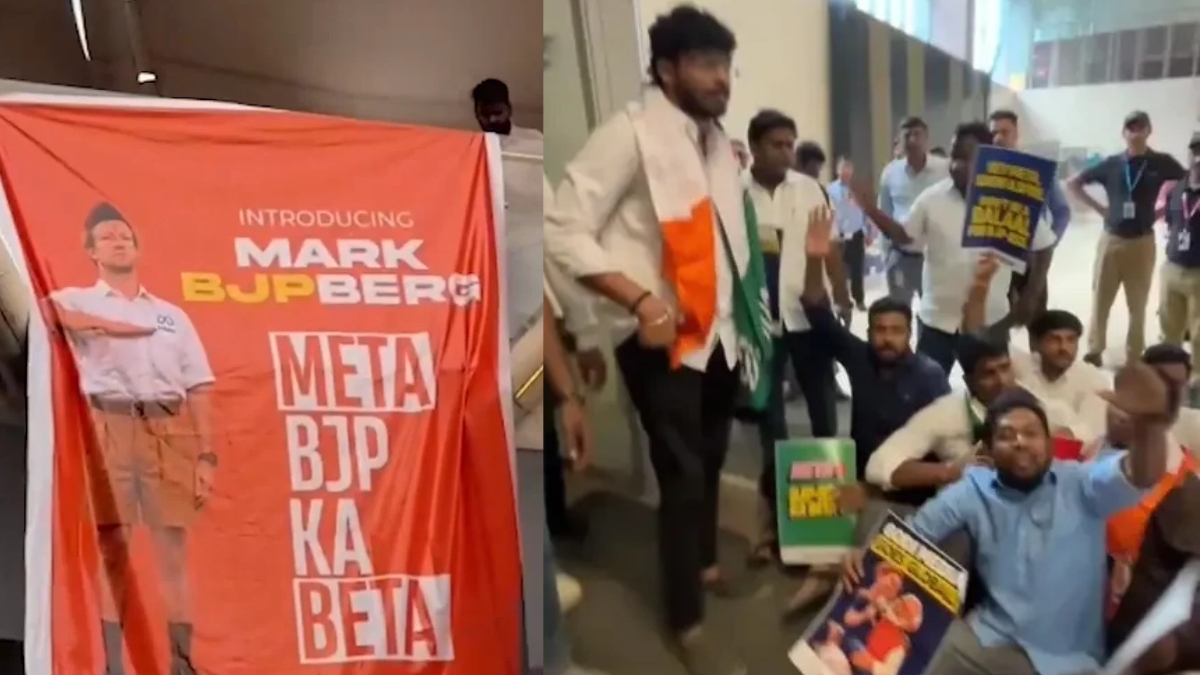
Tensions between social media giant Meta and India's opposition Congress party have escalated into physical confrontations, police complaints and a fierce political debate over digital censorship and state investment.
On Friday, November 20, members of the Indian Youth Congress staged demonstrations outside Meta's offices in Hyderabad, Mumbai and Gurugram. The protests followed the sudden suspension of Instagram accounts belonging to National Youth Congress President Uday Bhanu Chib and National In-charge Manish Sharma, alongside allegations that thousands of political posts were being automatically blocked by platform algorithms.
Protests, police cases and restored accounts
The demonstrations turned chaotic at multiple locations on Friday afternoon. In Hyderabad's IT corridor, protesters carrying placards stormed into the building housing Meta's office, smashing plant pots and clashing with police. Officers took 21 activists into preventive custody before releasing them roughly three hours later.
In Mumbai's Bandra-Kurla Complex, around 20 to 25 protesters gathered outside the premises at around 5:40 pm, raising slogans and confronting security guards. According to the police complaint, a demonstrator wearing a red floral dress damaged the building's glass exterior by spray-painting “META – son of RSS”. Mumbai Police subsequently registered a First Information Report naming Mumbai Youth Congress President Zeenat Sabrin, National Secretary Pawan Majethia, Nikhil Ruparel and Jaffer, alongside 15 to 20 unidentified women. The case was registered under Bharatiya Nyaya Sanhita Section 223, Maharashtra Police Act Sections 37(3) and 135, and the Maharashtra Prevention of Defacement of Property Act, 1995.
In Gurugram and Delhi, activists held banners demanding account restorations and put up posters referring to Meta Chief Executive Mark Zuckerberg as “Mark BJPberg”. Youth Congress leaders claimed that Meta restored the Instagram accounts of their president and in-charge just 15 minutes after workers visited the company's offices.
Four demands and a seven-day deadline
Following the street demonstrations, the Indian Youth Congress issued a formal ultimatum to Meta on Saturday under its 'Digital Azaadi' campaign. The organization set a seven-day deadline for Meta to respond to four specific demands.
First, it requested the exact number of Indian accounts withheld on government orders over the last six months and how many remain blocked. Second, it sought an official explanation for the alleged automated restrictions on posts mentioning Rahul Gandhi or criticizing Prime Minister Narendra Modi and the ruling party. Third, it demanded the removal of unlawful restrictions on opposition voices, journalists and content creators. Fourth, it called on Meta to respect the Indian Constitution rather than political instructions from the Bharatiya Janata Party.
Promising to fight the battle in courtrooms and on the streets, the youth wing asserted that commercial corporations cannot dictate public discourse, declaring: “No corporation gets to decide which Indian has the right to speak”.
Political row over violence and investment
The protests sparked a sharp political backlash from both the ruling party and opposition groups. Senior BJP MP Nishikant Dubey, chairperson of the Parliamentary Standing Committee on Communications and Information Technology, argued that Meta's algorithms were tailored in favor of Congress. Taking a jibe at the social media giant, Dubey remarked: “When you promote 'rakshas' (demons) and 'danav' (monsters), what else do you expect the outcome to be?”. Telangana BJP President N Ramchander Rao also accused Congress of glorifying unruly behaviour, alleging that goondaism is a feature of party culture.
In Telangana, opposition Bharat Rashtra Samithi leaders raised concerns over the state's economic reputation. BRS working president KTR and spokesperson Manne Krishank stated that the vandalism in Hyderabad damaged Brand Telangana and hurt its investment climate. Demanding a public apology from Telangana Chief Minister A Revanth Reddy and Congress leader Rahul Gandhi, Krishank claimed that political intimidation and failing law and order were scaring away investors.
Tighter rules and the free speech debate
The conflict comes amid growing national debate over online regulation and freedom of expression. Under updated rules introduced in February 2026, the Indian government requires social media platforms to remove unlawful content within three hours of notification, down from a previous 36-hour window. Free speech activists argue that this tight timeframe leaves companies with barely any time to review requests, leading to automated censorship.
Mark Zuckerberg-led Meta's transparency disclosures show that it restricted more than 5.4 million posts or accounts in India under local laws during the first half of 2026, up from about 70,000 across all of 2025. Meta stated that the vast majority of these items were proactive restrictions required to comply with local laws. While Prime Minister Narendra Modi's government maintains that content removals occur only when posts breach local laws, public safety or national security, opposition leaders accuse Meta of suppressing dissent to favor the ruling party.