
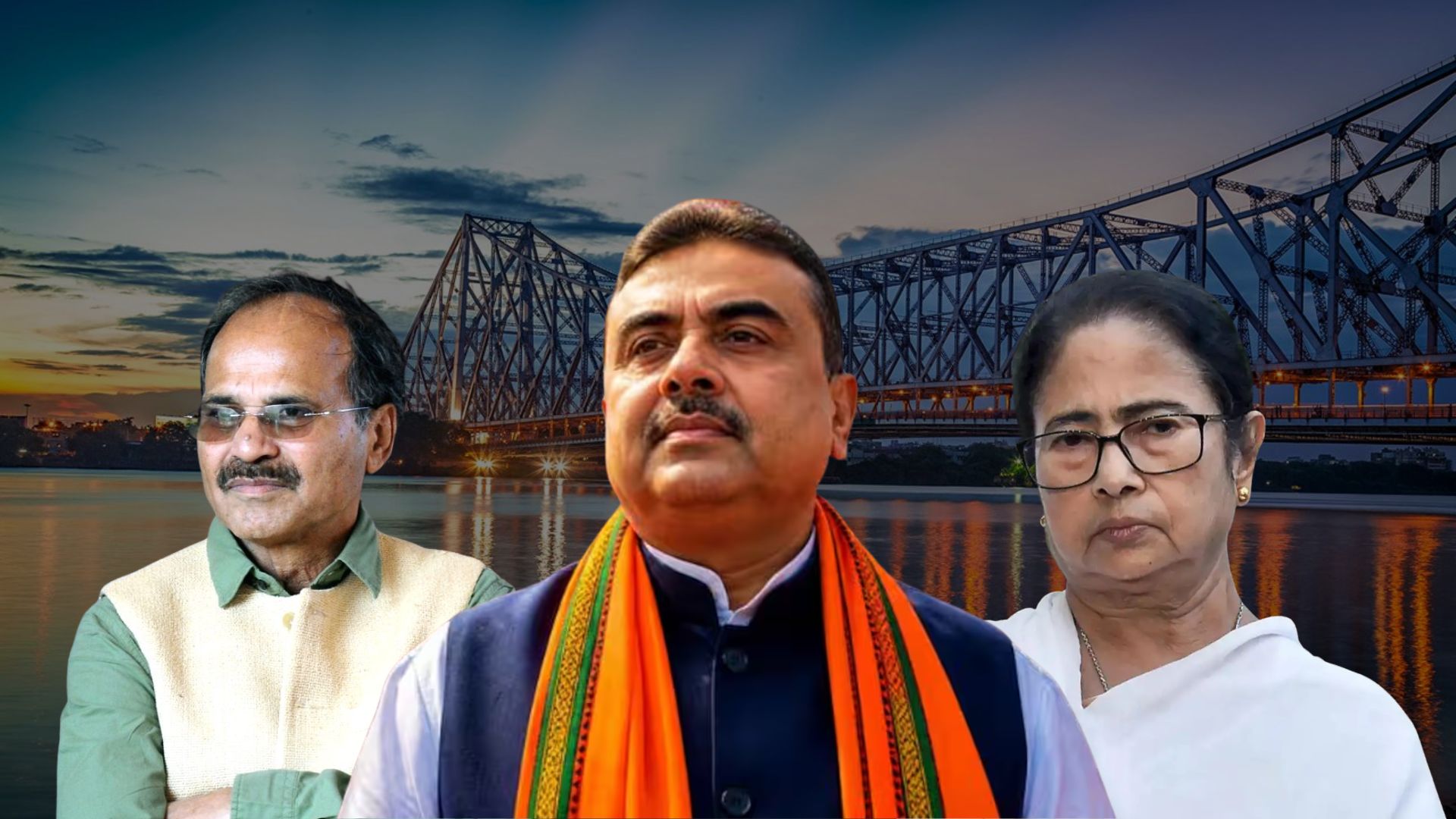

The Bharatiya Janata Party (BJP) on May 9 formed its first-ever government in West Bengal, decimating the Trinamool Congress (TMC) of former chief minister Mamata Banerjee. But one party which would not complain much despite its national rival, the saffron party, sweeping the polls, is the Congress.
Also read: Despite her call for a mega anti-BJP platform, why Mamata seems to be a lonely warrior
After opening its account in the state polls after five years, is the Congress set for a slow but gradual comeback in Bengal, a state it ruled for decades?
Congress’s slow revival?
The Congress once dominated Bengal. From 1947 to 1967, it ruled the state for 20 unbroken years, and again from 1972 to 1977. Then the Left came. Then Mamata came. The Grand-Old Party (GOP) slowly faded thereafter— year after year, election after election.
In 2011, Congress and the TMC were allies. They fought together and won together. But the partnership fractured by 2012. Since then, Congress refused to return to Mamata. In 2016 and 2021, it allied with the Left. In 2026, it went completely alone.
The party’s vote share in 2026 was nearly identical to 2021 — 2.97 per cent versus 3.1 per cent — yet it went from zero seats to two. In the 2024 Lok Sabha elections, the Congress won one seat with a 4.7 per cent vote share. This time, a lower vote share yielded better results, which points clearly to one thing: the Congress’s votes are not spread thin. They are concentrated deep in specific pockets.
Two wins that matter
The Congress won Farakka and Raninagar — both in central Bengal’s Murshidabad district, which was once the party’s bastion. The Farakka win had an added dimension: Congress candidate Motab Shaikh’s name had been deleted from the voter rolls during the Special Intensive Revision process. A tribunal restored his name. And then he won — by 8,193 votes against his nearest opponent, from the BJP.
In Raninagar, the Congress’s Julfikar Ali won by 2,701 votes against TMC’s Soumik Hossain.
The TMC, which had wrested Murshidabad from the Congress over the years, saw a complete collapse in the minority-dominated district.
Also read: How ‘Khela Hobe’ went from an election slogan to one of India’s most defining political battle cries
Of the 22 assembly seats there, the TMC fell from 20 seats in 2021 to only nine in 2026, while the BJP won eight, the Congress two, the new Aam Janata Unnayan Party (AJUP) 2, and the Left one.
Big names lost
There were also some painful losses. Veteran leader Adhir Ranjan Chowdhury lost by 17,548 votes to BJP’s Subrata Maitra in Baharampur, Murshidabad. It was Chowdhury’s second consecutive defeat at home in two years, having earlier lost his Baharampur Lok Sabha seat in
Mausam Benazir Noor, who had dramatically returned to the Congress from TMC in January, lost in Malatipur in the neighbouring district of Malda, also a minority-dominated one, by 59,747 votes.
The broader belt of Malda, Murshidabad and North Dinajpur tells a larger story. The TMC won 35 out of 43 seats in these districts in the 2021 assembly polls, but only 22 in 2026. The remaining seats were scattered to the BJP, Congress, the Left and AJUP.
TMC’s ‘minority’ collapse
When the TMC collapsed, anti-incumbency votes scattered in multiple directions — some to the BJP, some to the Left, some to the AJUP, and some back to Congress. In minority-dominated constituencies, Congress made a real dent.
Take, for example, Baharampur. Adhir Ranjan Chowdhury finished second — behind the BJP. The TMC, the ruling party, came third in what was once its own stronghold. In Beldanga, another Murshidabad seat with a majority-Muslim electorate, the Congress vote share went up by over four percentage points.
The TMC’s share fell from 55 per cent in 2021 to around 26 per cent in 2026, with even the AJUP crossing 20 per cent and the BJP winning the seat with roughly 32 per cent vote share.
Also read: BJP govt in Bengal sparks Teesta hope and immigrant ‘push back’ concern in Dhaka
The data on minority-heavy seats is stark. The TMC won only 73 of Bengal’s 146 seats with more than 25 per cent minority voters in 2026, while the BJP won 66. In 2021, the TMC had won 129 such seats, against the BJP’s 16.
A window opening
For years, Mamata overshadowed everyone in Bengal. She was the face of Bengal’s opposition to the BJP, and the Congress had no one to match her. But now she is out of power, her party is in shock, and the future of the TMC is uncertain.
The BJP has won — but they have never governed Bengal before. New Chief Minister Suvendu Adhikari still has to prove himself as an administrator. That is precisely where Congress may see its window. A BJP that is new to power is easier to challenge than a Mamata at her peak.
If the Congress plays this right — builds on Murshidabad and Malda, consolidates minority trust, and finds a credible face for Bengal — a real revival over the next five years is not out of the question.
Small, but real
Two seats and less than three per cent of the total votes sounds like nothing on paper. But context matters. The Congress has been nearly dead in Bengal for decades. This is the first sign of life — small, quiet and localised, but real.
Also read: Symbolism, social arithmetic define Bengal’s first BJP ministry as Suvendu takes oath as CM
By reviving an old fortress with a favourable demography, it could build on the gains elsewhere in the state. The party’s next major target will be the 2029 Lok Sabha elections, when minority votes may begin floating back to it.
The BJP has the headlines today. The TMC is mourning. But quietly, in Murshidabad, Congress is taking notes. And the GOP might just be back.
The content above has been transcribed from video using a fine-tuned AI model. To ensure accuracy, quality, and editorial integrity, we employ a Human-In-The-Loop (HITL) process. While AI assists in creating the initial draft, our experienced editorial team carefully reviews, edits, and refines the content before publication. At The Federal, we combine the efficiency of AI with the expertise of human editors to deliver reliable and insightful journalism.

Comments are closed.