
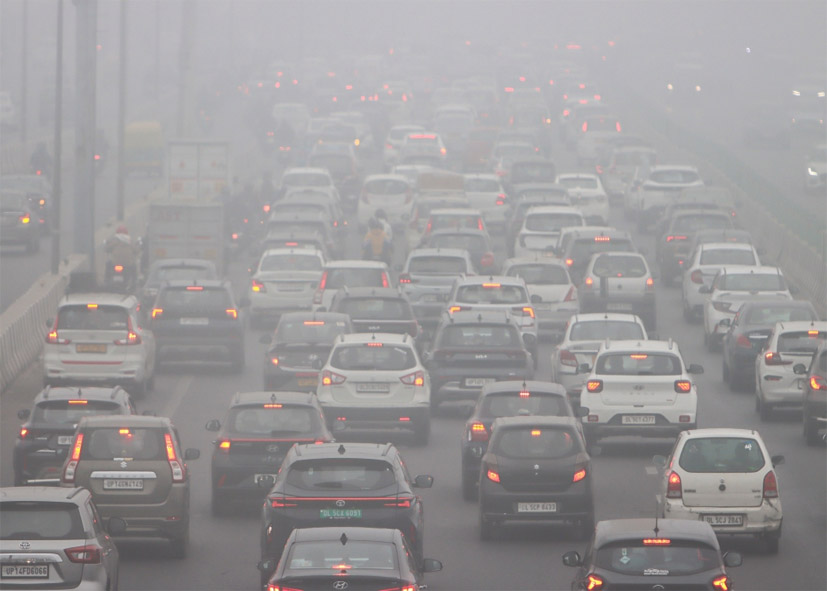
Strictness on vehicle pollution in Delhi, after CAG report, Assembly Secretariat gave strict instructions

The administration has now adopted a tough stance on vehicle-borne air pollution, which is one of the most serious environmental challenges in Delhi. Delhi Assembly Secretariat stepped up action on this issue and the Comptroller and Auditor General (AAG)A major initiative has been taken on the basis of CAG report. The third report of the Public Accounts Committee (PAC), taking into account the findings of the performance audit conducted on prevention and control of vehicle-borne air pollution, has been sent to the concerned authorities for necessary action. All concerned departments will have to take action on the recommendations of CAG. The status of implementation of the recommendations will have to be clarified by December 31, 2026. The complete action report will have to be submitted to the Assembly Secretariat by 31 January 2027.
Delhi Assembly Speaker Vijendra Gupta has said that coordinated and timely action is very important to deal with this serious problem. He clarified that instead of limiting the institutional processes to mere reports, the audit findings should be translated into concrete results at the ground level, so that the real impact of pollution control efforts can be seen. In this direction, Delhi Assembly Secretariat has sent a letter to the Transport Minister, Delhi Government and the Secretary-cum-Commissioner of the Transport Department. It has been requested to give a comprehensive and timely response to the recommendations of the Public Accounts Committee (PAC).
Review of important aspects of air pollution
The CAG based review report on vehicle-borne air pollution in Delhi has raised serious questions on the city’s air quality management system. The report highlights several shortcomings in the regulatory framework, enforcement mechanisms and institutional coordination that are hampering pollution control efforts. Taking forward the recommendations of the Public Accounts Committee, this report has been sent by the Delhi Assembly Secretariat to the concerned departments.
According to the report, there are many structural deficiencies in the capital’s pollution control system, such as glaring lack of planning, limited capacity of the monitoring system, imbalance in enforcement, inadequate establishment and operation of air quality monitoring centres, incomplete monitoring of many pollutants, lack of reliable emissions data. These reasons are affecting evidence-based policy making. Vijendra Gupta said that Delhi’s response to pollution should not be limited to small measures only. This problem is of structural level and a comprehensive and coordinated strategy is necessary to solve it.
Assembly Speaker Vijendra Gupta expressed concern
Assembly Speaker Vijendra Gupta has said that the capital’s bus and overall public transport system has been facing many structural challenges for a long time. Pointing out the shortcomings of the public transport system, he said that there is insufficient availability of buses, route coverage is limited and last mile connectivity remains weak. Apart from this, he also highlighted the delay in route rationalization and slow implementation of alternative transport systems as major problems. Due to these shortcomings, the dependence of citizens on private vehicles is continuously increasing, due to which the traffic pressure on the roads is increasing further. Also, he said that the direct effect of this trend is also being seen in the form of increase in air pollution, which is becoming a serious challenge for the capital.
Vehicle emission standards are not being followed
Expressing serious concern over the enforcement system related to vehicle pollution control, the Assembly Speaker said that there are flaws in the existing system at many levels, due to which the emission standards are not being followed uniformly. He said that limited number of pollution testing centers causes inconvenience to the people and sometimes it also affects the quality of testing. Apart from this, allegations of irregularities in the process of issuing PUC certificates have also been coming to the fore, which affects the credibility of the entire system.
The Assembly Speaker also said that lack of effective monitoring on the emission testing system and delay in adopting modern technologies is also a big problem. Along with this, he said that the large number of old vehicles is the main reason for pollution and said that the process of scrapping and de-registration is going on at a very slow pace, due to which the situation is becoming more serious.
However, he also acknowledged that several important policy initiatives have been taken by the government such as promoting electric vehicles, developing charging infrastructure and strengthening the emission testing system. But according to him, the implementation of these schemes has not been as organized as expected. He said the overall impact of these initiatives has been limited due to lack of better coordination between various agencies.
strong monitoring system
Assembly Speaker Vijendra Gupta said that it is necessary to adopt a comprehensive and sustained approach to deal with the problem of vehicle emissions. For this, he stressed on strong monitoring system, strict adherence to rules, expansion of public transport and promotion of clean transport options. Besides, better traffic management was also said to be an important part of this strategy. Gupta also said that timely and effective action in this direction is very important. He appealed to all concerned departments and agencies to implement the recommendations of the committee with clarity and promptness within the stipulated time frame. He expressed hope that the government will take concrete and decisive steps to remove the shortcomings revealed in the audit and for effective implementation of policies.
Follow the LALLURAM.COM MP channel on WhatsApp

Comments are closed.