
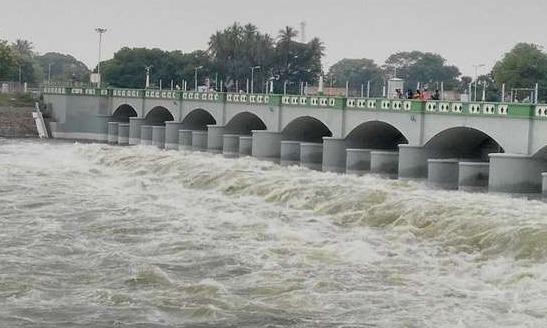

The Cauvery Water Regulation Committee (CWRC) on Tuesday (July 28) recommended that Karnataka release 3,500 cusecs of water per day to Tamil Nadu for the next 15 days, amounting to nearly 4 TMC in total.
The recommendation was made at the CWRC meeting held in New Delhi. Representatives from Karnataka, Tamil Nadu, Kerala and Puducherry participated in the meeting, which was conducted virtually.
Karnataka to appeal
The Karnataka government has decided to challenge the CWRC’s recommendation before the higher authority, the Cauvery Water Management Authority (CWMA).
Also read: Karnataka’s Mekedatu project does not require consent from other states: Centre
Minister for Major and Medium Irrigation Ramalinga Reddy said Chief Minister DK Shivakumar will hold an urgent meeting with senior officials of the Water Resources Department and legal experts to discuss the matter.
Under the rules, Karnataka can appeal against the CWRC’s recommendation before the Cauvery Water Management Authority. However, if the authority also directs the state to release water, that decision will be final, leaving Karnataka under pressure to comply.
Committee rejects Karnataka’s arguments
Officials from Karnataka’s Water Resources Department and a team of experts presented detailed data on the severe rainfall deficit being faced by the state. They informed the committee that, except for the Harangi reservoir, water storage levels in the KRS, Kabini and Hemavathi reservoirs are critically low.
The state government strongly argued that the shortage would affect not only irrigation but also the supply of drinking water to major cities, including Bengaluru. However, the committee did not accept Karnataka’s concerns or arguments and directed the state to release water to Tamil Nadu immediately. The recommendation has sparked serious concern among farmers and residents of the Cauvery river basin in Karnataka.
Sproadic protests
After CWRC’s decision, sporadic protests broke out in Mysuru and Mandya districts, the heart of the Cauvery river basin region, on Tuesday.
Farmers and the pro-Kannada outfits came on the highway in Mandya and took out a march raising slogans saying that injustice has been meted out to the state.
They staged a sit-in demonstration blocking vehicular movement and rolled on the street to lodge their protest against the CWRC award.
Speaking to reporters, Kannada activist Vatal Nagaraj told reporters that releasing water to Tamil Nadu will amount to betrayal at a time when the state is reeling under acute drought.
“We will fight for every single drop of water. At a time when we are struggling to protect every drop, if the Karnataka government releases water without exercising proper judgment, there will be a massive statewide agitation,” Nagaraj said.
In a video message, Kannada activist Praveen Shetty, who leads a faction of the Karnataka Rakshana Vedike, too said that the state has received only 20 per cent of rain this year and all the dams are empty.
“I strongly condemn the KWRC’s order of releasing 3,500 cusecs of water daily to Tamil Nadu when there is no water for Bengaluru. The government should take a strong decision. Water should not be released to Tamil Nadu for any reason,” Shetty said.
TN CM writes to PM Modi
Meanwhile, Tamil Nadu Chief Minister C Joseph Vijay has written to Prime Minister Narendra Modi, urging the Centre to withdraw its recent Rajya Sabha reply on the Mekedatu dam and block any project approvals unless they comply with the Cauvery Water Disputes Tribunal (CWDT) award and Supreme Court rulings.
Calling the reply ”disappointing”, he said it ignored the law on riparian consent, citing the Supreme Court’s Alamatti judgment (2000), which held that Karnataka cannot raise dam height without consent from other states and Central government’s approval.
Vijay argued the Court had upheld Clause XVIII of the CWDT Award, requiring states to regulate water use in ways consistent with the Tribunal’s directions. He said the Tribunal itself had prioritised coordinated release schedules — even in a minor case like Kerala’s Pambar project — and that Clauses XI and XX bar unilateral changes affecting downstream deliveries without mutual agreement.
Vijay also asked the Centre to withdraw the Ministry’s reply, withhold any approvals for the Mekedatu project unless they are consistent with the CWDT Award and the Supreme Court ruling, and protect the rights of lower riparian states over both the quantum and pattern of water releases.
Calling the Cauvery “the lifeline of millions of farmers and citizens across southern India”, Vijay sought Modi’s intervention in the interest of federal harmony and judicial compliance.

Comments are closed.