
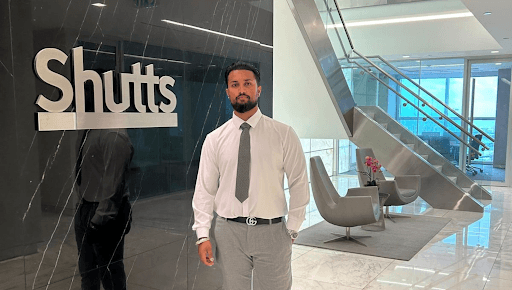

Daman Singh Saduara grew up with a family scattered across continents, including India, and a name that carried different meanings depending on which country he was standing in. By the time he finished his legal training in England and an LLM at the University of Miami, he had lived and studied on three continents. What he had not done was become a lawyer, and that was on purpose.
Three countries, one decision
Saduara’s academic path took him first to England for his legal training, then to Miami for an LLM, a route that put him within reach of a career at one of the country’s largest firms. He interned with Aliette Rodriguez’s team at Shutts & Bowen in Miami, an experience that showed him what practicing at the top of the profession looked like day-to-day.
It also showed him what he did not want. The turning point came later, while he was in Canada preparing for the New York bar exam. He was surrounded by a younger generation of founders building companies at a pace he found himself drawn to, and something about the traditional legal track started to feel like a ceiling rather than a ladder. “Being a barred attorney comes with restrictions I wasn’t willing to build my future around,” he said, pointing to rules that limit a lawyer’s ability to take equity in a client’s business or move freely between advising and building.
So he chose not to sit the exam. He told his parents first. He says they were cautious at the start, less because they doubted him and more because a legal education spanning England and Miami is not something most parents expect their child to set aside. That hesitation did not last. Within weeks of his return home, they could see something real starting to take shape.
From Toronto to a global consulting company
That something became Global Brotherhoodan AI automation and consulting company, founded in Miami in January 2026, alongside his brother, Gurvir Singh Saduara, as co-founder. Now based between Toronto and Miami, the company builds automation systems for businesses, including AI receptionists and workflow tools for companies where response time and client experience carry real weight. Its consulting arm extends further still, connecting businesses across Canada, Australia, England, Spain, and the United States, a footprint that mirrors the international path Saduara took to get here.
For a founder trained in law rather than computer science, Saduara describes the throughline as judgment rather than code. “Everything I learned in law, I’m using now. I just don’t have to ask permission to build with it,” he said. Reading risk, understanding where trust breaks down between a business and its clients, knowing when a relationship needs more structure and when it needs less: none of that came from a technical degree. It came from years spent inside rooms where those judgment calls mattered.
Saduara traces much of that judgment back to the people who taught him along the way. He credits Marike Paulson, one of his professors, with encouraging him to publish early in his academic career, and Howard Kwon with teaching him how to integrate AI into daily workflows at a law firm, a skill that would later inform his approach to building Saduara Global. Another memory comes from Daniel Gonzalez and Mark Cheskin, partners at Hogan Lovells in Miami, who once mentioned, almost as an aside, a former student who had gone on to become a client of their firm.
Small as it sounds, Saduara says it reshaped how he thought about ambition. The goal was never simply to work at a top firm. It was to become the kind of person a top firm would want as a client.
He also returns often to a line that has stuck with him since his time in Miami: once you have seen the penthouse, the lobby does not feel the same. He uses it to explain why going back to earlier versions of his life never quite fit again once he had built something bigger elsewhere.
Saduara Global’s client relationships are still developing, but they already reach into Canada, Australia, England, Spain, and beyond, a spread Saduara credits directly to family connections built over years across those same countries, India included. He talks about the business less as something he built alone and more as an extension of the people, professors, and family who shaped him along the way.
His ambitions for the company are not modest. Saduara wants Saduara Global to become one of the world’s largest AI and consulting companies. Whether that happens remains to be seen. What is already clear is that the path he took to get here, three countries, one law degree he chose not to use, and a decision to build instead of practice, was never the conventional one.

Comments are closed.