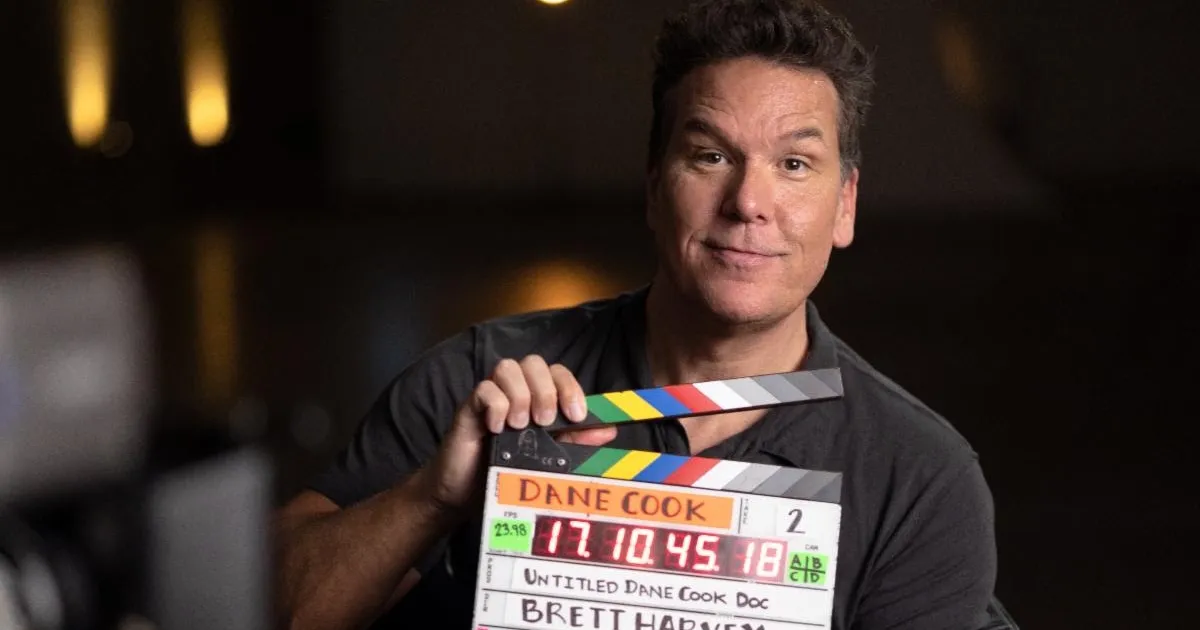
Funny Money: The Dane Cook Story’s Dane Cook spoke with News’s Tyler Treese about the new documentary on his life. Cook discussed the embezzlement incident that takes over the back half of the film, why the documentary was cathartic in ways, and more. It is out today on Digital.
“At the height of his career, Dane Cook wasn’t just selling out arenas, he was redefining what a stand-up comedian could be. Then, in a shocking betrayal, the person he trusted most stole multi-millions of dollars, forever changing his life. Funny Money: The Dane Cook Story is a gripping documentary about fame, family, greed, and survival, revealing the extraordinary true story behind one of comedy’s biggest icons,” says the official description.
Tyler Treese: Your new documentary, Funny Money: The Dane Cook Story, did it ultimately provide some closure for you? Because it has to be awkward reliving all this trauma and promoting it and then talking about it more. Did this kind of pick a scab open, or has it helped move the chapter a bit?
Dane Cook: Yeah, I mean, certainly in some regards, it feels like a complete sort of ending of a book of that chapter of my life. But it’s opening up so many—there’s certainly tentacles that are going out just by way of even the trailer that are bringing in conversation and people and information that I was not privy to. Fortunately, no, nothing that’s opening up a wound, so to speak, but definitely bringing things to light.
And if anything, probably mostly encouraging me to want to continue to get out there and talk about it because it’s a beautiful documentary. Brett Harvey did such an incredible job directing it. But truly, at the core of who I am is I love entertaining people.
And when everything back in the day that we were talking about, the early albums and early comedy specials, when everything first sort of hit, I think that’s where people saw me and the light that I’d always hoped to create for myself. And now, all these years later, it’s a celebration of that. But it’s once again me sort of showing people, like, this is how I want you to know me today.
So definitely a celebration on many counts. And yet, yes, there’s definitely a lot of emotional valves that get kind of turned when you’re talking about these things.
In the documentary, you’re even making some jokes. Obviously, comedians joke about trauma. You joke about your childhood and find humor in these situations. How difficult was it finding humor in this situation when suddenly you wake up and millions are gone?
Dane Cook: Yeah, would you believe me if I said I was on stage two nights later doing a show? Stand-up was always like a safe haven for me. Stand-up comedy was an escape mechanism and also one that I wanted to provide for my audience to feel like they could leave the hardships outside.
I grew up in a household that was dealing with alcoholism and some real gnarly sort of turns of the screw. So I felt like my job in the house, and one that I loved doing, was I was always trying to find ways to bring laughter to my household. So two nights after this happened, I found myself on stage performing because it was a release.
In 1991, I think I said stand-up comedy saved my life and gave me a life. And I can tell you strongly that when this happened with my brother, it was saving my life and it was giving me life. And here we are again, talking about it now in finished form.
And it feels like it’s really embraced and become the identity, in many ways, of my life, and then providing me whatever is going to come from this. So yeah, I’ve always dealt with things through humor, and I don’t really like to sit around and feel sorry for myself.
One of the shocking moments in this doc is where it shows that you were ready to waive the $12 million restitution if your half-brother would just meet with you and participate in this documentary. Was that shocking to see that it was turned down? Because obviously you’re hoping for an additional layer of closure and trying to put this behind you, and for whatever reason, he can’t face you.
I think the way you put it is very interesting. I don’t know if it’s that he can’t face me, but I think that there’s probably, if I were to guess, even a lot on his side that he has to face.
I mean, my sister, Courtney, who’s in the documentary, in so many ways, she was the heart of our household. And not only did he do this to me, this crime, but he abandoned his sister, and he put his own son through—you know, you’re 15 years old, you’ve got a cool uncle who’s a comedian, and your dad’s doing good for himself. And then suddenly the upheaval and what he put upon his own son, we sort of see all those things in the documentary. So the impact that he had on them, I feel like, is what most likely kept him apprehensive.
But I will tell you a little breaking news. I did reach out to him, and he did correspond with me through the attorneys. And there was the opportunity to sit across from each other. And I don’t think that’s out of the question still.
I think that if the documentary finds its way, and if the audiences that I feel like are out there show up and watch this, then where we sort of take the story with the knowledge that I have now, even since we completed the doc, I think it would make for an interesting sort of part two.
Obiously he is your half-brother, and you wonderfully show how supportive he was early on. It’s not like a hit piece. This isn’t like a super damning documentary. Could you see yourself having a relationship and moving past this situation with him?
Dane Cook: I mean, that is an intricate question because a relationship certainly is far more—I mean, there’s a lot of moving parts there for what has happened. Could I have some form of communication or correspondence? It’s not out of the question because I’m the kind of person that if somebody has wronged me, or if I’ve been wrong in some way that’s impacted a business decision or anything, I’m a come-to-the-table kind of guy.
I want to figure out how to get through it. I want to figure out, actually, how we’re better from it. I’m always trying to look for that.
And I’m sure you’ve seen in your life, sometimes the worst situation you go through with a person is actually what leads you to a better understanding of both yourself and that communication or that relationship. It’s not out of the question.
I definitely feel like, given what’s happened with the trailer being out and some of the things that I’ve heard and have transpired over the last month, that there could very well be the chance to have some kind of communication. But that remains to be seen.
There’s another interesting wrinkle. We see his ex-wife, Daryl’s ex-wife, Erica, throughout the documentary. She said that she would accept the phone call, very gracious of her. Have you spoken with her? There’s an incredible about-face near the end of the documentary when she is told some information and just does a complete 180. That was just a real incredible moment.
Yeah, when I watched that sitting with my sister and we saw that, everybody in the room—my wife, her family, my sister—I think there was a lot of coarse language.
I think that people that love documentaries would say that she’s great documentary. And I think that gotcha moment at the end is one of the most impactful moments in the doc. But I think if you like those kinds of docs, that’s what you’re looking for there.
But she is, she’s a bit of a chameleon. And I look forward to a follow-up conversation to be able to say, “What did you think of her, and how deep do you think her knowledge and ability went?” Because I think she’s a gamer, and I think she gamified when she needed to.
And I’ve also seen more evidence than is even in the doc, and clearly she had the ability to sort of move behind the scenes while letting Daryl sort of be the face of what was happening.
The first 40 minutes of this doc is actually very fun for the most part, seeing your rise, and you were one of the first to really take advantage of social media. Everybody is on social media nowadays. How was it just being a pioneer and seeing that impact? Because all celebs are on social media now. Clearly, you pioneered that.
I appreciate that, man. Yeah. And I would be lying if I didn’t say I felt like I was—I don’t know if I would use “pioneer,” but I certainly felt like I was cultivating a tech path.
I looked at it back then as like, “Hey, this is like a portal.” And if I catch your attention in it, maybe I share a WAV file, i.e., a comedy clip. Maybe I share some tour dates. If I can talk to people in a certain region, try to bolster tickets.
Very quickly I started to see that the relationship that you can have online—and it’s funny, it’s still the biggest mistake that people make today—is the one that I learned and quickly was amplifying, which is like a social media page or a website or anything in tech is soulless. And the only thing that brings it soul is truth.
You can put stuff, you can put clips, you can put even a little bit of rabble-rousing, anarchy, and you’ll catch some attention. But nothing is more interesting than someone’s truth. And I think we see it whether somebody puts tutorials up or a podcast about overcoming so-and-so or true crime, or there’s a myriad of selections.
But the ones that we’re seeing elevate is when there’s something very honest and very truthful in there. And I think I tapped into that then because I was writing people back and saying, “I genuinely appreciate, Mike from Tennessee, that you care about my comedy. And Caitlin from Tampa, thank you for coming into the chat room.”
And I saw I was shaking hands, meet-and-greet, one at a time, and trying to get elected as comedian of the year. And who knew it would actually become a global thing? And now I get to see some of my cohorts and people I’ve even mentored use it to come up and take it to places that I never even dreamed possible.
Thank you so much for your time today. I’m sorry we couldn’t have talked about something more fun. I know this is a bit of a bummer. I feel bad asking about it.
I mean it when I say that even though I went through all this, and when people watch it, there’s certainly hardships and some of it is very emotional, I think that the documentary that Brett Harvey made, it’s a beautiful story, and there’s comedic elements in there. I think it’s sort of everything I’ve ever wanted to do in storytelling. So the fact that you wanted to talk about it today, having seen it, means a lot to me.
Thanks to Dane Cook for taking the time to talk about Funny Money: The Dane Cook Story.