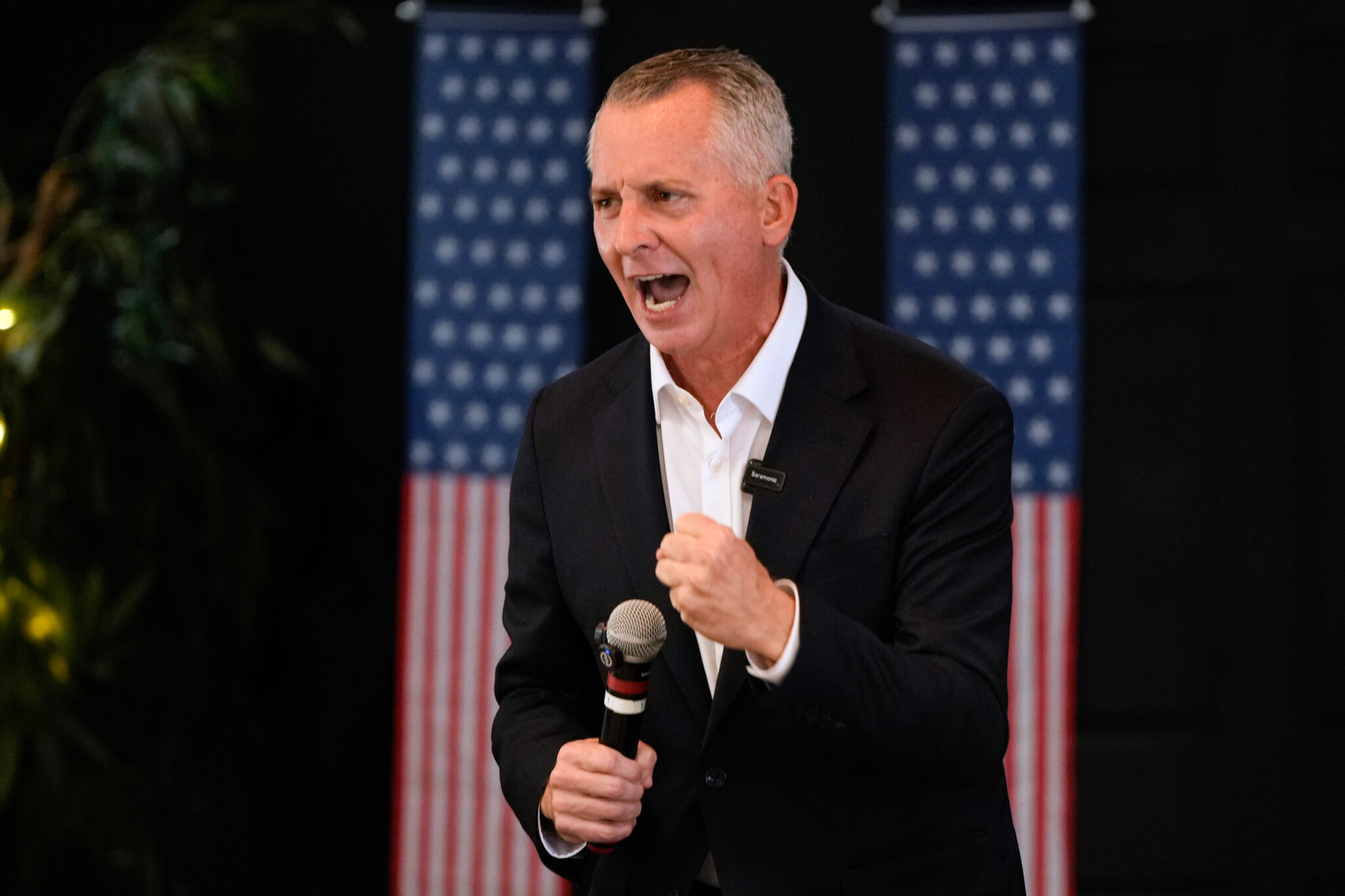
David Jolly Seeks Florida Comeback for Democrats Against Trump-Backed Byron Donalds/ TezzBuzz/ WASHINGTON/ J. Mansour/ Former Republican Rep. David Jolly is campaigning as a Democrat to revive his party’s prospects in increasingly Republican Florida. He faces a likely general-election contest against Trump-backed Rep. Byron Donalds, who holds a commanding fundraising advantage. Jolly argues that economic concerns, voter fatigue with cultural battles and shifting Latino support could make Florida competitive again.

Quick Look
- David Jolly left the Republican Party in 2018 and registered as a Democrat in 2025.
- He is seeking the Democratic nomination for Florida governor.
- His likely Republican opponent is Trump-endorsed Rep. Byron Donalds.
- Donalds has raised more than $100 million, compared with Jolly’s $10 million.
- Republicans portray Jolly as a radical liberal focused on cultural issues.
- Jolly is attempting to shift the campaign toward affordability and economic concerns.
- Florida Democrats have recently won special elections in Miami, Palm Beach and Tampa.
- Jolly says a Democratic Florida victory could reshape presidential and congressional politics.
- Some Democratic voters question whether his political conversion is genuine.
- Jolly selected former Rep. Gwen Graham as his running mate.


Deep Look
Jolly tries to overcome Democratic skepticism
Former Republican Rep. David Jolly is attempting an improbable political mission: persuading Florida voters that Democrats can once again win statewide in a state that has moved decisively toward the GOP.
His first challenge is convincing skeptical Democrats and independents that his own political transformation is genuine.
Cyn Doyle, a 71-year-old self-described political cynic, raised that concern when Jolly visited Leesburg, a central Florida community surrounded by lakes and Spanish moss.
“How can you assure us,” the 71-year-old pressed, “that you won’t become another John Fetterman?”
The mention of Pennsylvania’s contrarian Democratic senator drew jeers from the crowd gathered inside the clubhouse of a manufactured-home community for older residents.
Jolly, who previously analyzed politics as an MSNBC pundit, defended the evolution of his political identity.
“Change is part of my journey,” he responded. “What I can tell you is that the values I speak of — that the economy should work, that government can do a little bit to improve our lives and that everyone should have the right to be protected — those are the guideposts for how I’ll serve as governor.”
Doyle, an independent who said she registered as a Democrat mainly to participate in the party’s primaries, left the event persuaded.
“I believe him,” she said. “I don’t believe many.”
Jolly says Florida can become competitive again
For decades, Florida was one of the country’s most closely watched political battlegrounds.
Its elections brought together the competing interests of large metropolitan areas, agricultural communities, newly arrived retirees and diverse Latino populations.
Presidential and statewide contests were frequently decided by narrow margins, making Florida a central part of both parties’ national strategies.
Jolly believes that history is not over, despite years of Republican gains.
During a single campaign day, he addressed voters in a chandeliered ballroom in The Villages, a wealthy retirement community that generally favors Republicans.
He then traveled to the fluorescent-lit Leesburg clubhouse before concluding the day with a spirited address to Democrats in Hillsborough County, which includes Tampa.
Hillsborough supported a Republican presidential candidate in 2024 for the first time in 20 years, illustrating the scale of the Democratic decline Jolly is trying to reverse.
Trump era coincides with Democratic collapse
President Donald Trump’s political rise has occurred alongside a dramatic weakening of Florida’s Democratic Party.
Trump carried the state in three presidential elections, increasing his margin each time.
Republican Gov. Ron DeSantis won reelection in 2022 by 19 percentage points, a landslide that helped secure a GOP supermajority in the state Legislature.
Republicans now dominate Florida’s statewide offices and hold significant advantages in congressional and legislative representation.
For Jolly, overcoming those structural weaknesses will require rebuilding Democratic support while attracting independents and Republicans dissatisfied with the state’s current direction.
Donalds holds enormous fundraising advantage
Jolly’s most likely general-election opponent is Rep. Byron Donalds, the Trump-backed candidate in Tuesday’s Republican primary.
Donalds would become Florida’s first Black governor if elected.
He enters the campaign with a commanding financial advantage, having raised more than $100 million compared with approximately $10 million for Jolly.
That disparity will allow Donalds to advertise extensively across Florida’s expensive and geographically dispersed media markets.
Jolly will need outside investment from national Democratic organizations and donors to compete at the same scale.
So far, those groups have praised his campaign but have not committed enough money to erase the gap.
Donalds attacks Jolly as a liberal
Donalds has sought to portray Jolly as an out-of-touch liberal whose positions do not reflect Florida voters.
His campaign launched a statewide advertisement featuring Jolly discussing “gender-affirming care” and supporting communities that paint rainbow crosswalks to express solidarity with LGBTQ residents.
Republicans hope those issues will define Jolly before he can introduce himself to voters as an economically focused centrist.
Jolly has responded by accusing Donalds of ignoring affordability and other immediate concerns facing Florida families.
The competing strategies reflect a larger question about whether the election will be shaped primarily by economic conditions or the cultural disputes that have dominated state politics under DeSantis.
Jolly navigates transgender sports debate
During an interview over lunch at an Outback Steakhouse, Jolly discussed Florida’s prohibition on transgender girls and women participating in female sports at public schools and universities.
His wife and two young children colored nearby while he acknowledged that “there’s not going to be the political will” to reverse the ban.
Jolly said governors should not generally decide who may participate in particular athletic competitions.
At the same time, he called himself a “girl dad” and said “I don’t think we should have biologically born men playing in competitive sports.”
He drew a distinction between high-level competitive sports and community recreation.
“But look,” he added, “if a 10- or 12-year-old soccer league in the community has a coed team, I don’t think the governor should be throwing a flag on the field.”
The response reflects Jolly’s effort to avoid positions that could alienate moderates while opposing expansive state intervention in local decisions.
Some voters are exhausted by culture wars
Republicans also face political risks after years of cultural battles under DeSantis.
The governor’s feud with Disney and fights involving gender, sexuality and education energized conservative voters but left some Floridians weary of constant conflict.
Karen Kuhn, a 72-year-old resident of The Villages, described her emotional state as one of “despair.”
Jolly is betting that voters like Kuhn are ready to prioritize affordability, public services and less confrontational leadership.
His campaign argues that Republican dominance does not mean every Floridian remains satisfied with the direction of state government.
Democratic special-election wins offer hope
Florida Democrats have recently won a series of special elections in Miami, Palm Beach and Tampa.
Those victories have encouraged party officials who believe the political environment may be shifting.
Special elections often involve smaller and more engaged electorates than general elections, making them imperfect predictors of statewide outcomes.
Still, Democrats view the results as evidence that organizing, candidate quality and voter frustration can overcome the state’s Republican lean in certain contests.
Jolly is using those outcomes to argue that a competitive gubernatorial campaign is realistic rather than symbolic.
Immigration enforcement could affect Latino support
Former Republican Rep. Carlos Curbelo said Latino voters who supported Trump in 2024 may not remain with the GOP.
He pointed partly to the administration’s aggressive immigration enforcement policies, which have affected immigrant families and communities across Florida.
Latino voters are not a single political bloc, and Florida’s Cuban, Puerto Rican, Venezuelan, Colombian and other communities often respond differently to candidates and issues.
Republican gains among Latino voters helped move Florida further to the right in recent elections.
Even a partial Democratic recovery could narrow statewide margins.
“I definitely can see a scenario where it’s a closer race, where it’s a competitive race,” said Curbelo, who narrowly lost his reelection bid in 2018, the last wave election year for Democrats.
Florida result could reshape 2028 calculations
Jolly is promoting the race as more than a contest for governor.
He has discussed Florida’s potential with nationally prominent Democrats who may consider presidential campaigns in 2028.
Those figures include Illinois Gov. JB Pritzker, California Gov. Gavin Newsom, Kentucky Gov. Andy Beshear and former Transportation Secretary Pete Buttigieg.
Jolly argues that restoring Florida as a battleground would transform the national electoral map.
“All of a sudden the road to the White House looks dramatically different,” Jolly said. “It reshapes the House of Representatives. The structural change from winning Florida is a generational opportunity for Democrats.”
A credible Democratic performance could encourage presidential candidates, congressional committees and major donors to reinvest in the state.
Democrats criticize decision to abandon Florida
State Rep. Emily Gregory, who flipped a Palm Beach district containing Trump’s Mar-a-Lago estate, echoed Jolly’s argument.
“To abandon Florida was deeply, deeply unwise,” she said. “I hope that investment is coming back because it is a purple state and I feel very confident going into November.”
For years, national Democrats reduced spending and organizational attention in Florida as Republican margins widened.
Critics argue that the retreat became self-reinforcing: declining investment weakened party infrastructure, which produced larger defeats and justified further withdrawal.
Jolly’s campaign is asking national leaders to break that cycle.
Florida Democratic Party rebuilds operations
Florida Democratic Party Chair Nikki Fried acknowledged that “the bottom fell out” for the party.
She has spent several years attempting to rebuild its organizing, fundraising and candidate-recruitment operations.
National Democratic committees responsible for winning congressional and state legislative seats are prioritizing selected Florida races this year.
The targeted strategy could help the party recover ground even if a complete statewide turnaround remains difficult.
A strong gubernatorial campaign could also increase turnout and assist Democratic candidates further down the ballot.
Democratic governors hold back financial commitment
Beshear, who chairs the Democratic Governors Association, has expressed interest in Jolly’s campaign without committing significant financial support.
“David’s working really hard,” he said in an interview. “He’s a good candidate, and we’re watching it closely.”
The cautious approach reflects the difficult choices national organizations face when distributing limited campaign money.
Investing heavily in Florida could create a major opportunity, but it could also divert resources from states where Democrats have stronger recent records.
Jolly must demonstrate competitiveness before national donors are likely to make Florida a top priority.
Donalds campaign remains confident
Donalds’ campaign says Florida voters will reject Jolly’s political repositioning and liberal policy agenda.
His communications director, Gates McGavick, framed the election around affordability while accusing Jolly of increasing costs.
“Florida voters will reject radical liberal David Jolly because he will make life more expensive.”
“Byron Donalds will make life in Florida more affordable,” he said. “Our campaign will make that case to voters every single day.”
The message attempts to neutralize Jolly’s focus on economic issues and attach the Democratic candidate to national liberal policies.
Jolly began as a ‘Bush 41’ Republican
Jolly is an unusual figure to lead a Democratic effort to reconsider Florida’s political future.
He first gained national attention in 2014 by winning a Tampa Bay congressional district for Republicans in a special election widely viewed as a political bellwether.
During campaign speeches, Jolly describes himself as a “Bush 41” Republican, referring to former President George H.W. Bush.
He left the GOP in 2018, remained an independent for several years and formally registered as a Democrat in 2025.
Jolly frequently describes himself as a “53-year-old white former Republican with salt-and-pepper hair.”
That background differs from a Democratic Party increasingly emphasizing younger and more diverse candidates.
Political conversion remains a vulnerability
Orange County Mayor Jerry Demings competed against Jolly before suspending his campaign in June after announcing that he had prostate cancer.
Demings acknowledged that Florida Democrats must appeal to independent voters.
He also warned that voters may distrust a politician whose party identification has changed repeatedly.
“people don’t want a chameleon.”
“That’s the big challenge that he’s had, is convincing people that he has stepped away from the Republican policies,” Demings said.
Jolly’s campaign must demonstrate that his shift reflects durable values rather than political convenience.
Some voters admire Jolly’s evolution
Other Democrats and independents view Jolly’s departure from the Republican Party as evidence of courage.
Sylvia Rieger, a 70-year-old resident of The Villages, said his political evolution demonstrated “moxie.”
Steven Slyter, an 81-year-old retired handwriting expert, called Jolly’s decision to leave the GOP “courageous.”
“He made a decision about what he stands for,” Slyter said. “I like that.”
Their reactions suggest Jolly’s former Republican identity may be an asset among voters who dislike Trump but remain uncomfortable with the Democratic Party’s left wing.
Charlie Crist’s defeat presents warning
Florida’s previous Democratic nominee for governor, Charlie Crist, was also a former Republican.
Crist lost to DeSantis by 19 percentage points in 2022, demonstrating that a party switch and centrist appeal are not sufficient to make Democrats competitive.
Several party members argue that Jolly is running a more effective campaign than Crist did.
Jolly has traveled extensively, emphasized his personal evolution and tried to speak directly to voters in Republican-leaning communities rather than focusing only on Democratic strongholds.
Whether those differences can overcome the state’s structural Republican advantage remains uncertain.
Jolly builds coalition across Democratic factions
Jolly faces minimal opposition for the Democratic nomination, allowing him to avoid many of the ideological disputes that have divided the party in other state primaries.
He has secured support from progressives including Rep. Maxwell Frost.
At the same time, he strengthened his centrist credentials by selecting former Rep. Gwen Graham as his running mate.
Graham is the daughter of Bob Graham, the late Florida governor and longtime U.S. senator whose name remains influential in state Democratic politics.
The ticket combines Jolly’s appeal to independents and former Republicans with a connection to Florida’s traditional Democratic establishment.
Supporters say Jolly may uniquely fit Florida
Some supporters believe Jolly’s experience in several political camps is particularly suited to Florida.
Jeff Adelman, a candidate for a nonpartisan seat on the Coral Springs City Commission in Broward County, described Jolly as a potentially distinctive match for the state after attending a Democratic club meeting.
“We live in Florida,” he said. “I don’t think you’re going to get somebody like Bernie Sanders to run for governor in the state of Florida.”
Jolly’s campaign rests on the idea that Democrats cannot regain Florida simply by replicating strategies used in heavily Democratic states.
He is presenting his Republican past, independent period and Democratic conversion as evidence that he can build the kind of broad coalition required to compete.
November will determine whether that unconventional profile can revive a party that has spent years losing ground—or whether Florida’s transformation into a Republican stronghold has become too entrenched to reverse.
More on US News