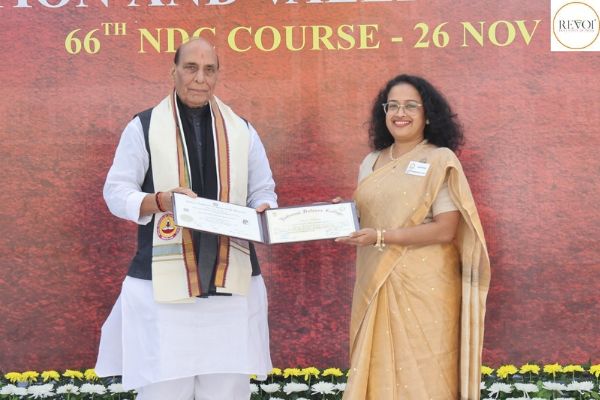
New Delhi, November 26, 2026 – convocation and valedictory ceremony of the 66th NDC Course Defense Minister Shri Rajnath Singh has called for anticipating emerging threats, examining alternative scenarios and preparing institutions for the future security environment while ensuring effective responses to immediate threats arising from changing geopolitical dynamics and the changing nature of war. Addressing the Convocation and Convocation of the 66th National Defense College (NDC) Course in New Delhi on November 26, 2026, he stressed that the changing global balance of power, the emergence of new centers of strategic influence and re-evaluation of traditional engagements, as well as the changing nature of conflict have made the security environment increasingly complex.
The Defense Minister added that cyber attacks, disinformation, economic coercion, supply chain disruptions and other forms of hybrid warfare are increasingly co-existing with conventional military threats, blurring the boundaries between internal and external security and peace and conflict. He stressed that India's geographical location, vast land borders, maritime interests and growing international responsibilities place it in a complex strategic environment, which mandates a forward-looking approach to national security.
Emphasizing the need to link strategic education with national security policy-making, Shri Rajnath Singh said that the NDC provides a valuable platform to harness the collective professional experience and intellectual capabilities of senior officers of the defense forces, civil services and friendly countries. He advocated greater use of this intellectual capital to contribute directly to India's national security policy-making.
Also read: Terrarium competition organized under the flower show to be held in Ahmedabad, know how to participate?
The Defense Minister suggested that the NDC, in consultation with the Ministry of Defence, should institutionalize a mechanism to identify some important contemporary national security challenges for intensive examination during each course. He said that these challenges could be related to India's strategic neighbours, border management, maritime security, critical technology, economic security, protection of critical infrastructure and emerging internal and external threats.
Raksha Mantri addressed the Convocation & Valedictory Ceremony of 66th NDC Course in New Delhi.
Read More:
— Ministry of Defence, Government of India (@SpokespersonMoD) November 26, 2026
Shri Rajnath Singh also urged the NDC to develop a mechanism by which serving senior military officers, civil servants and other relevant authorities are invited to formally present specific contemporary challenges facing the nation for examination by the course participants. He said, “These challenges can be drawn from the real operational, strategic, administrative and policy concerns faced by various ministries and institutions. This will bring real-world issues into the educational framework of the NDC and provide an opportunity to examine them from multiple perspectives.”
Also read: Deputy Chief Minister Harsh Sanghvi inaugurated Hyrox Ahmedabad edition, watch VIDEO
Underscoring the need to translate academic research into actionable policy inputs, the Defense Minister stressed that the research conducted by the course participants should not be limited to academic papers or classroom discussions. He stressed that selection studies should result in comprehensive reports containing specific, practical and implementable recommendations. He said that these reports should be formally submitted to the Ministry of Defense and other line ministries where applicable and presented to the appropriate levels of government for consideration.
Shri Rajnath Singh said, “Each course at the NDC should not only graduate a batch of trained strategic leaders, but also leave behind a corpus of research, analysis and policy recommendations that contribute to the nation's institutional knowledge and national security preparedness. The intellectual capital generated at the NDC should find meaningful expression in our strategic thinking and policy-making processes. Here, dynamic linkage is the key.”
The Defense Minister said that in the real world, especially in matters of national security, leaders rarely have access to complete information or the ability to examine every possible option before taking decisions. He stressed that strategic leadership requires evaluating the available options and taking informed decisions while being conscious of their broader operational, economic, diplomatic and institutional implications.
Shri Rajnath Singh called for strengthening the strategic gaming exercise of NDC by incorporating emerging technologies. He said these exercises should create more dynamic and realistic situations, facilitate the examination of alternative courses of action, and enable participants to understand the broader and often unanticipated consequences of strategic choices.
Also read: Serious allegations of conversion and discrimination against Gujaratis in this university of Gandhinagar
The Defense Minister highlighted that the NDC is India's premier institution for strategic education and highlighted that the greatest strength of the College lies in bringing together senior military officers, civilian officials and international participants on a common platform and providing them a unique opportunity to explore not only inter-regional complexities but also international perspectives. He added that the diversity of experience and perspectives that this organization brings together is invaluable in an era when national security challenges transcend institutional and geographic boundaries.
Shri Rajnath Singh praised the launch of special sessions at NDC on Artificial Intelligence (AI), Machine Learning, Robotics, Unmanned Autonomous Vehicles, Aerospace Technology, Semiconductors and other emerging technologies. He also welcomed the introduction of a dedicated AI capsule and the inclusion of closed-loop AI concepts in strategic gaming exercises. He said that such initiatives will increase the contemporary relevance of the course and expose future strategic leaders to emerging technological developments.
The Defense Minister also welcomed the educational transformation undertaken by NDC and said that 'Executive MBA in Strategic Leadership and Public Policy' under the aegis of IIT Madras is an important step towards enhancing the academic quality and contemporary relevance of the course. He said that the association with a prestigious institution like IIT Madras has brought valuable expertise in management, science and technology to the study of national security.
Shri Rajnath Singh highlighted the contribution of NDC in strengthening India's international strategic engagements through the participation of officials of friendly countries. He noted that studying with Indian counterparts provides these officers with opportunities for continued professional interaction, appreciation of diverse strategic perspectives, and the development of lasting bonds of friendship and mutual trust. Such relationships, built through shared learning and experience, become an enduring asset in India's engagement with partner countries.
The Defense Minister also acknowledged the role of initiatives like the International Strategic Engagement Program (INSTEP) in facilitating broader international dialogue. He referred to the fourth edition of the recently concluded two-week programme, which brought together 25 international participants from 22 countries of the Global South, 10 senior officers from the Indian Defense Forces and civil services and three executives from defense companies.
Underscoring the importance of international cooperation in an increasingly interconnected world, Shri Rajnath Singh said: “India believes in meeting such challenges through a cooperative approach based on respect for sovereignty, mutual trust and shared responsibilities. The professional relationships and friendships developed at the NDC should continue long after the completion of the course. The Institute's international alumni network is a valuable repository of experience and strategic understanding that can contribute to stronger bilateral relations and international cooperation. Is.”
On this occasion, Air Marshal Manish Kumar Gupta, Commandant of NDC and Dean (Faculty) of IIT Madras, Prof. K. Murali, senior officials of the Defense Ministry and faculty and participants of the NDC course were present.
About 66th NDC Course
This course runs for 47 weeks every year from January to November, which is divided into six studies. These six studies include 'Introduction to India's Understanding and Strategy', 'Studies on Economic Security, Science and Technology', 'Global Issues', 'International Security Environment', 'India's Strategic Neighboring Countries' and 'Strategies and Frameworks for National Security'.
A total of 122 officers including officers from India and abroad participated in this course. They come from the Indian Defense Forces, Indian Civil Services, Indian Police Services and other organs of the government. The 40 foreign officials were from Afghanistan, Australia, Bangladesh, Bhutan, Brazil, Egypt, Indonesia, Iran, Japan, Kenya, Kazakhstan, Maldives, Myanmar, Nepal, Nigeria, Philippines, Russia, Saudi Arabia, South Africa, Sri Lanka, UK, USA, Uzbekistan and Vietnam.
♦ Give your opinion about special articles and news published in Revoi. – Email: (email protected) ♦