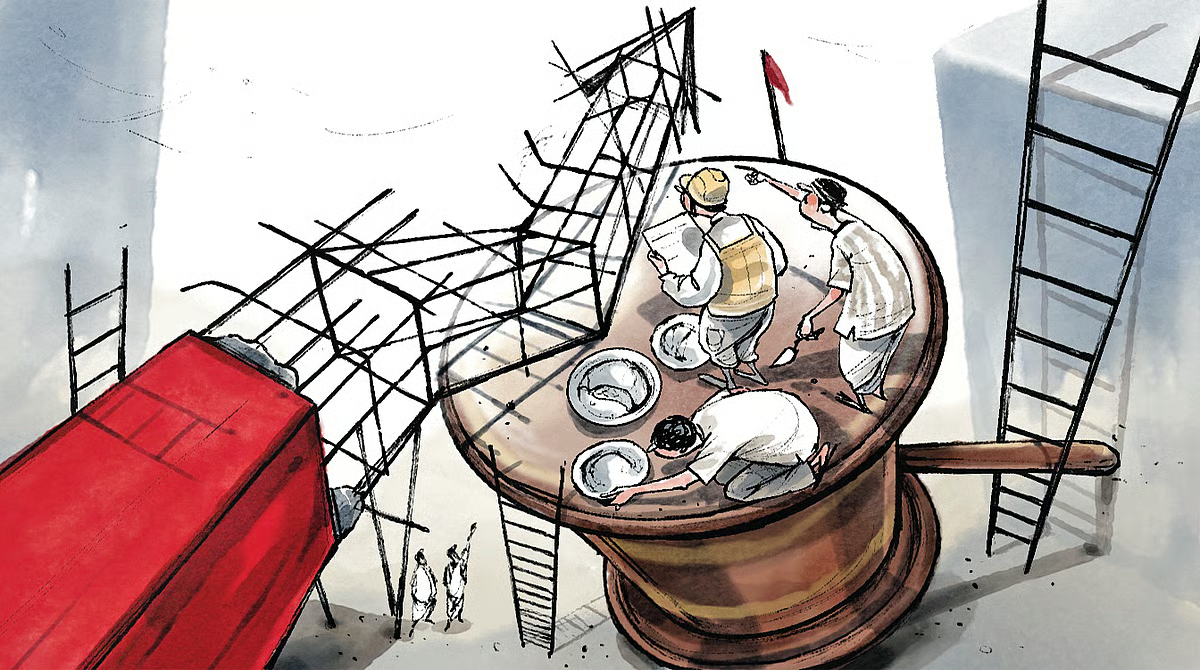
The critical issue will be how courts distinguish a genuinely excluded activity from an economically-organised activity merely adopting a certain label. A government enterprise cannot necessarily become a sovereign function simply because it is government-owned; similarly, an organisation cannot avoid employment obligations just by claiming to be socially-oriented.
For employers, this judgement is likely to be welcomed as it promotes greater flexibility and legal certainty. India’s labour reforms aim to reduce fragmentation and simplify compliance. The Industrial Relations Code raises the threshold for establishments requiring prior government permission for layoffs, retrenchments and closures from 100-300 workers, which was the earlier limit under the Industrial Disputes Act.
These changes can make workforce restructuring easier for companies and may encourage investment, particularly in sectors where employment needs fluctuate. However, ease-of-doing business shouldn’t compromise labour responsibilities. An attractive business environment requires clear rules for employers, informed workers and efficient dispute resolution. If the new definition merely shifts uncertainty between provisions, true simplification won’t be realised.
Business flexibility, workers’ security
The outlook for industrial growth is mainly positive, as the new code can enhance legal certainty and adapt to today’s economy. While it offers some benefits for pending labour disputes, future protections for workers remain uncertain due to exclusions under Section 2(p), which may limit coverage under industrial relations law.
The challenge now lies with the courts and tribunals interpreting the Industrial Relations Code to avoid loopholes and maintain effective labour protection without discouraging legitimate businesses.
As India’s economy has evolved since 1978 with a shift towards services and complex contractual arrangements, it is crucial that the law adapts accordingly. Economic flexibility and worker protection can coexist, fostering an environment in which businesses can thrive and workers are safeguarded against arbitrary treatment. Ultimately, success will depend on whether Bharat can create productive enterprises and jobs without sacrificing worker’s rights in pursuit of flexibility.