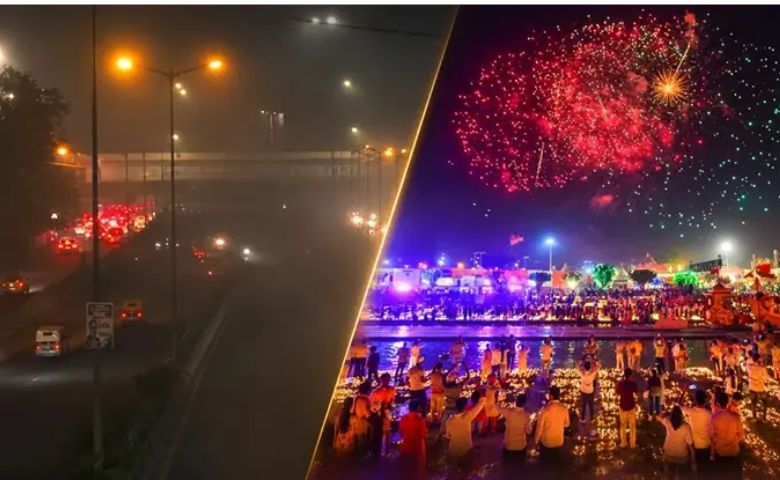
Delhi Air Pollution: After the celebration of Diwali, Delhi, the capital of the country, has faced a serious problem of pollution. Smoke from firecrackers and already poor air conditions have blanketed Delhi with a blanket of toxic smog. An alarming rise was recorded in Delhi's Air Quality Index (AQI) in the early hours of Monday, November 9. According to AQI.in statistics, the AQI peaked at 1,331 at 1:31 pm. Even at 8:01 am it was 663. Last year after Diwali, the number reported on AQI.in on October 21, 2025 was 393. In comparison, the morning AQI this year has been about 69 percent higher. These statistics show how severe the pollution situation has become in Delhi after Diwali.
Big jump in pollution after 10 pm
AQI was recorded at 681 at 9:31 PM on Diwali. It then increased rapidly and by 11 pm the figure had reached 1,153. The AQI finally peaked at 1,331 at 1:31 p.m. Air quality remained a concern even though pollution figures eased slightly in the early morning hours.
Air quality bad even before Diwali
Pollution problem in Delhi was not limited to Diwali night only. The AQI was 124 on October 30, which rose to 393 on November 2 and 464 on November 3. Air pollution was increasing due to vehicular smoke, industrial emissions, construction dust and waste burning activities. Diwali crackers added to it. On the other hand, the polluted air could not disperse quickly due to low wind speed and inclement weather. Smoke from stubble burning in neighboring states can also add to the pollution.
Restrictions of GRAP-3 applicable in Delhi-NCR
The third phase of the Graded Response Action Plan (GRAP) was implemented in Delhi-NCR from November 6 by the Commission for Air Quality Management (CAQM) as the air quality worsened. Despite these restrictions, there has been a huge spike in pollution after Diwali. According to weather and pollution forecasts, Delhi's air quality may remain at critical levels in the coming days as well.