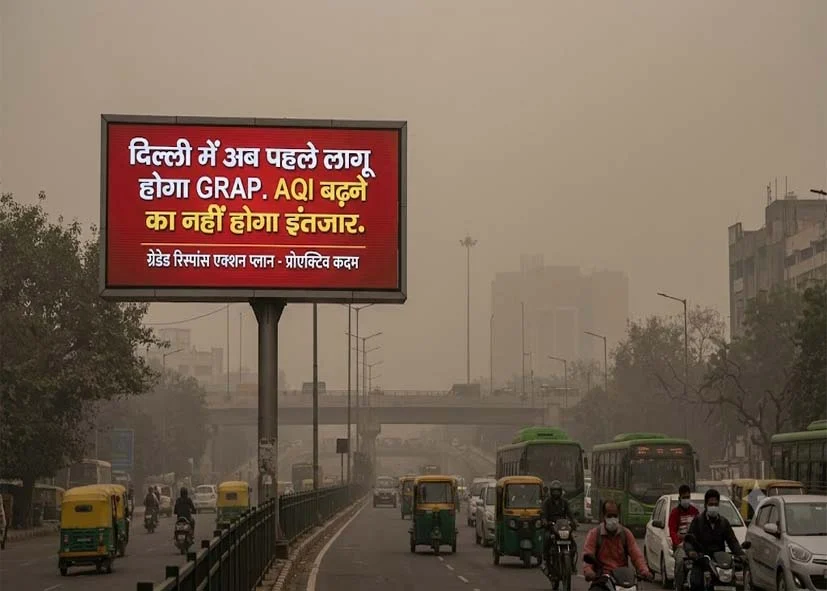
Changes have been made in the Graded Response Action Plan (GRAP) implemented to deal with air pollution in Delhi-NCR. Now different phases of GRAP can be implemented even before the respective AQI limits are reached. Its objective is to initiate pollution control measures even before the air quality deteriorates. The Commission on Air Quality Management (CAQM) issued an advisory informing about the revised GRAP and the changes made to maintain air quality.
48 actions included in four phases
A total of 48 actions have been included in the revised GRAP under four phases. CAQM has made several changes to various stages of GRAP, so that necessary steps can be taken in time in case of increased pollution. In the new provisions, the rules related to dust control have also been made stricter than before. The concerned agencies have been instructed to take extra precautions to control dust emanating from construction and other activities.
Changed to GRAP to stop pollution in winterAnd
Changes have been made in the Graded Response Action Plan (GRAP) to control air pollution during winter in Delhi-NCR. Dr. SD Attri, Member Secretary, Commission for Air Quality Management (CAQM) informed about the changes and pollution control measures made under the revised GRAP. According to Dr. Attri, four phases of GRAP have been determined based on different AQI levels. Some changes have been made in these four phases, so that effective steps can be taken in time if the pollution situation worsens during winter. In the revised GRAP, emphasis has been laid on taking action as per the pollution situation. Under this, even before the AQI reaches the prescribed level, measures of the relevant phase can be implemented considering the circumstances.
Why was there a change in the steps of GRAP?
Changes have been made in the Graded Response Action Plan (GRAP) to deal with the increasing air pollution during winter in Delhi-NCR. CAQM Member Secretary Dr. SD Atri said that the main objective of the amendment is to take necessary steps in advance instead of waiting for pollution to increase, so that the air quality can be prevented from worsening.
Four stages of GRAP are applied according to AQI
According to Dr. SD Attri, four phases of GRAP are implemented depending on different AQI levels.
Stage I: AQI 201 to 300
Stage II: AQI 301 to 400
Stage III: AQI 401 to 450
Stage IV: AQI more than 450
In the revised system, some provisions have been changed under these phases, so that timely action can be taken even if there is a possibility of the pollution situation worsening.
Registration required for construction projects
Mainly two types of changes have been made in GRAP. These include amendments in instructions related to construction and demolition activities. Registration on the web portal run by the Pollution Control Board has been made mandatory for construction projects with an area of more than 500 square meters in NCR. Apart from this, provisions like completing self-certified reporting related to projects within 15 days will also be implemented.
Some old actions were included in the first phase from the second phase.
According to Dr. SD Atri, Member Secretary of CAQM, some of the actions to be implemented under different phases in the revised GRAP have also been reorganized. Under this, the restrictions which were earlier imposed after the level of pollution increased, have now been implemented in the initial phase itself. The aim is to initiate pollution control measures without waiting for AQI to reach critical levels.
Ban on buses of BS-IV and below from the first phase
The 30th meeting of the Full Commission of CAQM on 28 September approved changes to the existing GRAP schedule for the NCR. Under the revised schedule, the restriction applicable on buses with BS-IV and below emission standards coming from other states in Delhi-NCR has been removed from Stage-II to Stage-I (AQI 201-300). That is, now as soon as the AQI of Delhi-NCR reaches between 201 to 300, restrictions can be imposed on the movement of the concerned buses. Earlier this action was taken in the second phase of GRAP. In the revised GRAP, restrictions related to diesel generator sets have also been shifted from Stage-II to Stage-I. This means that as soon as AQI reaches the level of 201-300, restrictions on the use of diesel generators will be imposed.
System will not wait for AQI to increase
According to CAQM, the main objective of the changes made in GRAP is to make the pollution control system more active. Now there will be no need to wait for AQI to reach the next critical stage to take action against any polluting activity. Efforts will be made to prevent further increase in pollution by imposing necessary restrictions at the initial level itself. The four steps remain intact in the revised GRAP. Stage-I applies to AQI 201-300, Stage-II 301-400, Stage-III 401-450 and Stage-IV applies to AQI above 450. Under the new changes, many of the actions included in these phases have been rearranged according to their nature and the need for pollution control.
Important changes also made in Stage-III and Stage-IV
The provisions of Stage-III and Stage-IV have also been changed in the revised GRAP. Earlier, during both these phases, goods vehicles of BS-IV and below standards carrying essential goods like fruits, milk and other essential commodities were exempted under certain circumstances. This exemption has been abolished in the amended system.
Ban on cars will be implemented in 5 districts
Changes have also been made in Action No. 1 of Stage-III. Now the ban on cars running on BS-III petrol and BS-IV diesel will not be limited to Delhi, Gurugram, Faridabad, Ghaziabad and Gautam Buddha Nagar, but will also be applicable in Sonipat district. After this change, when Stage-III is implemented, the scope of restrictions on the movement of cars with relevant emission standards in these areas will increase.
Ban on entry of old diesel goods vehicles in Delhi
Under the new provisions, when Stage-III is implemented, there will be a complete ban on entry of diesel-powered light and medium goods vehicles (LGV/MGV) of BS-IV and below standards registered outside Delhi into Delhi. That means such vehicles will no longer be allowed to enter Delhi during Stage-III. With this, control over the movement of old diesel goods vehicles coming from outside states in Delhi will be further tightened.
Exemption for works like road repair
However, some essential activities have been given relief during the strict restrictions of Stage-III. These include essential works like repairing potholes on roads. Its objective is to control pollution as well as to protect essential public works from being completely affected.
Changes in Citizen Charter also, total 48 actions decided
The revised GRAP schedule also changes the instructions regarding dos and don'ts given in the Citizen's Charter under each phase. The actions to be implemented at different stages have been rearranged with the inclusion of some new instructions. Now a total of 48 actions have been prescribed in the revised GRAP. These include 25 actions in Stage-I, 8 in Stage-II, 10 in Stage-III and 5 in Stage-IV.
Scope of monitoring of construction sites increased
The Commission has also strengthened the web portal based system for monitoring dust pollution caused by construction and demolition (C&D) activities in NCR. Under this, instructions number 11 to 18 have been amended. Now the scope of the existing web-portal registration and monitoring system has been extended to urban areas outside municipal limits, controlled areas, industrial development areas and highway corridor zones. This will enable monitoring of dust control measures on ongoing construction and demolition works in these areas.
Advisory also for school-college sports events
In the revised system, instructions have also been issued regarding school-college sports events to be held in NCR during winter. According to the advisory, the timing of physical sports competitions to be held in November-December should be decided keeping in mind the local air quality. It has been advised to schedule the event especially keeping in mind the health and safety of the students. The Commission has also made it clear that necessary action can be taken if the instructions are ignored.
Follow the LALLURAM.COM MP channel on WhatsApp