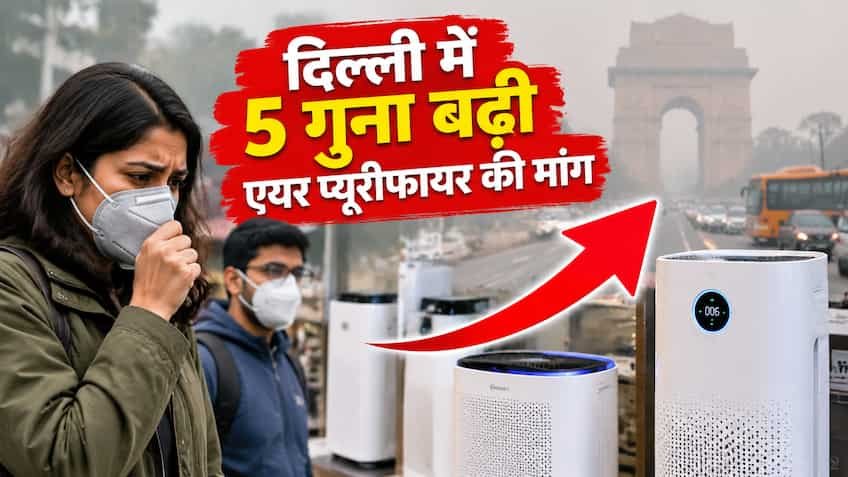
The havoc of suffocating smog and poisonous air in the country's capital Delhi and NCR has increased to such an extent that now even breathing clean air has become a big challenge for the common man. According to Central Pollution Control Board (CPCB) data, the air quality index (AQI) in many areas of Delhi has increased from 'very poor' to 'severe' category i.e. beyond 400. To protect their families, children and elderly from this deadly pollution, a large number of people are now installing air purifiers in their homes, offices and shops. Due to this sudden increase in the need, a huge jump of up to five times has been recorded in the demand for air purifiers in the electronics markets and online platforms of Delhi-NCR within the last few days. The situation is such that due to this unexpected surge in demand, the stock of air purifiers with many major companies and dealers has started running out.
'Chamber of Trade and Industry' (CTI), the apex organization of traders and entrepreneurs of Delhi, while sharing the latest market data, said that as the pollution level has increased, there has been an unprecedented increase in customer inquiries and purchases. According to CTI Chairman Brijesh Goyal and General Secretary Gurmeet Arora, on normal days, an average of only 4 air purifiers were sold per day at an electronic shop in Delhi, but now this number has increased to about 20 units per day. Brijesh Goyal said that when Delhi's AQI crosses 400, then according to doctors, breathing that air is as harmful as smoking 20 to 25 cigarettes daily. In such critical health conditions, air purifier is no longer a luxury item in the homes of the rich, but has become a basic need of every common family like a life-saving medicine.
In view of the increasing demand and the economic burden falling on the pockets of common people, the Chamber of Trade and Industry (CTI) has written an official letter to Union Finance Minister Nirmala Sitharaman demanding immediate reduction in the Goods and Services Tax (GST) imposed on air purifiers. Under the current tax structure, 18 percent GST is charged on air purifiers and its critical components. The traders' organization argues that due to the heavy tax of 18 percent, the prices of good quality air purifiers become very high, due to which middle and lower-middle class families are not able to buy them even if they want to. CTI has demanded that in public interest, the government should directly reduce the GST rate on air purifiers from 18 percent to 5 percent slab. Along with this, the organization has also urged to reduce GST on spare parts like HEPA Filter, Carbon Filter, UV Lamp, Motor and Sensor from 18 percent to 5 percent, because it is mandatory to change the filter every six months during the pollution season, which leads to additional expenses on the customers.
In its letter, the merchant organization has not only suggested providing relief to consumers, but has also presented a roadmap to promote domestic manufacturing. CTI has demanded that GST on raw materials used in manufacturing air purifiers in the country should be reduced from 12 percent to 5 percent. This will increase the production of cheap and affordable air purifiers in India under 'Make in India' and reduce the dependence on imports from countries like China. Additionally, CTI has also demanded the Central Government to release a special pollution relief package of ₹5,000 crore for the capital Delhi. Under this package, it is proposed to allocate an amount of ₹ 500 crore to install air purifiers in government schools, hospitals, Anganwadi centers and 100 major markets of Delhi, so that children, patients and lakhs of people working in the markets can get clean air.
Due to the stringent restrictions of the Graded Response Action Plan (GRAP) implemented for pollution control and the ban on construction and transportation work, traders of Delhi-NCR are also suffering huge economic losses. CTI has requested the Finance Minister to give a 6-month moratorium (relief) in paying EMIs of banks to the affected businessmen who are facing recession due to pollution related restrictions. Also, a special rebate of 2 percent should be provided in the interest rate on working capital loans of such businessmen. Experts believe that if the GST Council and the Finance Ministry approve this proposal to reduce the tax on air purifiers, then the prices of air purifiers in the market will immediately reduce by 10 to 12 percent, which will help millions of families in Delhi-NCR in fighting the poisonous air.