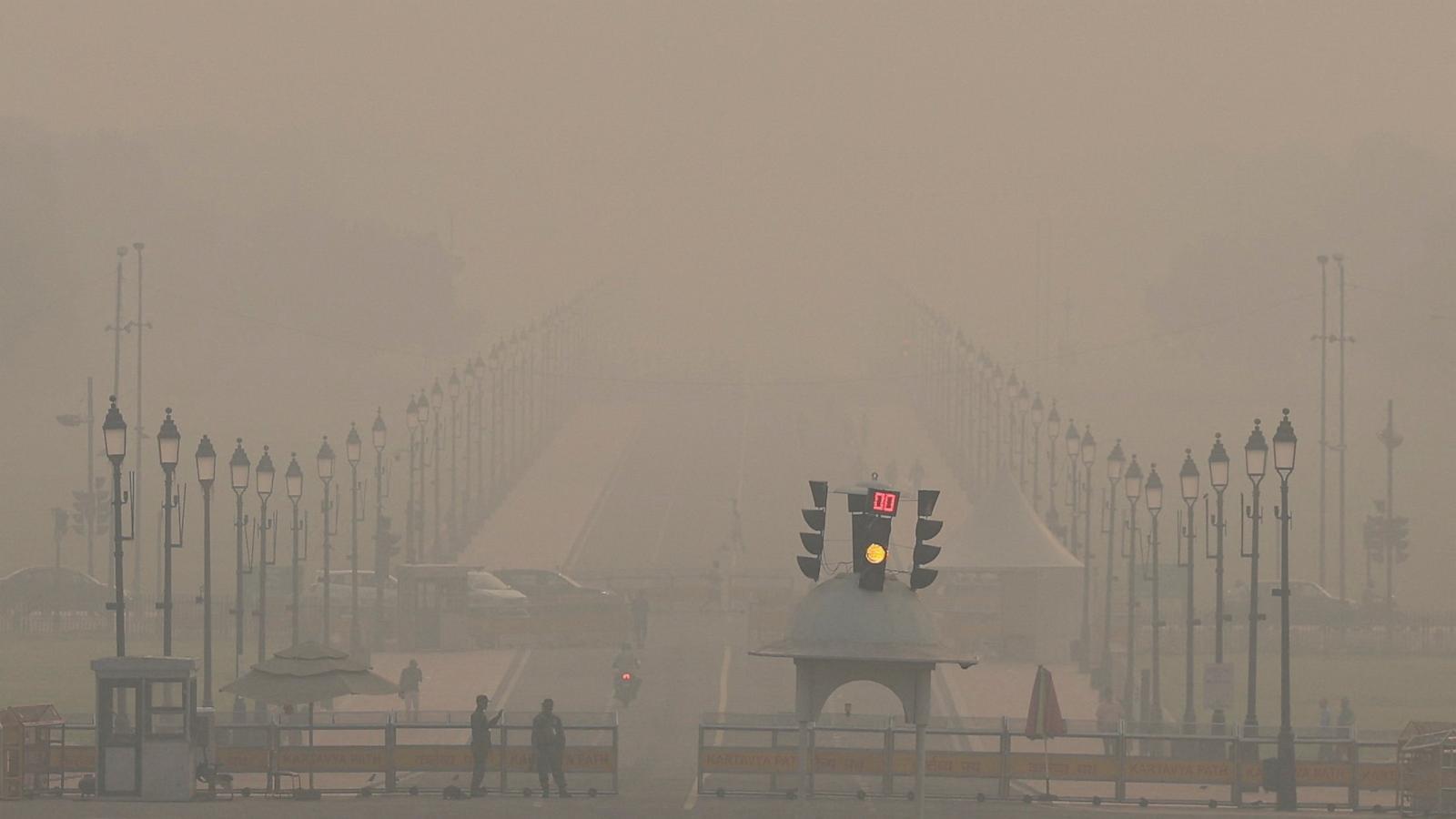
Delhi’s post-Diwali pollution crisis took a sharp turn overnight, with the capital’s overall Air Quality Index (AQI) reportedly soaring to 1,713 at 2 am on Monday. Although the reading fell to around 843 by 6:01 am, the city continued to remain under a thick layer of smoke, with residents reporting breathing difficulties and visibility dropping as firecracker emissions spread across neighbourhoods. The scale of the pollution was reflected in monitoring data, with 20 of the 59 stations reporting at 10 pm recording ‘severe’ air quality.
Delhi’s worst-hit neighbourhoods report alarming pollution readings
The pollution was not limited to one pocket of the capital. As per reports, Sonia Vihar registered an AQI of 463, the highest among the monitoring stations, while Jahangirpuri followed at 450. Burari, Alipur and Punjabi Bagh also reported elevated pollution levels. Sonia Vihar, Jahangirpuri, Punjabi Bagh, Burari, Okhla and Rohini remained in the severe category throughout Sunday.
According to the Central Pollution Control Board’s Sameer app, Vivek Vihar recorded an AQI of 445, Jahangirpuri 442, Rohini 438, DTU 430 and Bawana 427. Punjabi Bagh registered 408, followed by Alipur at 395, Narela at 386 and IIT Delhi at 363.
Delhi-NCR also struggles as firecracker smoke spreads beyond the capital
Reports say that the pollution extended across neighbouring cities, with Ghaziabad recording an AQI of 371. Noida stood at 338, Faridabad at 323 and Gurugram at 309.
Firecracker activity gathered pace between 5 pm and 6 pm on Sunday after relatively quiet roads during the day. Bursts were reported from Pitampura, Burari, Mayur Vihar and Lutyens’ Delhi. Burari saw particularly intense fireworks, while celebrations continued around Bishambardas Marg and other parts of Lutyens’ Delhi, though the intensity eased slightly later. Smoke accumulated over residential areas and roads, leaving behind the smell of burnt firecrackers.
Delhi’s green cracker restrictions fail to prevent pollution spike
Reportedly, the government had appealed to residents to follow the Supreme Court’s directions on the sale and use of green firecrackers. An order issued by the District Magistrate (East) allowed their use only on November 7 and 8, during two windows: 6 am to 7 am and 8 pm to 10 pm.
Under CPCB standards, an AQI of 0–50 is ‘good’, 51–100 ‘satisfactory’, 101–200 ‘moderate’, 201–300 ‘poor’, 301–400 ‘very poor’ and 401–500 ‘severe’.
Delhi likely to remain under severe pollution for several days
The Air Quality Early Warning System has forecast that Delhi’s air quality will enter the severe category from November 9 and remain there for the following few days. Experts have linked the expected deterioration to unfavourable weather conditions, vehicle emissions, Diwali celebrations and the peak stubble-burning season in neighbouring states.
A ventilation index below 6,000 square metres per second, along with average wind speeds below 10 kilometres per hour, makes it difficult for pollutants to disperse. PM2.5 remained the dominant pollutant on Sunday, with firecracker emissions adding to particulate matter.
Also Read: Four Members Of Family, Two Children Burnt Alive After House Catches Fire; Flames From LPG Gas Stove Trapped Them – What Happened?
Khalid Lateef is a Sub-Editor at NewsX Digital, specializing in Indian politics and global affairs. He also covers viral trending stories and major crime developments.
The post Delhi AQI Crosses 1,700 After Diwali Celebrations, Burari Among Worst-Hit Areas As Firecracker Smoke Engulfs Capital appeared first on NewsX.