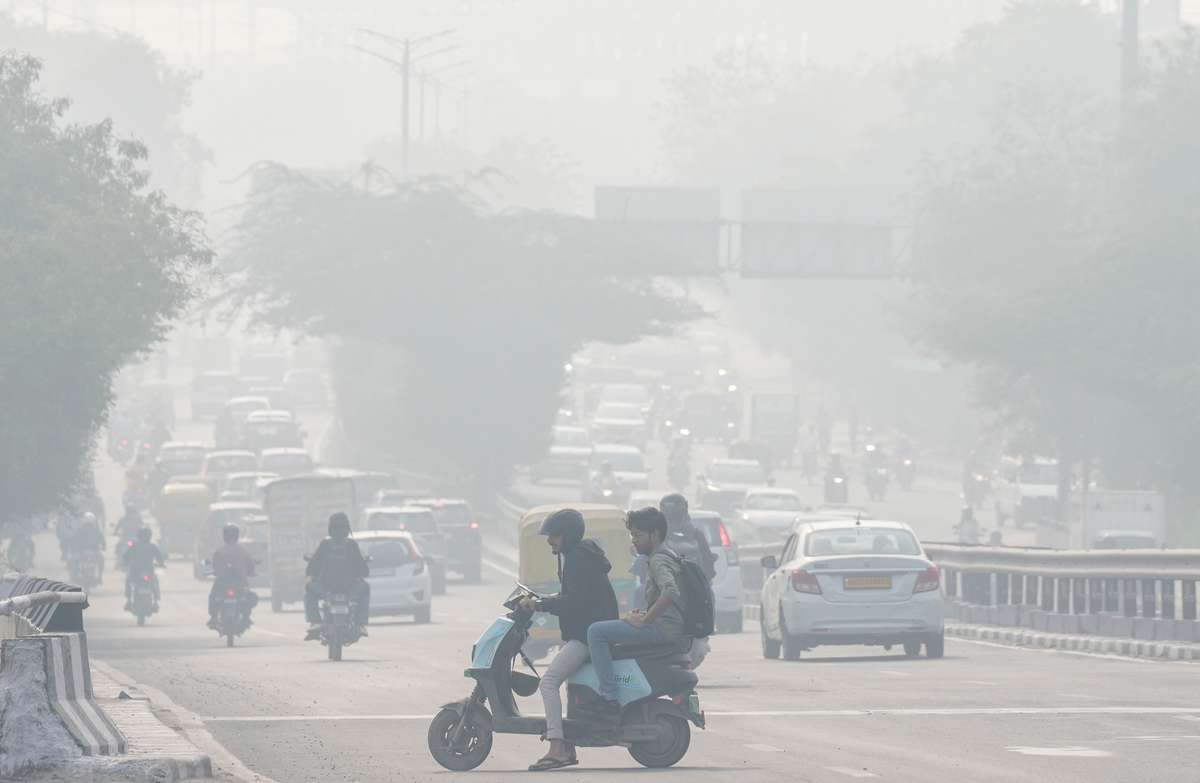
The Supreme Court said stubble burning was not the only contributor to Delhi’s pollution, pointing to vehicle emissions, traffic congestion and festive consumption habits.
New Delhi: The Supreme Court has raised concerns over the contribution of private vehicles and festive shopping habits to Delhi’s worsening air pollution, calling for a cultural shift to tackle the recurring crisis as the city’s Air Quality Index (AQI) approached the severe category.
A three-judge Bench headed by Chief Justice of India (CJI) Surya Kant, along with Justices Joymalya Bagchi and V Mohana, made the observations on Friday while hearing a petition concerning air pollution in Delhi and the National Capital Region (NCR).
The CJI pointed out that the practice of exchanging expensive Diwali gifts had increasingly become a social and status symbol among affluent sections of society. He suggested that a change in such consumption habits was also necessary to address the pollution problem.
The court also questioned the role of private vehicles, particularly high-end cars, in worsening air quality, rather than focusing exclusively on stubble burning in neighboring states.
Supreme Court questions vehicle emissions
The Bench observed that vehicles entering Delhi from different parts of the country made it difficult to monitor their emission levels.
“It’s a free-for-all. Vehicles from across the country come in. You cannot monitor the overall condition of the vehicle or what kind of emissions it is making. Even if a vehicle comes in for two hours, the damage is done,” the CJI said.
The court also flagged traffic congestion, with vehicles moving bumper-to-bumper on roads connecting Delhi and neighboring NCR areas, as another source of pollution.
Senior advocate Aparajita Singh, assisting the court as amicus curiae, said transportation was the primary source of air pollution in the Delhi-NCR region. She also pointed out that pollution levels remained close to the severe category and were affecting her voice.
Singh said breathing the air in the region was equivalent to smoking 30 cigarettes a day. She estimated that stubble burning contributed around 14 percent to Delhi’s pollution levels.
AQI touches 400 as court questions pollution control measures
The observations came as Delhi’s average AQI stood at 389 on Friday, according to the Central Pollution Control Board (CPCB), with readings crossing 400 in several areas.
The CJI questioned the effectiveness of existing measures, noting that the AQI was already approaching 400 despite various interventions.
The Centre’s representative, Additional Solicitor General Aishwarya Bhati, told the Bench that restrictions had been imposed on vehicles entering Delhi, including the requirement that only Bharat Stage 6 (BS6)-compliant vehicles be allowed entry.
She also referred to the phased removal of diesel-powered rickshaws, regulations governing buses entering Delhi from other cities and pollution certificates linked to the locations where they are issued.
However, Singh pointed out that a previous directive against prolonged vehicle idling at toll plazas was not being properly implemented. Vehicles entering Delhi from NCR areas were allegedly being made to wait at border points with their engines running, adding to emissions.
Court seeks better planning for stubble management
The Bench also stressed the need for advance planning to prevent stubble burning. It said the procurement price for crop residue should be announced well in advance and the system for managing it should be made available to gram panchayats.
Singh called for urgent action against both farm fires and local sources of pollution, including waste burning.
The Centre, meanwhile, cited Delhi’s geographical location and limited dispersal of pollutants during winter as factors contributing to the recurring pollution crisis. It also referred to the Graded Response Action Plan (GRAP) and other short- and medium-term interventions.
The court observed that repeated judicial directions could lead to instances of non-compliance, emphasizing the need for effective implementation of measures rather than relying solely on fresh orders.