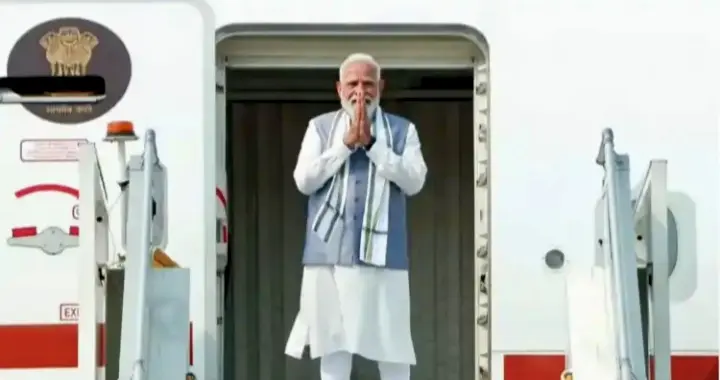
New Delhi: While holding that even redacted passenger details could expose sensitive aspects of his security arrangements and even pose risks to national security, the Delhi High Court has set aside a Central Information Commission (CIC) order directing the Indian Air Force (IAF) to disclose records of Prime Minister Narendra Modi’s foreign air travel on IAF aircraft.
Justice Amit Mahajan recently heard a challenge to the CIC order by the Air Headquarters Central Public Information Officer’s (CPIO).
The CIC had directed it to provide relevant disclosure of ‘Part II Special Flight Returns’ (SFR-II).
The passenger manifests, when combined with publicly available information, could reveal sensitive aspects of the Prime Minister’s security arrangements, the Court held. It allowed the IAF’s petition and set aside the CIC’s July 8, 2020, order.
“The learned CIC erred in directing disclosure of the SFR-II relating to the foreign visits of the Hon’ble Prime Minister after redaction of the names and identifying particulars of security personnel…The potential implications of such disclosure for national security and the security apparatus accompanying the Hon’ble Prime Minister cannot be disregarded,” the Court observed, as reported by The Indian Express.
“Once the concerned authority was of the view that revealing certain information could jeopardise national security and the security of the Hon’ble Prime Minister, it was entitled to invoke the exemption,” Justice Mahajan said.
The IAF was justified in invoking the exemptions under Sections 8(1)(a) and 8(1)(g) of the Right to Information (RTI) Act to deny disclosure of the aforesaid information, in view of the potential implications for national security and the “life and physical safety of the Hon’ble Prime Minister”, the Court held.
Section 8(1)(a) of the RTI Act protects national security, while Section 8(1)(g) allows information to be withheld if its disclosure could endanger a person’s life or physical safety.
The RTI application was filed by Commodore Lokesh K Batra (retired) on June 5, 2018, seeking records of the Prime Ministers’ foreign visits on Air Force aircraft from April 1, 2013. In its reply dated July 10, 2018, the IAF said it had already provided information about PM Modi’s visits from May 26, 2014, to June 6, 2016.
Former prime minister Manmohan Singh had made no such journeys between April 1, 2013, and May 25, 2014, it said. From June 4, 2016, to July 9, 2018, it said PM Modi had made three such visits.
The IAF refused copies of Part I and Part II Special Flight Returns, which include aircraft, aircrew, passenger and ‘Special Protection Group’ details. Such disclosure could affect national security and endanger people associated with the Prime Minister’s security arrangements, the air force said.
While Batra’s first appeal was dismissed on September 20, 2018, the CIC allowed his second appeal on July 8, 2020, directing the IAF to provide certified copies of available and relevant Part II records. The aur force then challenged that direction before the High Court.
Removing security personnel’s names and identifying particulars would not eliminate the risks, the IAF argued. Part II records also contain designations, appointments, identification numbers, flight references, passenger strength and agency particulars, it said.
These details could be compared with public information to identify security personnel, reveal the Prime Minister’s entourage and suggest patterns of security deployment, it was submitted. The air force also argued that collating the information could give adversaries strategic and tactical advantages.
The Court accepted that removing names alone would not necessarily eliminate the potential risks. Sections 8(1)(a) and 8(1)(g) of the RTI Act could be invoked for information whose disclosure could prejudice national security or endanger a person’s life or physical safety, it held.
The court or the CIC cannot sit in appeal over the subjective satisfaction of the competent security agencies as to whether disclosure of particular information could “jeopardise national security or endanger the life and physical safety of the Hon’ble Prime Minister”, Justice Mahajan noted.
The Court said that such an assessment falls primarily within the domain of the agencies entrusted with the responsibility of “ensuring the security of the Hon’ble Prime Minister and this Court cannot substitute its own assessment for that of the competent security agencies”.
The records concerned foreign visits paid for with public funds and were therefore a matter of significant public interest, Batra’s counsel contended. The applicant wanted details of private individuals accompanying the Prime Minister at public expense, not security personnel’s identities, he said.
Public expenditure alone did not justify releasing information that could compromise security arrangements, the Court insisted, saying: “The mere fact that public funds have been expended on the foreign visits of the Hon’ble Prime Minister does not, by itself, justify disclosure of information which may compromise the security arrangements put in place for such visits,” it said.
It found no sufficient larger public interest to outweigh the risks. Referring to Supreme Court rulings on the RTI Act, it noted that Section 8(2) permits a public authority to disclose exempt information when public interest outweighs harm, but does not give applicants an automatic enforceable right to obtain it. “In the absence of any demonstrated larger public interest that outweighs these concerns, disclosure of the information sought cannot be directed,” it said.