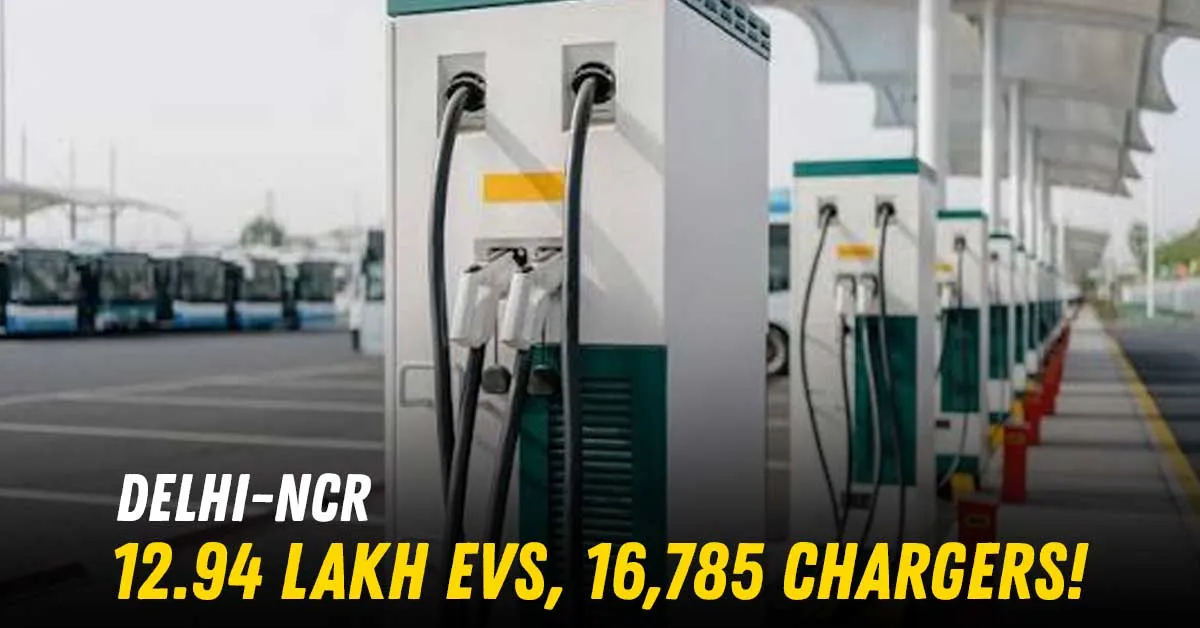
Delhi and the neighbouring NCR areas are pushing motorists and commercial operators towards electric vehicles, but the charging network is developing very unevenly. Figures cited by the Commission for Air Quality Management (CAQM) show 12.94 lakh registered EVs across Delhi and the NCR-linked figures for Uttar Pradesh, Haryana and Rajasthan, against only 16,785 reported charging points. More strikingly, nearly nine out of ten of those points are in Delhi itself.
The figures are part of a status report submitted by the CAQM to the Supreme Court. The commission was reviewing steps to reduce vehicle emissions in a region that struggles with severe air pollution. Its findings raise a straightforward concern: it is difficult to persuade people to change vehicles when dependable charging is concentrated on one side of a state border.
As of October 31, 2026, Delhi had 6,83,251 registered EVs and 14,913 operational charging points, according to the reported data. That works out to almost 89% of the total charging points counted across the four jurisdictions. Delhi is clearly better supplied than its neighbours, even though it still faces local problems with charger availability, uptime and access.
The contrast is sharp. Uttar Pradesh’s figures in the report show 3,47,587 EVs and just 565 charging points; Haryana has 2,18,530 EVs and 1,285 points; and Rajasthan has 44,987 EVs but only 22 points. Taken together, the three neighbouring jurisdictions account for more than 6.11 lakh EVs, yet only 1,872 of the reported charging points.
Many electric two-wheelers are charged at home. Electric buses, cars and delivery vehicles may use private or depot charging, while battery-swapping networks serve certain vehicle categories. A charging point also differs from a station with several connectors. Even with those qualifications, the size of the geographical gap is difficult to ignore.
For a buyer in Noida or Greater Noida, the issue may not be how many chargers Delhi has. It is whether there is a dependable charger near home, at the office, beside a regular route or on the way to a neighbouring city. The same applies to a Gurugram resident travelling regularly to Delhi, Faridabad or Manesar. Charging infrastructure needs to work across journeys, not stop at a political boundary.
An EV owner with an allotted parking space and permission to install a home charger may hardly use a public charger during a normal week. Someone living in a rented flat, a crowded apartment complex or a neighbourhood without dedicated parking has a very different experience. Such buyers depend much more on public infrastructure, which makes broken chargers, queues and inconsistent operating hours a serious ownership problem.
There is also a difference between a charger appearing on an app and a driver being able to use it. Chargers can be blocked by parked vehicles, inaccessible after business hours, incompatible with a vehicle’s connector or unavailable because of a technical fault. A realistic charging plan needs information on actual availability, power output, payment methods and maintenance, not merely a growing installation count.
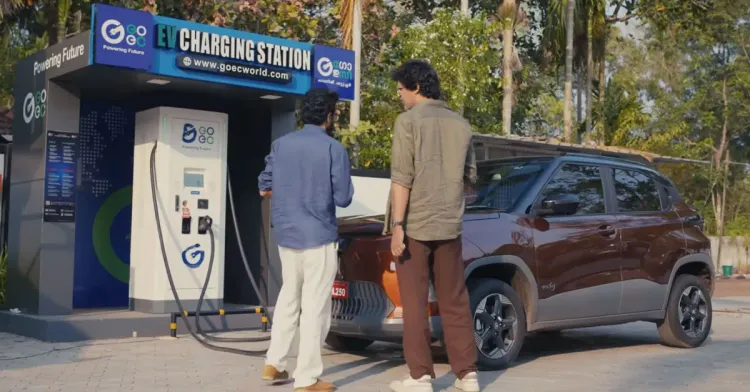
Delhi’s own expansion has been substantial. In October, the government said it had crossed its December 2026 installation target three months early, reporting 14,225 points at the end of September against a target of 13,913. The CAQM figures now put the operational point count at 14,913 a month later. That is progress, but building capacity in Delhi alone will not solve a regional commuting problem.
The urgency is increasing because Delhi’s EV Policy 2026, implemented from July 1, sets deadlines for shifting certain vehicle categories to electricity. New registrations of electric L5-category three-wheelers are to become mandatory from January 2027, while the requirement for new two-wheelers is scheduled for April 2028. Commercial fleets also face transition targets. Drivers working long shifts are particularly dependent on fast, reliable turnaround.
For an electric taxi, delivery van or auto-rickshaw, waiting at a charger means lost earning time. Operators need charging points where vehicles actually stand between trips, as well as reliable power supply and transparent tariffs. Battery swapping can serve some use cases, but it needs compatible vehicles, standardised systems and enough inventory. Simply increasing a citywide charger target does not guarantee a working network.
Before buying an EV in NCR, the safer approach is to map the charging options around the actual routine. Confirm whether home charging is permitted, look for functioning chargers on both ends of a daily commute and identify a backup that does not involve a long diversion. Owners planning inter-city journeys should check the locations and recent reliability of fast chargers, rather than relying only on a map marker.