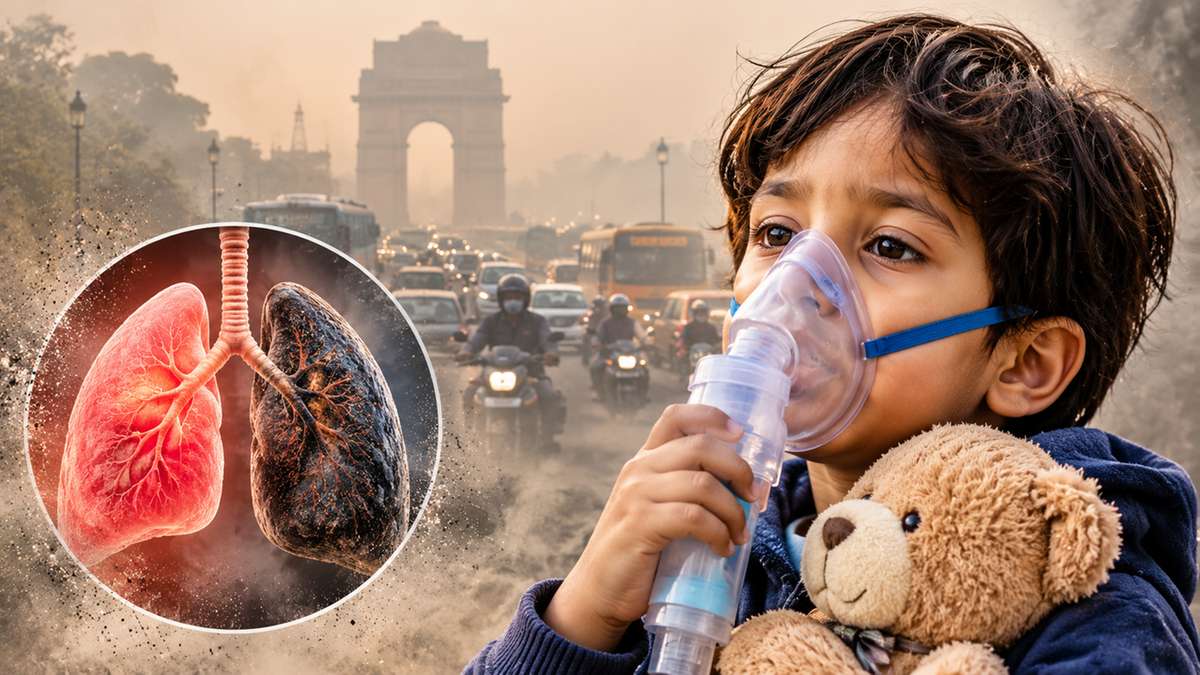
Can breathing Delhi's polluted air every day turn children's lungs black? As air quality continues to deteriorate in the national capital, concerns about the long-term impact of toxic pollutants on respiratory health are growing.
To advertise here,
While blackened lungs are commonly associated with heavy smoking and occupational exposure to substances such as coal dust, prolonged exposure to air pollution can also cause particulate matter to accumulate in the lungs, Dr Beena Amar Bodhi, Chief Medical Officer in the Directorate of AYUSH under the Government of Delhi, has warned.
ALSO READ: Delhi pollution: Are your N95 mask and air purifier really protecting you? AYUSH doctor explains
However, she cautioned that people exposed to heavy air pollution over prolonged periods may also experience the accumulation of fine particles in their lungs.
“Initially, there may be patches of particle deposition. If air quality improves, the lungs may gradually be able to clear some of these particles. But if exposure continues, inflammation can develop and the lungs can slowly get damaged,” she explained.
Why are children more vulnerable to Delhi's air pollution?
Children are particularly vulnerable to air pollution because their lungs are still developing, the doctor said.
Even relatively mild respiratory infections and irritation can have a greater impact on younger children. The younger the child, the greater the risk of serious symptoms and complications, she explained.
Pregnant women also need to be cautious, as PM2.5 particles can enter the bloodstream and potentially reach the developing fetus.
Elderly people are another vulnerable group, particularly those with weakened immunity or existing respiratory conditions. Exposure to polluted air can aggravate their symptoms.
People with asthma and allergic bronchitis are also at risk, as pollutants can trigger or worsen their existing conditions.
The doctor also pointed to the growing number of respiratory complaints she has been observing in outpatient departments (OPDs).
“Almost one in three cases are now respiratory complaints. People are coming in with burning eyes, throat irritation, a runny nose and dry cough. Those who are already asthmatic or have allergic bronchitis are also experiencing worsening symptoms,” she said.
ALSO READ: Don't skip this tiny Rs 3 pill – it could save your life
How can Delhi residents protect themselves from polluted air?
For people who cannot avoid stepping outdoors, monitoring the daily Air Quality Index (AQI) and limiting outdoor activities when pollution levels are particularly high are among the precautions recommended by the doctor.
Those who have flexibility in their schedules should monitor AQI readings and plan outdoor activities for periods when air quality improves, she said.
Staying hydrated is another important precaution. Adequate hydration helps keep the respiratory tract's mucous membranes moist, supporting their natural ability to trap particles.
Dr Beena Amar Bodhi also recommended including foods rich in antioxidants and vitamins A and C in the diet to support the body's response to inflammation.
People with asthma and other respiratory conditions should carry their prescribed medication whenever they step outdoors so they can use it if symptoms are triggered.
For daily commuters, she recommended using the Delhi Metro wherever possible. Those traveling by car should use air-conditioning with the recirculation setting to reduce the entry of polluted outdoor air.
'Pollution should not be a seasonal agenda'
While individual precautions can help reduce exposure, Dr Beena Amar Bodhi stressed that Delhi's air pollution crisis requires sustained action throughout the year.
She pointed out that public attention and pollution-control measures tend to intensify during winter, when stubble burning and other seasonal factors contribute to deteriorating air quality. However, vehicular emissions, construction activities and industrial pollution remain concerns throughout the year.
“Pollution is a year-long problem. We mostly discuss it during these two winter months, but what about vehicular pollution? What about construction sites and industrial emissions? These are issues throughout the year,” she said.
ALSO READ: Teachers' Day Special: His greatest wealth is not money but the students who still call him 'Asan'
She also questioned the effectiveness of temporary interventions introduced when air quality reaches emergency levels, calling for authorities to monitor whether such measures actually deliver results.
“Whenever there is an emergency, measures are introduced, but we are not checking whether they are actually helping. Whatever measures are taken should be concrete, monitored throughout the year and result-oriented,” she said.
Emphasizing the need for collective responsibility, she urged residents to contribute towards reducing pollution while pressing authorities to implement long-term solutions.
“Next year, we should not be discussing the same thing again. We should not have the same AQI and the same discussion every year,” she said.