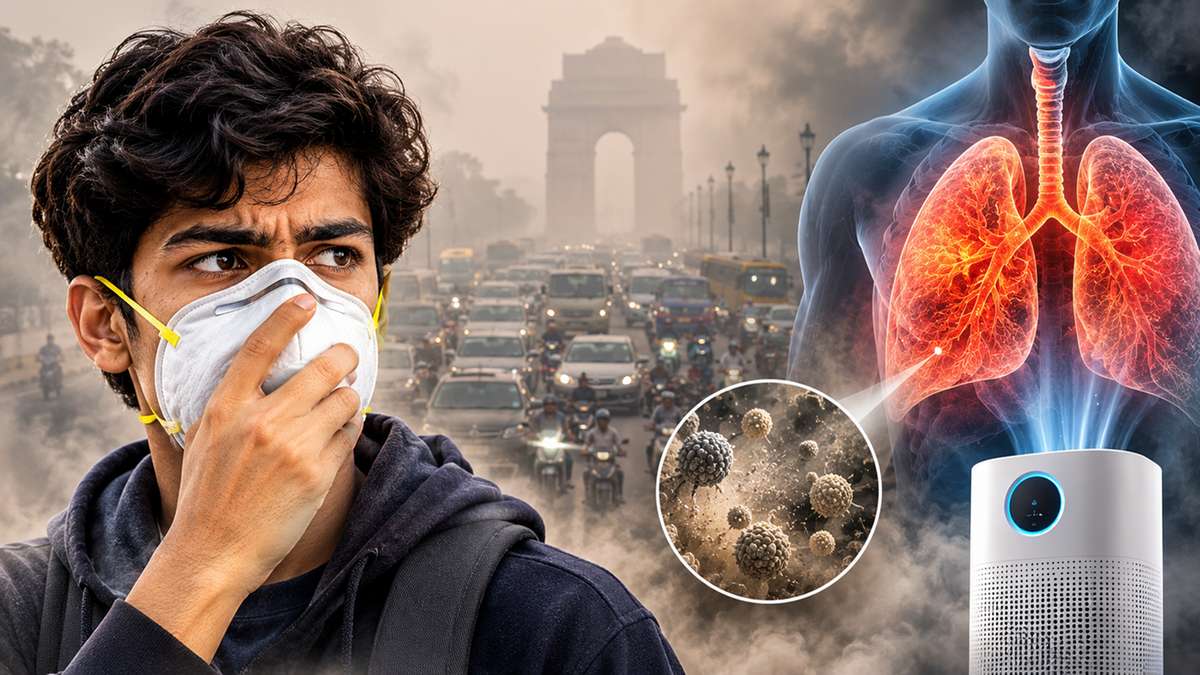
With Delhi's air quality deteriorating, residents are increasingly turning to N95 masks and air purifiers in an attempt to protect themselves from toxic air. But are these measures enough? Can an ordinary surgical mask keep out dangerous pollutants? And what happens when fine particulate matter enters the lungs?
To advertise here,
“These particles will not be able to be exhaled easily. They can pass through the natural protective mechanisms of our respiratory system, reach the lungs and eventually enter the bloodstream,” she said.
Explaining the difference between PM10 and PM2.5, Dr Beena Amar Bodhi said the smaller PM2.5 particles are particularly dangerous because they can travel deeper into the lungs, where the body's natural defense mechanisms cannot easily remove them.
ALSO READ: Can Delhi pollution turn children's lungs black? AYUSH doctor explains the risks
The initial effects may include a runny nose, throat irritation, allergic reactions and a dry cough. Continued exposure can lead to sputum production and aggravate existing respiratory conditions such as asthma and allergic bronchitis.
The bigger concern, however, is what prolonged exposure can do to lung function.
“If you are exposed to these pollutants for a long time, they can cause scarring in the lungs. Once the lungs are scarred, that damage can be permanent. It also affects lung capacity and how effectively the lungs function,” she cautioned.
Delhi's overall Air Quality Index (AQI) stood at 216 at 7.05 am on Monday, placing it in the 'poor' category, according to the Central Pollution Control Board (CPCB). Sirifort recorded an AQI of 346, falling in the 'very poor' category, while several other monitoring stations reported elevated pollution levels.
Do N95 masks really protect you from Delhi's pollution?
For people who cannot avoid stepping outdoors, an N95 mask is among the precautions recommended by the doctor. However, simply wearing one does not guarantee protection. How well the mask fits is equally important.
“There should be no gap between your face and the mask. It should be sealed properly. If there are gaps, there is no point in using it,” she said.
A properly fitted N95 mask can help filter fine particles such as PM2.5. However, the doctor warned against repeatedly using disposable masks or washing them, as this can compromise their filtration effectiveness.
She also cautioned residents against assuming that ordinary surgical or cloth masks offer the same protection.
“Surgical masks will not be able to prevent the entry of PM2.5 particles effectively. Washing an N95 mask can also affect its pore size. There is no point in using a mask that has lost its effectiveness,” she explained.
The doctor also highlighted an important precaution for parents: children below 2 years should not wear masks because of the risk of suffocation. Children up to 5 years should wear them only under adult supervision.
Can an air purifier protect you inside your home?
Air purifiers equipped with HEPA filters can help reduce indoor exposure to fine particulate matter, including PM2.5, Dr Beena Amar Bodhi said. However, their effectiveness depends on whether polluted outdoor air continues to enter the room.
“You should be able to seal the doors and windows properly so that toxic air does not come in,” she explained.
ALSO READ: What if it's not just a toxic relationship? The narcissistic abuse signs people often miss
She suggested using air purifiers when residents are indoors, particularly while sleeping, with doors and windows kept closed to limit the entry of polluted air.
However, she cautioned against treating air purifiers as a permanent answer to Delhi's pollution problem.
“They definitely improve indoor air quality, but they are not a long-term solution at all,” she said.
The doctor also pointed out that not everyone can afford air purifiers or create a protected indoor environment. This makes the problem particularly serious for people who spend much of their day outdoors.
“The most vulnerable are people who cannot afford to have clean air inside their homes. There are many people, including children, who spend most of their time outdoors. Daily-wage workers cannot simply stay home, even when pollution levels are hazardous, because they have to earn a living,” she said.
Who faces the greatest health risks from Delhi's toxic air?
While air pollution affects everyone, children, pregnant women and elderly people are particularly vulnerable, according to the doctor.
Children face greater risks because their lungs are still developing. The younger the child, the more serious the symptoms and complications can be, she explained.
MUST WATCH: What happens to your family's finances if your income suddenly stops?
Pregnant women also need to be cautious. Fine particulate matter can enter the bloodstream, potentially exposing the developing fetus to pollutants.
Elderly people are another vulnerable group, particularly those with weakened immunity or existing health conditions. Exposure to polluted air can aggravate their symptoms and trigger respiratory complications.
People with asthma and other respiratory conditions should take additional precautions, as exposure can worsen their symptoms.
Dr Beena Amar Bodhi also pointed to the growing respiratory complaints she has been observing in outpatient departments (OPDs).
“Almost one in three cases are now respiratory complaints. People are coming in with burning eyes, throat irritation, a runny nose and dry cough. Those who are already asthmatic or have allergic bronchitis are also experiencing worsening symptoms,” she said.
She described this as an indication of the growing health burden associated with deteriorating air quality.