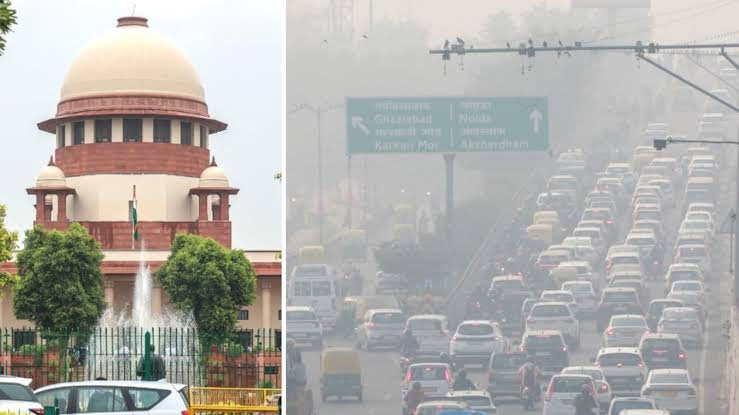
The Supreme Court has expressed strong displeasure over the attitude of neighboring states regarding the continuously increasing air pollution in Delhi-NCR. The court clearly said that the responsibility of reducing pollution does not lie with Delhi alone, but Punjab, Haryana, Uttar Pradesh and Rajasthan will also have to play an active role in it. A bench of Chief Justice Surya Kant, Justice Joymalya Bagchi and Justice V. Mohana reprimanded the four states for their laxity in pollution control efforts. During the hearing, the bench raised questions on the inaction of the neighboring states and said, “You always behave like backbenchers. Why don't you take all the responsibility? Why are you so passive in this process of controlling pollution?”
Asked four states – What steps should be taken to reduce pollution?
The Supreme Court asked Punjab, Haryana, Uttar Pradesh and Rajasthan to take more responsibility for pollution control. The bench asked these states what kind of steps they have taken so far to reduce air pollution. The court said that to deal with the problem of pollution in NCR, joint efforts will have to be made by all the concerned states. The bench directed the four states that their Advocate General should be present in the court during the next hearing of the case. The court wants information about the steps taken by these states and the action plan for pollution control.
Discussion on implementing BS-6 standard in entire NCR
During the hearing, the Supreme Court also discussed the suggestion to impose conditions of compliance with BS-6 emission standards in the entire National Capital Region (NCR) beyond Delhi. The court raised the question that if some restrictions are being imposed on vehicles registered in Delhi, then why should not the same restrictions be imposed on vehicles registered in neighboring states?
The bench said, “If you are imposing some restrictions on vehicles registered in Delhi, then why should they not be imposed on vehicles of neighboring states also? Because then what is the point? If you allow only certain types of vehicles to ply in Delhi, while on the other hand you exempt all types of vehicles, then pollution will not reduce.” The purpose of the court's remarks was to highlight the need for a uniform system to control vehicular pollution across the NCR.
Warned of far-reaching consequences of immediately imposing a complete ban
The Supreme Court also warned against immediately imposing a blanket ban to reduce pollution. The bench said that before imposing any kind of major ban, it is necessary to consider its long-term consequences. The court's emphasis is on practical measures that can be taken while controlling pollution, while also keeping in mind the impact on common people and essential services.
Consideration of stopping commercial vehicles
During the hearing, Chief Justice Surya Kant raised the question whether the entry of commercial vehicles in Delhi can be completely stopped? He suggested that warehousing facilities should be developed on the borders of Delhi itself, where goods coming from other states can be unloaded. After this, non-polluting vehicles can be used to deliver goods within the city. Under this system, fruits, vegetables and daily essential items can be transported within Delhi by electric or other non-polluting vehicles. This can help in reducing the movement of heavy commercial vehicles in the city. However, before implementing this system, its practicality and necessary features will have to be considered.
Air may remain bad till 27th November
The Air Quality Early Warning System of the India Meteorological Department has also expressed concern over the pollution situation in Delhi. According to the forecast, the air may remain in poor category from 25 to 27 November. The air quality is expected to remain in the poor to very poor category in the subsequent six days also. During this period, due to low wind speed, the spread of pollutants will be limited. In such a situation, the concentration of pollutants in the atmosphere may increase and air quality may be affected.
The ventilation index is expected to reach 2500.
According to the Meteorological Department, ventilation index less than 6000 square meters per second and average wind speed less than 10 kilometers per hour is considered unfavorable for the spread of pollutants. According to the forecast, the ventilation index is likely to be 2500 on November 25 and 2000 square meters per second on November 27. Due to low ventilation index and slow wind, pollutants will have difficulty getting out of the atmosphere. Due to this, the pollution level is expected to increase in the coming days.
Possibility of morning fog from 25 to 27 November
According to the forecast of the Meteorological Department, there may be light fog or mist in some areas of Delhi in the morning from 25 to 27 November. During this period, the maximum temperature is likely to be between 24 to 26 degrees Celsius and the minimum temperature is likely to be between 9 to 11 degrees Celsius. The maximum temperature is expected to be below normal. However, the sky will be mainly clear during the day. During this period the wind speed can remain between 5 to 15 kilometers per hour. Due to drop in temperature and light mist in the morning, people may feel cold more. Especially people leaving home early in the morning will need to be careful due to low visibility. According to the forecast of the Meteorological Department, at present there is no sign of any major change in the weather conditions in the capital.
Follow the LALLURAM.COM MP channel on WhatsApp