
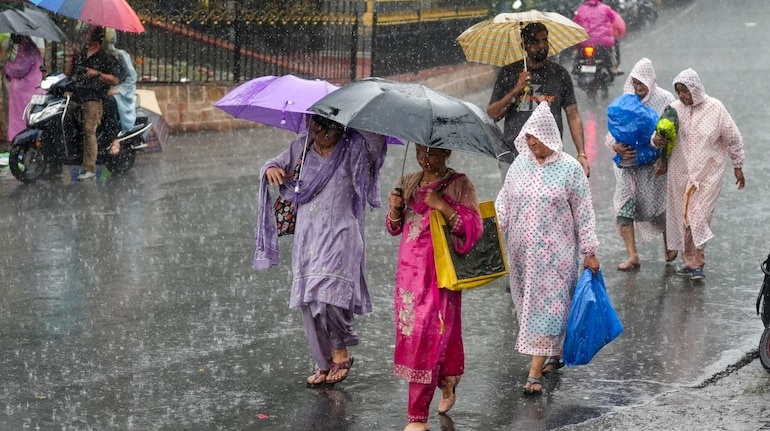
Delhi Weather Update: ‘Grand entry’ of monsoon in Delhi after 5 days delay, temperature drops, alert of torrential rain from July 5

The moment for which the people of Delhi-NCR were eagerly waiting for weeks has finally arrived. Ending the torture of weeks of scorching heat, humidity and deadly heatwave, the South-West Monsoon has made a grand entry in Delhi. However, this time Badra has arrived 5 days late from the scheduled time. With the arrival of monsoon, there was light to moderate rain in many areas of the capital and there were dense dark clouds in the sky throughout the day. Due to this, a huge drop in the temperature of Delhi has been recorded, which has given great relief to the people from the sticky humidity. The Indian Meteorological Department (IMD) has officially announced the arrival of monsoon in Delhi after favorable weather conditions are created. ‘Yellow Alert’ issued for today, mercury will fall to 32 degrees. Meteorological Department has issued ‘Yellow Alert’ in Delhi-NCR for Friday. Today the sky in the capital will be generally densely cloudy and several rounds of moderate rain are expected. Due to this monsoon shower, the minimum temperature of Delhi today is expected to be around 22 degrees Celsius and the maximum temperature will be around 32 degrees Celsius, due to which the weather will remain very pleasant. The next round of torrential rains will start from July 5, understand the mathematics of trough. According to famous meteorologist Mahesh Palawat (Skymet Weather), due to the change in the weather system, the rainfall activities in Delhi are going to increase rapidly once again. Palawat said, "The main seasonal trough line of monsoon is currently extending from Punjab to the Bay of Bengal. In the next 24 to 48 hours, this trough will move a little towards the south i.e. towards Central India, which will cause heavy rains in Madhya Pradesh and surrounding states. During this period, rainfall may reduce slightly in the plains of Delhi, Punjab and Haryana."
But the real twist for the people of Delhi will come from July 5. Meteorologists predict that by July 5, this trough line will again move northward (Northward Shift), due to which Delhi and other parts of North-West India will see another very heavy round of torrential monsoon-like rains. For the first time after 2021, it started in July, see the record of previous years. According to the official data of the Meteorological Department, this is the first time after the year 2021 that the monsoon has reached Delhi after the month of June i.e. in July. Earlier in the year 2021, monsoon had proved to be quite mild and reached Delhi on 13th July. Let’s take a look at the dates of arrival of monsoon in Delhi in the last few years: 2025: 29 June 2024: 28 June 2023: 25 June 2022: 30 June 2020: 25 June If we examine the weather history of the last 125 years of Delhi, the earliest arrival of monsoon here was recorded on 15 June 2008, while the most late arrival of monsoon was recorded on 15 June 2008. Monsoon reached Delhi on 26 July 1987. Records broken from Safdarjung to Palam, the coldest morning in 5 years. The first showers of monsoon have completely reset the temperature of Delhi. The maximum temperature in Safdarjung, the main weather center of Delhi, was recorded 4.4 degrees below normal i.e. 33 degrees Celsius. At the same time, the minimum temperature dropped by 5.1 degrees below normal to 22.8 degrees Celsius. This is the lowest minimum temperature since July 21, 2021. The condition of other areas of Delhi was similar: Palam: Maximum 33°C. Min 21.2°C Lodhi Road: Max 33°C | Minimum 23.6°C Ridge Station: Maximum 33.8°C | Min 21°C Ayanagar: Max 32.4°C | Minimum 22.6°C Badra Why late? The scorching heat of pre-monsoon spoiled the game. Explaining the real reason for the delay in monsoon this year, experts said that the moisture-rich easterly winds coming from the Bay of Bengal, which act as fuel for the continuous monsoon rains, could not reach Delhi and the plains of North India on time. Due to this, the pre-monsoon season was many times hotter and drier than normal this time. According to IMD data, the average minimum temperature of Delhi during March to June this year was 22.9 degrees Celsius, which is the hottest after 2022. At the same time, the average maximum temperature was recorded at 37 degrees Celsius, which is the second highest average temperature in the last six years. Due to this extreme heat and humidity, monsoon winds had to struggle extra to reach Delhi.

Comments are closed.