Democratic Primary Voters Send Clear Message: They Want Political Change, New Leadership/ TezzBuzz/ WASHINGTON/ J. Mansour/ Morning Edition/ Recent Democratic primaries show no unified ideological shift but reveal a broad voter demand for political and generational change. Progressives prevailed in Michigan and Minnesota, while moderate David Crowley narrowly stopped socialist Francesca Hong in Wisconsin.
The challenge for Democrats is converting dissatisfaction with their own party into victories over Republicans in November.

Quick Look
- Democratic voters are choosing change across ideological lines.
- Progressives won major Senate primaries in Michigan and Minnesota.
- Moderate David Crowley narrowly defeated democratic socialist Francesca Hong in Wisconsin.
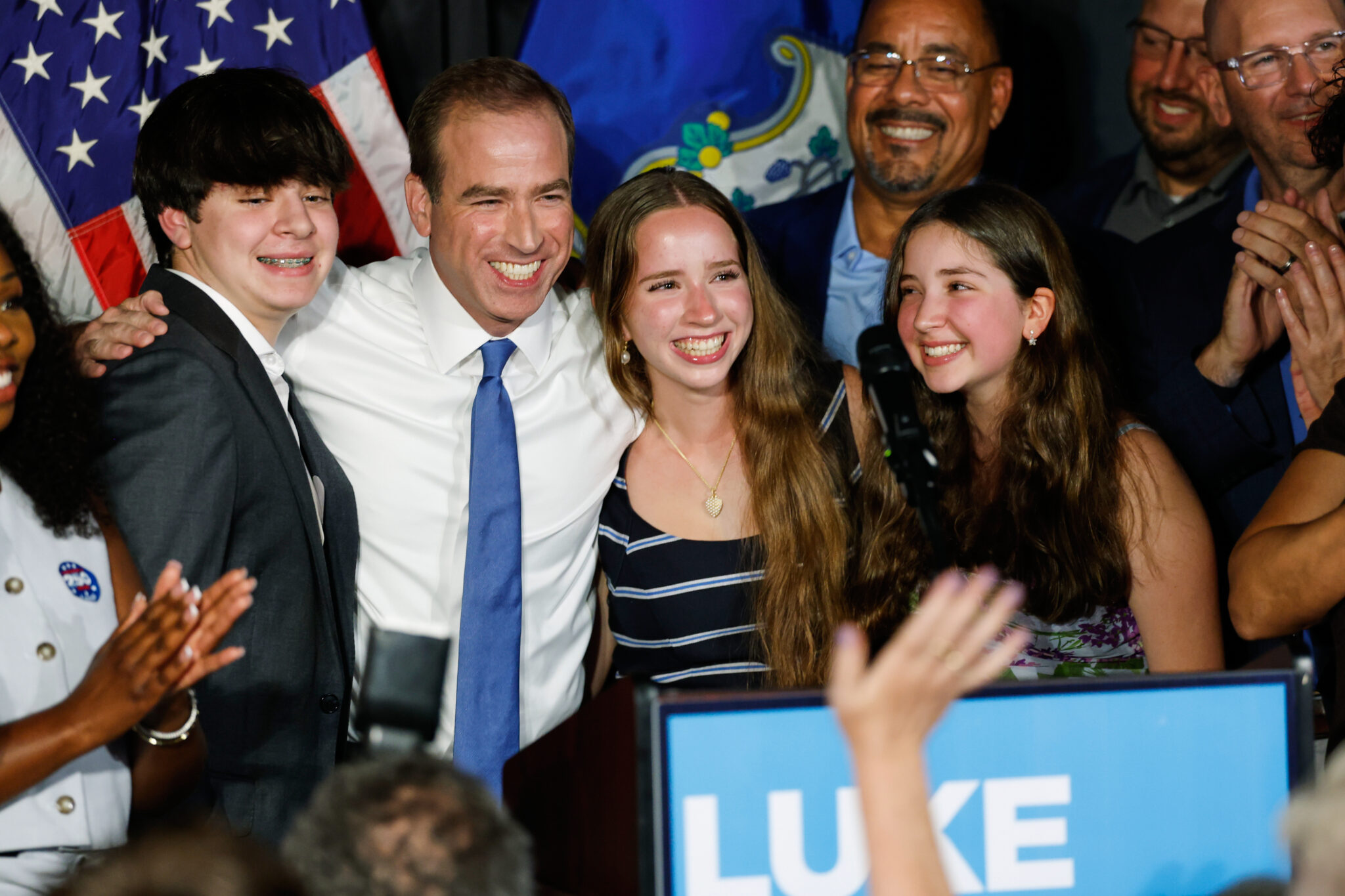
- Luke Bronin ousted 14-term Connecticut Rep. John Larson.
- Seven Democratic House incumbents have lost primaries this year.
- Younger candidates and voters are increasingly influencing the party.
- Economic populism is resonating more broadly than some progressive cultural positions.
- Several insurgent candidates prevailed despite being significantly outspent.
- Democrats must now determine whether their primary messages can attract general-election voters.
- The results could help shape the party’s leadership and 2028 presidential field.


Deep Look
Democratic voters demand change more than ideological purity
Democrats remain divided over whether their party should move toward the ideological left or remain closer to the political center. Recent primary results, however, are delivering a clearer message: Democratic voters want change.
Progressive candidates defeated establishment-backed members of Congress in closely watched U.S. Senate primaries in Michigan and Minnesota.
Wisconsin Democrats narrowly rejected a democratic socialist but selected Milwaukee County Executive David Crowley, a 40-year-old moderate seeking to become the state’s first Black governor.
In Connecticut, voters removed one of Congress’ longest-serving Democrats and chose a challenger who emphasized generational turnover.
Taken together, the results do not amount to a consistent ideological mandate. Instead, they add to evidence that Democratic voters are frustrated with longstanding political institutions and eager to replace familiar leaders, regardless of whether their challengers come from the party’s left or center.
“The through line between these races isn’t ideology. It’s impatience with this political system that feels disconnected from the urgency voters feel,” said Lis Smith, a national Democratic strategist. “The demand for change is much broader than the demand for socialism.”
Democrats must redirect frustration toward Republicans
The party’s immediate challenge is turning the frustration driving revolts against Democratic incumbents into opposition to Republicans in the November general election.
Primary challengers can campaign against party leaders, wealthy donors and a political system they describe as unresponsive. Once nominated, however, they must broaden their coalitions to include independents, moderate Democrats and other voters who did not participate in the primaries.
The results also carry implications for the 2028 presidential race, when a younger group of contenders is expected to compete for control of the Democratic Party’s direction.
“If leaders in our party don’t recognize that we need to make changes, then the changes are going to come from the ground up,” Luke Bronin, a former mayor who defeated 14-term Connecticut Rep. John Larson in Tuesday’s primary, said in his victory speech. “That’s a message our party needs to hear.”
Wisconsin demonstrates the limits of progressive momentum
Democratic socialist Francesca Hong attempted to build on recent progressive victories in her campaign for the Wisconsin Democratic gubernatorial nomination.
Her candidacy followed Abdul El-Sayed’s upset victory one week earlier in Michigan’s Democratic Senate primary.
Hong came close but narrowly lost to Crowley, a more moderate candidate endorsed by outgoing Democratic Gov. Tony Evers.
The result slowed the progressive momentum visible in other contests and reinforced Democratic concerns about electability in closely divided states.
Wisconsin is an essential battleground where Republicans and Democrats frequently compete in elections decided by narrow margins.
Past statements created vulnerabilities for Hong
Hong’s campaign faced renewed scrutiny over previous statements, including her support for defunding the police and a social media post calling for Thanksgiving to be canceled. She later described the Thanksgiving comment as a joke.
Unlike El-Sayed, Hong did not receive endorsements from some of the country’s most prominent progressive leaders. Sen. Bernie Sanders and Rep. Alexandria Ocasio-Cortez declined to back her.
Her narrow defeat illustrates a broader challenge for the Democratic left.
Progressive candidates promoting economic populism have increasingly succeeded among primary voters. Policies focused on affordability, corporate power, wealth inequality and political corruption have attracted support across significant portions of the party.
Some cultural positions previously associated with the progressive movement, however, remain potential liabilities—especially among Democrats focused on nominating candidates capable of winning statewide elections.
“A lot of Democrats are traditionalists on things like culture issues. This is not about culture, it’s about economics. It’s about corruption,” said David Axelrod, who was an adviser to President Barack Obama. “The closer that candidates hew to those issues, the larger the base they’re going to be able to accumulate.”
Some Wisconsin Democrats voted strategically
Sarah Atkins Hoggatt, a 61-year-old Wisconsin voter, reflected the conflict between ideological preference and general-election calculations.
She agreed with Hong on some issues but feared that Hong’s deeply progressive politics and democratic socialist label would make it harder for her to defeat Republican nominee Tom Tiffany in November.
Atkins Hoggatt voted for Crowley instead.
“I didn’t vote my heart,” Atkins Hoggatt said.
Her decision demonstrated that some Democratic primary voters were evaluating not only which candidate best reflected their values but also which nominee they believed could win in a competitive state.
Crowley’s victory will now test the establishment argument that a moderate candidate offers Democrats the strongest opportunity to retain Wisconsin’s governor’s office.
Minnesota delivers decisive progressive victory
Progressives achieved a much clearer result in Minnesota, where Lt. Gov. Peggy Flanagan decisively defeated centrist Rep. Angie Craig for the Democratic Senate nomination.
Craig entered the race with endorsements from House Democratic Leader Hakeem Jeffries, former House Speaker Nancy Pelosi and several senators representing battleground states.
Flanagan also had influential allies. Sanders, Sen. Elizabeth Warren and retiring Minnesota Sen. Tina Smith supported her campaign.
She used Craig’s institutional and financial advantages against her, presenting the contest as a struggle between ordinary voters and wealthy political interests.
Flanagan emphasized Craig’s support from affluent donors and attacked her vote for a Trump-backed immigration measure.
That vote became especially damaging after federal immigration officers shot and killed Renee Good and Alex Pretti in Minneapolis, generating intense opposition to President Donald Trump’s immigration policies.
Flanagan overcomes spending disadvantage
As in Michigan, the victorious progressive candidate was substantially outspent.
Flanagan portrayed the disparity as proof that grassroots voters could overcome corporate and wealthy donor influence.
“For months now, I have been telling you that this campaign was about the many versus the money,” Flanagan said as she celebrated her victory in Minneapolis. “Well guess what? The many just won.”
Her win strengthened the progressive argument that economic populism and opposition to political spending can mobilize Democratic voters even when establishment-backed opponents possess greater financial resources.
The contrasting outcomes in Minnesota and Wisconsin also demonstrate that progressive momentum is neither uniform nor unlimited.
November becomes the larger progressive test
The general election will offer a more consequential measure of progressive strength.
El-Sayed and Flanagan must prove that the messages that carried them through Democratic primaries can appeal to a wider electorate.
Primary voters tend to be more ideologically committed than general-election voters. The nominees will now need to attract voters who may be less progressive on economic, cultural or foreign-policy questions.
Victories in November would strengthen the argument that progressive candidates can compete beyond heavily Democratic districts and urban constituencies.
Defeats could reinforce establishment warnings that left-wing candidates risk alienating moderates in competitive statewide races.
Generational change emerges as a powerful theme
Age and generational turnover also connect many of the successful Democratic candidates.
Flanagan is 46, Crowley is 40 and El-Sayed is 41.
The clearest demand for new leadership came in Connecticut, where the 47-year-old Bronin defeated Larson, a 78-year-old incumbent first elected to Congress in 1998.
Bronin, a former Hartford mayor, made generational change a central component of his campaign.
Larson became the seventh Democratic House incumbent to lose a primary during the 2026 election cycle. Many of the defeated lawmakers were replaced by younger challengers.
Because both the incumbents and their challengers represent different ideological factions, the pattern cannot be explained solely as a movement toward the left.
Instead, the results suggest frustration with longevity in office and a desire for leaders who appear more responsive to the current political moment.
Biden’s 2024 campaign intensified concerns about age
The demand for generational turnover gained urgency after Democratic defeats in 2024.
Concerns about President Joe Biden’s age eventually forced him to abandon his reelection campaign, prompting an uncomfortable partywide debate about senior leaders who had remained in positions of power for decades.
Bronin linked his congressional challenge to that experience.
Earlier in the year, he argued that Democrats needed “new members of Congress, new Democratic leaders who have the energy and courage and clarity of mission that this moment demands.”
Voters in Larson’s district echoed that message.
Dan Schnaidt, a 73-year-old Democrat, said he respected Larson’s service but believed the district needed a new representative.
“It’s time for new blood, for new ideas,” Schnaidt said.
Younger voters reshape Democratic primaries
Hong’s narrow loss still demonstrated the growing power of younger Democratic voters.
Cody Chandler, a 35-year-old software engineer, voted for Hong and described her as “probably the most exciting candidate I’ve seen.”
In previous elections, Chandler said he selected the contender he considered most electable. This time, he voted for the candidate he most wanted to win.
Jesse Heer, a 32-year-old Madison business owner, also supported Hong, pointing to her focus on affordability.
Their support was reflected in the geographic results.
Hong carried Madison, home to the University of Wisconsin’s flagship campus, by nearly 7 percentage points. That margin, however, was not large enough to offset Crowley’s advantages elsewhere.
College communities helped power El-Sayed’s victory
Younger and college-educated voters produced similar patterns in Michigan.
El-Sayed carried Washtenaw County, home to the University of Michigan, by nearly 25 percentage points.
He won Ingham County, which includes Michigan State University, by 23 points. El-Sayed also carried Grand Rapids, a city with a substantial younger and college-educated population, by almost 26 points.
Those margins helped him overcome the spending advantage and institutional support enjoyed by his opponent.
The results indicate that progressive candidates are finding particularly strong support in university communities and areas populated by younger professionals.
Trust and independence matter to young voters
For some younger voters, support for progressive candidates reflects not only policy preferences but also concerns about political authenticity.
Jordan Snyder, a 20-year-old Michigan voter, supported El-Sayed because of his progressive positions and because she saw him as someone she could trust rather than “someone who I feel could be bought and sold.”
“People are feeling like a lot of the people that they’ve trusted that have been in government haven’t really been living up to expectations,” Snyder said.
That frustration connects the progressive victories, moderate successes and incumbent defeats occurring across the Democratic primary calendar.
The emerging message is less a unified demand for socialism or centrism than a rejection of leaders, institutions and funding structures that voters believe have failed to address urgent economic and political problems.
Whether Democrats can channel that demand for change into a successful national coalition will become clearer in November—and could determine who leads the party into the 2028 presidential election.
More on US News