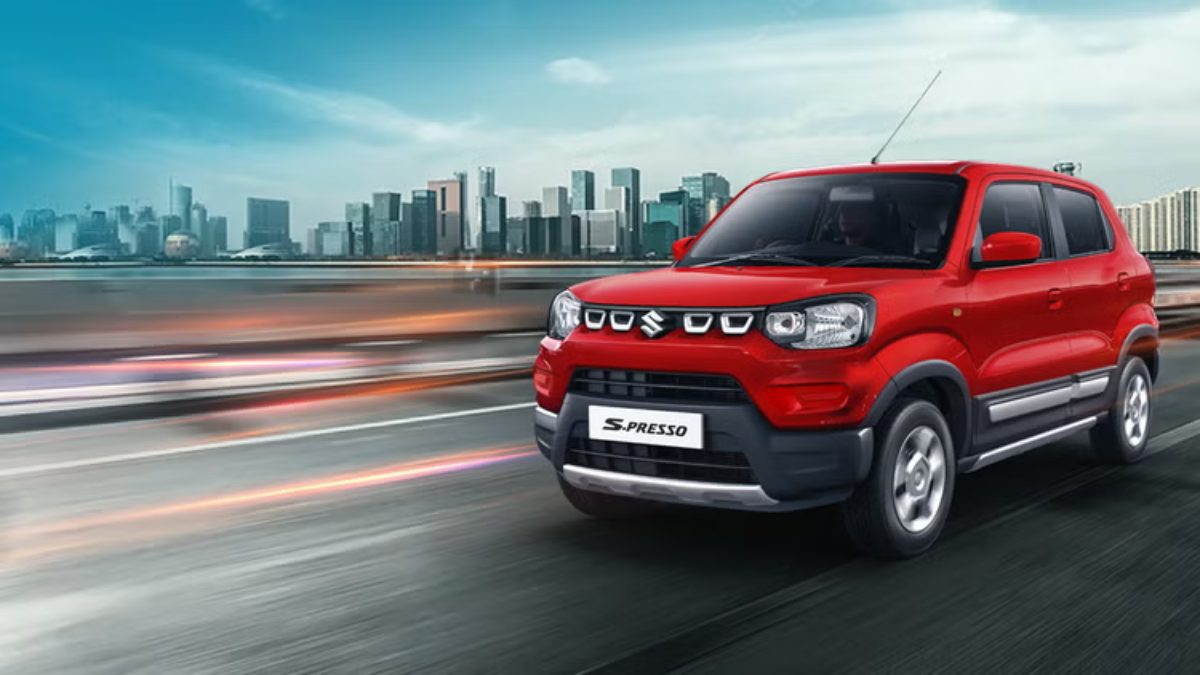
Automobile Desk: Budget segment vehicles have always been liked in the Indian car market, but Maruti Suzuki's micro-SUV look car S-Presso seems to be lagging behind in attracting buyers these days. The situation is that the company's own entry-level hatchback Alto K10 has pushed it far behind in terms of sales. Not only this, the other rival vehicle in the market, Renault Kwid, also appeared to be performing better than it for several months. Surprisingly, despite the huge relief in GST rates on small cars, the sales of S-Presso did not achieve the stability that was expected.
If we look at the latest data related to the automobile sector, in the total 13 months between October 2025 and October 2026, only 24,085 vehicles of Maruti S-Presso were sold. In sharp contrast, the Alto K10 recorded a whopping sales of 1,35,159 units in the same time period. That means there was a huge gap of more than 1.11 lakh units between the two vehicles. Whereas, if we talk about Renault Kwid, it sold 6,226 vehicles during this period. It is worth noting that the monthly sales of Kwid remained above S-Presso for four consecutive months between July and October 2026. Only 566 S-Presso were dispatched to dealerships in October 2026 alone, while 11,523 units of Alto K10 and 808 units of Kwid were dispatched in the same month.
Sales graph kept going up and down throughout the year
In the last 13 months, the demand for S-Presso has been like a roller-coaster ride. While 2,857 units were sold in October 2025, by March 2026 this figure dropped to just 226. Although it showed a sudden jump with 5,210 units in April and 6,388 units in May, but this rise could not last long. Sales fell again to 1,028 units in June and to just 100 units in July. In August, only 107 vehicles and in September, only 55 vehicles could reach the dealers, after which this number reached 566 in October. On the other hand, the Alto K10 held firmly above 8,600 units in most of the months, while the Renault Kwid remained in the range of 300 to 808 units per month.
Even tax reduction did not provide much benefit
To provide relief to customers, under the GST 2.0 rules implemented from September 22, 2025, the effective tax on small petrol cars was reduced from 29 percent to 18 percent. Lower prices revitalized the entire entry-level segment and increased purchases, but the S-Presso failed to capitalize on this opportunity.
Why did the showroom remain empty and what did the company say?
Stock of this model was not available at many dealerships for a long time. When the customers who reached the showroom did not get this car, the sales team advised them to buy Alto K10 which comes in the same budget or Celerio if the budget is slightly higher. Partho Banerjee, Senior Executive Officer of Marketing and Sales Department of Maruti Suzuki has clarified the situation on this supply crisis. According to him, after the implementation of GST 2.0, the company had shifted the production of S-Presso to another manufacturing unit keeping in mind the domestic demand and export needs.
Due to this change, the supply of vehicles was disrupted in the intervening months. Banerjee says that the work of shifting the plant has now been completed and sending vehicles to dealers has been started again from this month itself. The company believes that there is a good trend towards the car in the market and currently customers have to wait for 6 to 8 weeks to buy it. However, market experts believe that low price alone does not guarantee success; Compared to the decades-old reliability of the Alto K10, the boxy and tall design of the S-Presso is still not appealing to every category of buyer.