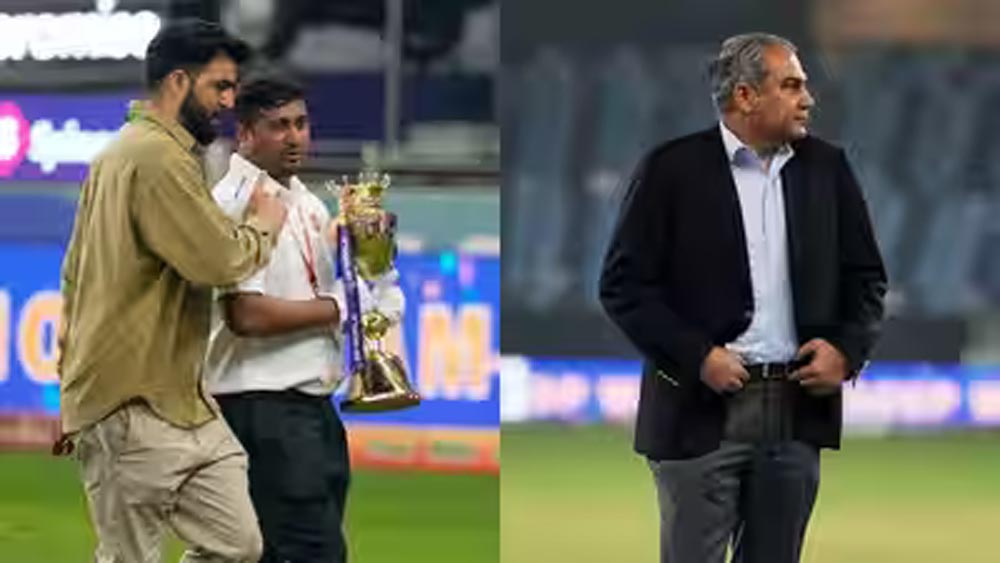
India won the final of the Women’s Asia Cup. The Indian team became the champion by defeating Sri Lanka by 72 runs, but as soon as the match ended, the story moved from the cricket field to India-Pakistan relations and politics. The reason was the trophy presentation and Mohsin Naqvi present on that stage.
Asian Cricket Council (ACC) Chairman Naqvi had arrived for the presentation with the trophy, but the Indian players did not come forward to take the trophy from his hands. India did not accept the trophy. Later Naqvi gave the runner-up check to Sri Lanka and left from there.
But the biggest question in this entire incident is no longer why India did not take the trophy.
The big question is that when Naqvi already knew that the Indian team would not take the trophy from his hands, then why did he come for the presentation?
Naqvi was already informed about India’s decision
Now the Board of Control for Cricket in India (BCCI) has given important information on this entire matter. BCCI Vice President Rajeev Shukla told after reaching Delhi that the Indian Board had discussed among themselves and decided that the team will not accept the trophy from Naqvi. Information about this decision was already given to the concerned people.
This means that what happened in Dubai was not a sudden controversy. India’s decision was already decided. ACC was aware of this. Naqvi was also not unaware of this stance. Still he reached the presentation stage. And there what was already known happened – the Indian team refused to accept the trophy.
The same story was repeated in 2025
What makes this development more interesting is the 2025 Asia Cup. Even after the men’s team’s Asia Cup final, India did not accept the trophy from Naqvi. This means that this was not a completely new development for Naqvi.
This time the situation was even clearer. Last year’s example was there and BCCI had informed its stand to ACC even before the final.
Despite this, Naqvi arrived for the presentation. This is where the question becomes bigger – was this just protocol? Or was it important for Naqvi to be present on this stage in itself?
No official answer to this question has emerged. Therefore, it would not be right to say that Naqvi had reached there as per any specific political strategy. But it is certain that he was aware of India’s stand and despite this he remained present in the presentation.
Naqvi did not even protest
There was no major confrontation in Dubai after India’s refusal. Rajeev Shukla said that Naqvi did not raise any objection to this decision. He gave the trophy to whoever he wanted and then left from there. That is, the picture became something like this – India did not change its decision and Naqvi also did not protest on the stage.
Neither did India take the trophy from Naqvi’s hands, nor did Naqvi publicly object to it. But this quiet development definitely left a big question – if this was to be the end, then what was the need for Naqvi to reach there?
Pakistan was not even in the final, yet Naqvi came to the centre. This is the most interesting aspect of this story.
The final was between India and Sri Lanka. Pakistan was not in the competition at all. But by the end of the match, Pakistan’s most famous cricket face came at the center of the entire incident. Naqvi is not just the president of ACC at this time. He is also the Chairman of Pakistan Cricket Board (PCB) and Home Minister in the Government of Pakistan.
Therefore, the Indian team’s refusal to accept the trophy is not just an ordinary incident related to cricket administration. It is natural to draw its political meaning in the context of the current relations between India and Pakistan.
This is the reason why the trophy presentation of an Asia Cup final instantly turned into an old India-Pakistan story.
Also understand the status of Naqvi in Pakistan
Naqvi holds an influential position in both power and cricket in Pakistan. He is considered close to the powerful ruling establishment of Pakistan. He also holds the command of PCB and also the post of Home Minister in the government. But being in a powerful position and being undisputed on every front is a different thing.
During his tenure in Pakistan cricket, there has been constant debate regarding the team’s performance, selection, decisions related to players and administrative changes. This means that Naqvi already has many questions on the cricket front.
In such a situation, any clash between India and Pakistan cricket is not just sports news for them. He immediately becomes part of the debate related to political and national identity.
Protest for India, new narrative for Naqvi?
This is where the most interesting aspect of this entire controversy comes to the fore. The message from India was clear – not to accept the trophy from Naqvi… But like any political dispute, the interpretation of this incident can be different on both sides.
In India, the picture will be seen in such a way that the Indian team, maintaining its stand, refused to accept the trophy from Naqvi.
Whereas in Pakistan, there is scope for presenting the same incident with another narrative – India protested, but Naqvi remained present at his place, did his work and left from there without any objection.
This means that two political meanings can be derived from the same picture. This is where it is no longer just a matter of trophies.
Did Naqvi get political benefit from this?
It would be too early to say that Naqvi had deliberately come to the presentation for this very benefit. There is no solid public evidence of this. But it is also true that this development once again brought him into the center of the India-Pakistan conflict.
The decision through which India registered its protest also gave Naqvi an opportunity to be presented in Pakistan as a character who stood before India and did not back down despite the controversy.
That is, India’s message was in place, but the political narrative of the dispute can be made on the other side as well. And the value of narrative is not less in politics.
Saikia and Naqvi’s conversation was also discussed
Pictures of the conversation between BCCI Secretary Devjit Saikia and Naqvi during the final were also revealed. After this the question arose that if India had decided not to accept the trophy from Naqvi, then why were BCCI officials talking to him?
Rajiv Shukla called it a normal professional conversation. According to him, the officials meet and talk to each other during the match. Therefore, the conversation between Saikia and Naqvi should not be seen as any special indication.
With this, BCCI also made its position clear – talks and protocols are in place, but the decision to accept the trophy was in its place.
Who actually won?
The answer on the field is very clear: India’s. India defeated Sri Lanka and won the Asia Cup. But India did not take the trophy from Naqvi in the trophy presentation. That is, despite becoming the champion, the Indian team did not participate in the formality of lifting the trophy from the stage.
Naqvi could not give the trophy. But he definitely became the biggest character in this entire controversy. This is the biggest twist of this story. India became champion by winning the trophy. Naqvi could not give the trophy. But the controversy again brought Naqvi to the center of the India-Pakistan conflict.
And now when it has become clear that India’s decision was already decided and its information was already given, then the question becomes more acute. The answer to this has not been officially revealed yet.
But the most interesting part of this entire story of Women’s Asia Cup is this – India did not take the trophy, Naqvi could not give the trophy… but the dispute between the two definitely took the trophy into the headlines once again.