
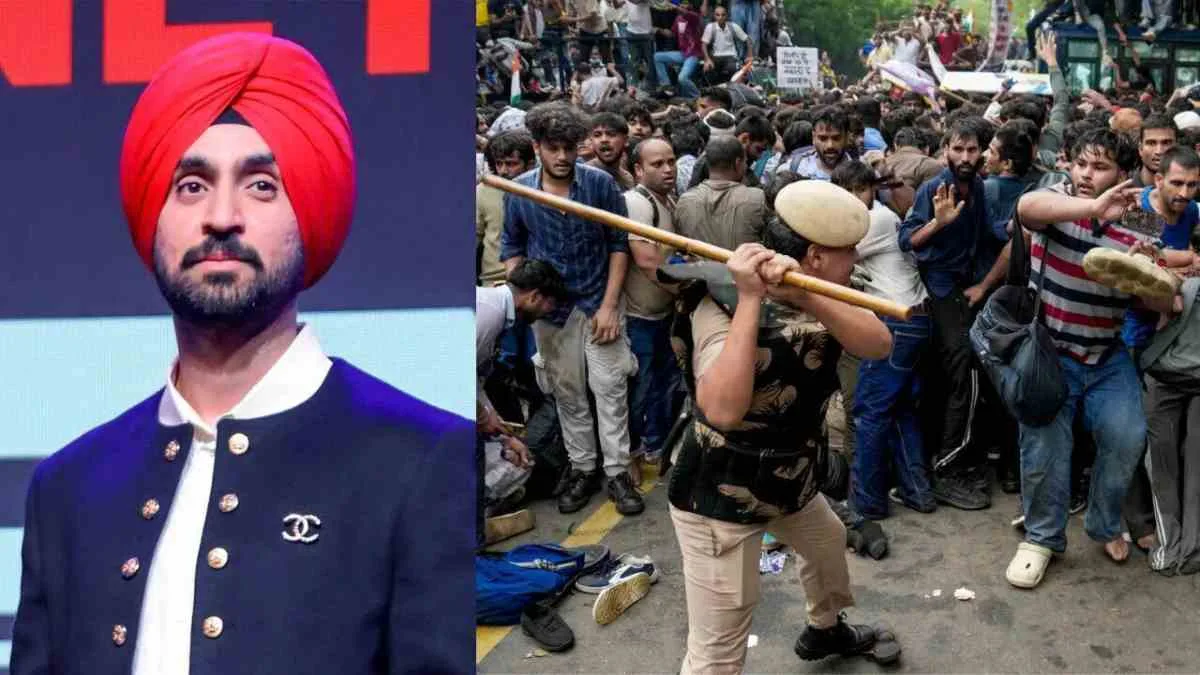
Diljit Dosanjh Backs CJP Protest After Student Lathi-Charge, Says ‘I’ll Be Called Anti-National Again’

Singer-actor Diljit Dosanjh has voiced his support for the Cockroach Janta Party (CJP)-led student movement after protesters marching towards Parliament were lathi-charged by police in Delhi. Sharing his reaction on social media, Diljit said he was aware that speaking in favour of the students could once again invite criticism and labels such as “anti-national”, but maintained that he could not remain silent over the treatment meted out to peaceful demonstrators.
Diljit’s remarks come weeks after he had distanced himself from the protests, saying he was “an artist, not a politician” and that he preferred to stay away from political issues. His latest statement marks a significant shift in his position, with the actor saying recent events compelled him to speak out. Referring to the police action against students during the “Sansad Chalo” march, he said the protesters should not have been treated in such a manner.
In his post, Diljit wrote that he knew some people would once again brand him “anti-national” for expressing solidarity with the students. However, he said such labels would not deter him from standing by young people raising concerns about their future. Quoting a Punjabi saying, “Lokan di awaaz Rab di awaaz hundi aa” (The voice of the people is the voice of God), he urged authorities to listen to the concerns of students instead of responding with force.
The protests intensified after thousands of students and supporters gathered in Delhi for the CJP’s “Sansad Chalo” march during the Monsoon Session of Parliament. Demonstrators sought reforms in the education system and accountability over alleged irregularities in competitive examinations, including the NEET paper leak controversy. Police used barricades, batons and tear gas to stop the march, leading to clashes and injuries that drew widespread criticism from opposition leaders, activists and public figures.
The movement has been spearheaded by CJP founder Abhijeet Dipke and supported by education reformer Sonam Wangchuk, who has been on an indefinite hunger strike demanding systemic reforms in the education sector and the resignation of Union Education Minister Dharmendra Pradhan. Wangchuk was recently shifted to hospital after his health deteriorated following nearly three weeks of fasting, but organisers have said the agitation will continue until their demands are addressed.
Diljit’s latest intervention adds to a growing list of film personalities who have expressed support for the movement. In recent days, celebrities including Riteish Deshmukh, Vishal Dadlani, Prakash Raj, Aamir Khan, Imran Khan, Shekhar Suman and Kavita Kaushik have either questioned the police action, voiced concern over Wangchuk’s health or appealed to the government to engage in dialogue with protesting students.
The actor has previously spoken on several public issues, most notably during the farmers’ protests, when his statements generated both praise and criticism. His support for the current student movement has similarly divided opinion online. While many social media users applauded him for taking a stand despite anticipating backlash, others criticised his remarks, arguing that celebrities should refrain from commenting on politically sensitive matters.
Diljit’s comments also drew attention because they contrasted sharply with his earlier response to the protests. Earlier this month, he had told fans during an Instagram Live session that he wanted to stay away from the issue, saying he was unaware of the details of the agitation. That stance had disappointed some CJP supporters, who had hoped the singer would use his influence to amplify the students’ concerns.
As the protests continue to gather momentum, Diljit Dosanjh’s statement has added another prominent voice to the growing chorus calling for accountability and dialogue. His message, centred on listening to the concerns of students and respecting peaceful dissent, has further intensified the public conversation surrounding the movement and the government’s response to it.
Comments are closed.