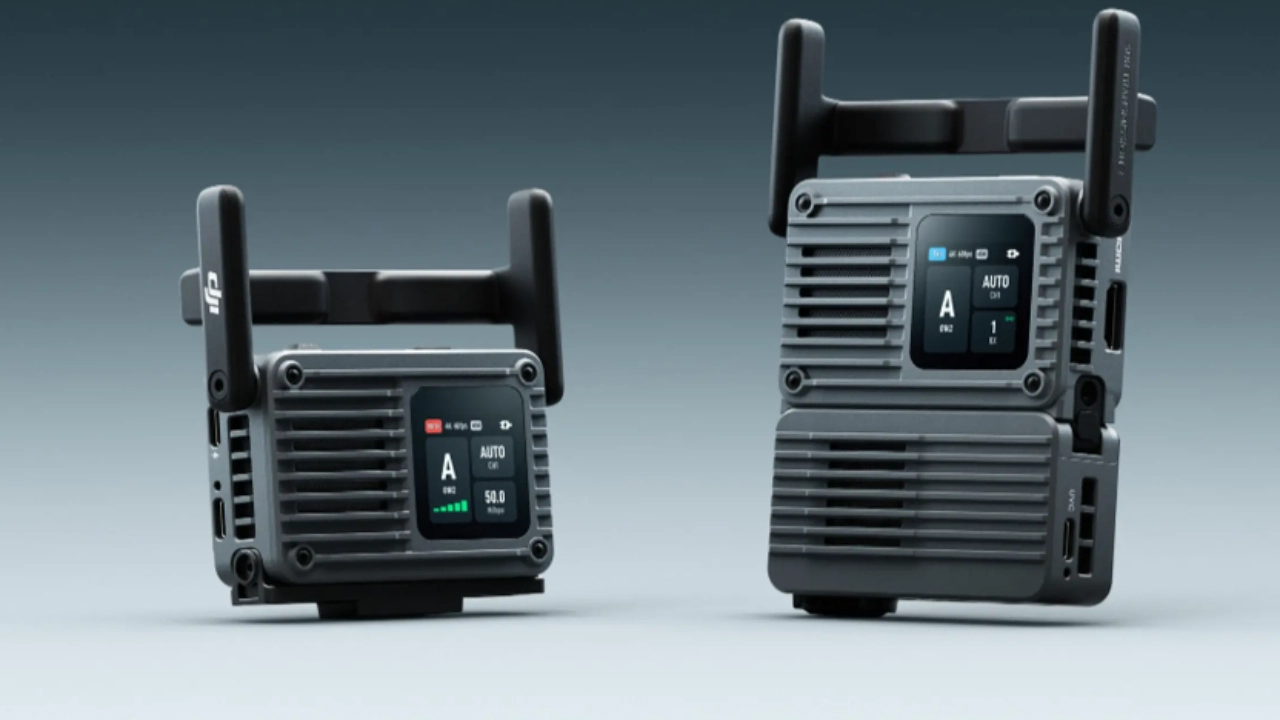
DJI SDR Transmission 2: DJI’s new wireless video system brings DCI 4K/60fps HDR, 50Mbps maximum encoding bitrate, and up to 4km of transmission range under CE testing conditions, or 3km under FCC conditions, but its switchable transmitter-receiver design could make the biggest difference for small and medium production crews.
DJI has officially launched the SDR Transmission 2 internationally in supported markets on September 17, 2026, following its international debut at IBC 2026. The second-generation wireless video system is designed for small and medium-sized film and video productions, including commercials, documentaries, short films, and multi-camera live productions. On paper, the headline upgrades are straightforward: DCI 4K at 60fps, 10-bit HDR, H.265 transmission with a maximum encoding bitrate of up to 50Mbps, and a rated transmission range of up to 4km under CE conditions or 3km under FCC conditions, measured with one transmitter and one receiver in an open, unobstructed, and interference-free environment.
But the more interesting change is underneath those numbers. Every SDR Transmission 2 unit can operate as either a transmitter or a receiver.
The Biggest Change Is the Switchable TX/RX Design
One Set of Hardware Can Adapt to Different Productions
The first-generation DJI SDR Transmission used dedicated transmitter and receiver units, while SDR Transmission 2 introduces a single transceiver design that can perform either role. That gives production crews more freedom when configuring a shoot.
A one-camera production could use one unit as a transmitter and several as receivers for a director, client or focus-pulling team. A multi-camera shoot could instead configure multiple units as transmitters and distribute the remaining units to monitoring positions. DJI says one transmitter can connect to up to eight receivers, with each receiver supporting remote control, while up to five transmitters and 40 receivers can operate simultaneously as part of the system’s supported multi-group operating limit.
For independent filmmakers, rental houses, wedding and event teams, documentaries and commercial productions, this means the same hardware inventory can be reorganized around different shoots instead of requiring a fixed ratio of dedicated TX and RX units. That flexibility may prove more valuable on set than the jump in headline specifications.
4K60 HDR and 50Mbps Push Wireless Monitoring Further
SDR Transmission 2 supports DCI 4K/60fps, 10-bit HDR and H.265 transmission with a maximum encoding bitrate of up to 50Mbps. That represents a substantial increase over the first-generation SDR Transmission, which topped out at 1080p/60fps and 20Mbps. The 50Mbps figure is a maximum encoding bitrate, however, and the actual bitrate can vary depending on the environment and transmission distance.
DCI 4K/60 HDR requires HDMI or DisplayPort/USB-C on the main transceiver, so the capability is not available through every connection path.
DJI retains the same 35ms minimum transmission-latency claim as the first generation. DJI measures that figure excluding latency introduced by the camera and display, with the measurement covering 1080p/60 and 4K/60 video. Similarly, the transmission range is a rated maximum under specific testing conditions rather than a guarantee for every production environment. DJI specifies up to 4km under CE conditions and 3km under FCC conditions, measured with one transmitter and one receiver in an open, unobstructed and interference-free environment. So the second-generation upgrade is less about dramatically reducing latency and more about combining higher image quality with greater flexibility.
Auto Channel 2.0 Makes Multi-Camera Setups More Practical
The SDR Transmission 2 is also designed to handle more complicated wireless environments. DJI’s Auto Channel 2.0 is intended to help manage wireless channels when multiple transmission systems are operating in the same area. In Auto mode, the transceivers recognize one another, coordinate frequencies, scan spectrum conditions and diagnose channel conflicts before hopping frequencies as needed. That becomes increasingly important as productions move from a single camera and monitor toward several cameras and multiple monitoring positions.
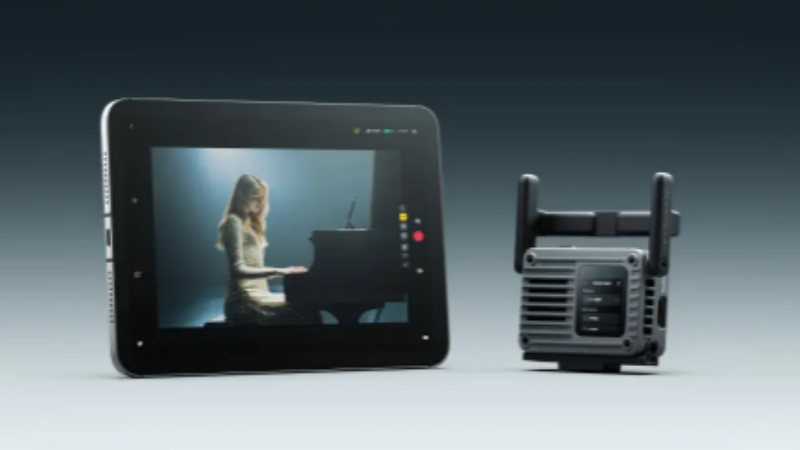
With up to five transmitters and 40 receivers supported simultaneously as part of the system’s multi-group operating limit, the system begins to function more like a small multi-camera monitoring network. The system also supports smartphone and tablet monitoring: a phone or tablet connects to a receiver/transceiver operating in RX mode via a USB-C or Lightning cable and the DJI Ronin app.
Separately, DJI’s Ronin ecosystem supports compatible gimbal-control workflows. The compatible list includes RS 5, RS 4 Pro, RS 4, RS 3 Pro, Ronin 2, and Master Wheels, with additional cables required for some setups. Master Wheels is primarily used for compatible gimbal control and record start/stop, rather than serving as a general monitoring feature.
There Is One Important SDI Limitation
The SDR Transmission 2 supports HDMI connectivity, while professional users can add SDI through DJI’s optional Expansion Plate. However, there is an important distinction: the Expansion Plate does not support any 4K input or output. DJI’s own support documentation confirms that DCI 4K and 4K UHD signals are supported by the main transceiver through its supported connections, while the Expansion Plate is limited to lower-resolution operation.
That means the headline 4K capability should not be interpreted as 4K support across every connection. This is particularly important information for production crews working in SDI workflows.
How Much Does DJI SDR Transmission 2 Cost?
DJI’s Hong Kong pricing lists the single transceiver at HK$2,399, while the Combo costs HK$4,099. The Expansion Accessory Kit is priced at HK$1,159. These figures are specific to Hong Kong and should not be treated as global pricing.
For the international launch in supported European markets, DJI lists the single unit at £309 / from €349, while the Combo is priced at £559 / from €629. Regional availability and pricing can differ.
The second-generation system also cannot cross-connect with the original DJI SDR Transmission or other DJI video-transmission products, making it a separate hardware generation rather than a directly compatible expansion of an existing SDR Transmission setup.
A Bigger Workflow Change Than a Specification Upgrade
The SDR Transmission 2 certainly delivers the specification jump filmmakers will notice: DCI 4K/60fps, 10-bit HDR and up to 50Mbps maximum encoding bitrate, alongside a rated transmission range of up to 4km under CE conditions or 3km under FCC conditions. However, the most convenient advance of the SDR Transmission 2 could be in its capability to use any unit both as a transmitter and receiver.
Instead of purchasing and managing separate TX and RX inventories, smaller production teams can configure the same hardware differently from one shoot to the next. Add support for up to eight receivers from one transmitter, multi-transmitter operation within DJI’s supported multi-group limit of five transmitters and 40 receivers, Auto Channel 2.0 and mobile monitoring, and DJI is positioning SDR Transmission 2 as more than a longer-range wireless video link.
The 4K60 HDR, 50Mbps encoding bitrate and longer transmission range are specification upgrades. The TX/RX-switchable architecture and multi-group scalability represent the bigger workflow changes, giving smaller crews a more flexible way to build a wireless production setup — and that may be the upgrade that matters most.
(Source)