

While many people fear that fruits are sweet and so can harm the body, and some with diabetes or fatty liver disease even avoid them completely, Dr. Tsai Ming-Chieh says fruit is not a “killer” that damages health, according to Taiwan media SET.
The key lies in how much to eat and how, he says. On his social media page, he lists eight common misconceptions that many still believe:
Drinking 100% fruit juice is the same as eating fruit
Tsai says the juicing process removes most of the fiber from fruit. As a result, sugar is absorbed much faster into the body, causing blood sugar levels to rise and fall like a roller coaster. While eating two oranges might make you feel full, a single glass of orange juice require at least five oranges.
Eating fruit in the morning is ‘gold,’ eating it at night is ‘trash’
For healthy people, the timing of fruit consumption is not the deciding factor. What matters most is the total amount consumed throughout the day. He advises people to remember the simple rule of “eating one serving of fruit about the size of your fist each time, twice a day” to not exceed the safe amount.
Eating fruit causes fatty liver disease
Only excessive fruit consumption can contribute to fatty liver disease. On the contrary, eating a reasonable amount may help prevent the condition. The fiber and antioxidants found in fruit can help protect the liver when consumed in appropriate amounts.
Eating fruit causes diabetes
Again, while eating too much might increase the risk of the disease, moderate consumption could well prevent diabetes. Many major studies have shown that people who regularly eat an appropriate amount of fresh fruit have a significantly lower risk of developing type 2 diabetes than those who do not eat fruit at all.
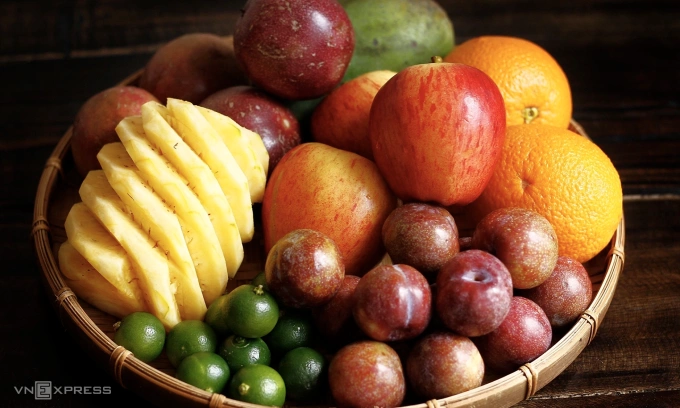
Experts say all fruits can be part of a healthy diet when consumed in appropriate portions. Photo by Bui Thuy |
Fruit contains fructose, and fructose is harmful
The type of sugar that is truly harmful is high-fructose corn syrup added to processed products. When evaluating fruit, people should consider its overall composition, including fiber and water, both of which are highly beneficial to health.
Natural, whole foods should not be equated with refined syrups commonly found in bubble tea and industrially produced beverages.
The sweeter the fruit, the higher its sugar content
Sweetness does not necessarily reflect sugar content.The sweetness of fruit is influenced by organic acids, water content, and the ratio of fructose, sucrose, and glucose.
Some fruits may not taste sweet despite containing high amounts of sugar. Conversely, some might taste very sweet but have a relatively low sugar content because of their high water content.
People concerned about blood sugar can only eat less-sweet fruits
Even among different types of fruit, as long as portion sizes are properly controlled, total sugar intake will not exceed dangerous levels. In medical research, experts generally focus on the quantity consumed rather than the specific type of fruit.
Eating more than 100 grams of fruit will stop the body from burning fat
The human metabolic system is an extremely complex and dynamic process, not a simple on-and-off switch. What stops your body from burning its own fat is definitely not that 100 grams of fruit. It is the large, sugar-filled bubble tea you just drank or the plate of fried chicken you ate as a late-night meal.
Regardless of where fruit comes from, it can be part of a healthy diet as long as portions are controlled. People should stop stigmatizing fruit and treating it like “poison.” A balanced diet and moderate consumption remain the best way to maintain a healthy body.
Comments are closed.