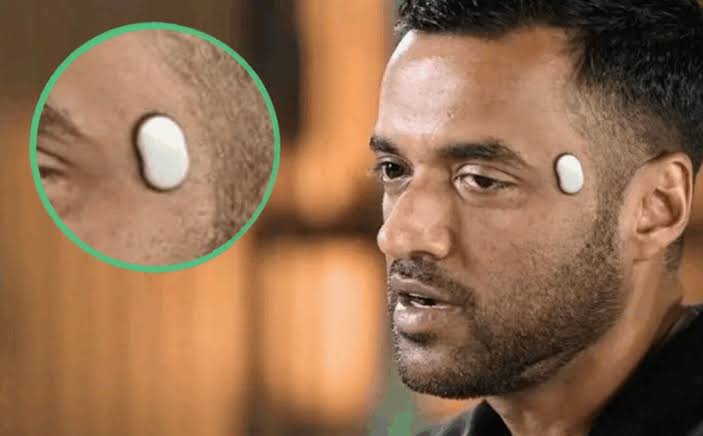
Deepinder Goyal, co-founder of Zomato, is facing questions from medical professionals over the scientific claims behind his latest venture, Temple. The company’s forehead-worn wearable device, priced at Rs 85,000, claims to monitor physiological signals associated with brain blood flow and provide insights into ageing and overall health.
While Goyal has defended the technology and cited internal research, doctors have questioned whether the device can accurately measure cerebral blood flow and whether its proprietary health metrics have sufficient scientific validation.
What Is Deepinder Goyal’s Temple Wearable?
Temple is a wearable device designed to continuously monitor physiological signals using optical sensors positioned near the temples. It focuses on two proprietary measurements: BrainFlow and Entropy.
BrainFlow is intended to track changes in blood circulation associated with the brain. Entropy is a metric developed by the company to indicate how hard the body is working to sustain itself under different conditions, including exercise, stress, sleep and meditation.
The company positions Entropy as its primary feature and believes the measurement could offer users insights into their physiological condition.
Temple opened pre-orders in India on November 1 at Rs 85,000. Deliveries are expected to begin approximately three months after ordering. The device is being positioned as a wellness and research product rather than a medical diagnostic device.
Why Are Doctors Questioning Temple’s Technology?
One of the main concerns relates to the device’s ability to measure blood flow inside the brain using sensors placed on the forehead.
Temple uses photoplethysmography (PPG), an optical sensing technology that detects changes in blood volume. However, doctors point out that the superficial temporal artery, located near the sensor, supplies blood to the scalp and face. The brain receives its primary blood supply through the internal carotid and vertebral arteries.
Medical professionals argue that changes in blood flow near the scalp do not necessarily represent changes in cerebral circulation.
Doctors have also questioned whether a measurement taken at a single location can accurately represent blood circulation across different regions of the brain.
Questions Over the Entropy Metric
The company’s proprietary Entropy measurement has also attracted scrutiny. Doctors have questioned whether the metric represents a scientifically established biological parameter and whether it can reliably provide insights into metabolism, ageing or longevity.
They have called for greater transparency regarding the methodology used to calculate the score, its biological basis and its performance across different individuals.
Medical professionals have also highlighted that correlations between wearable readings and other physiological measurements do not automatically establish that a new metric accurately measures the health parameter it claims to represent.
Deepinder Goyal Defends the Science
Goyal has rejected allegations that Temple is misleading consumers and said the company has invested approximately $30 million in developing the technology, including $20 million of his personal funds.
He has cited company-funded research studies supporting the BrainFlow measurement and said the findings will be followed by peer-reviewed publications and independent validation.
Goyal has also offered to provide devices to qualified researchers for independent testing. He maintains that Temple is a wellness and fitness product, not a medical device, and that users can evaluate its performance after receiving it.
The company has also introduced a 14-day return policy, according to Goyal.
Independent Research Will Be Important
The debate surrounding Temple highlights the challenges involved in bringing new health-monitoring technologies to consumers. While wearable devices can track several physiological signals, establishing their accuracy and clinical usefulness requires independent research and validation.
For Temple, future studies will need to establish whether BrainFlow and Entropy provide reliable information beyond existing monitoring technologies and whether their measurements have meaningful applications for health and ageing research.
Summary
Deepinder Goyal’s Rs 85,000 Temple wearable is facing scientific scrutiny over its claims related to brain blood flow, ageing and physiological health. Doctors have questioned the accuracy of its optical sensors and the validation of its proprietary metrics. Goyal has defended the technology, citing internal research and promising independent studies. The debate now centres on whether further scientific evidence can establish its claimed capabilities.