
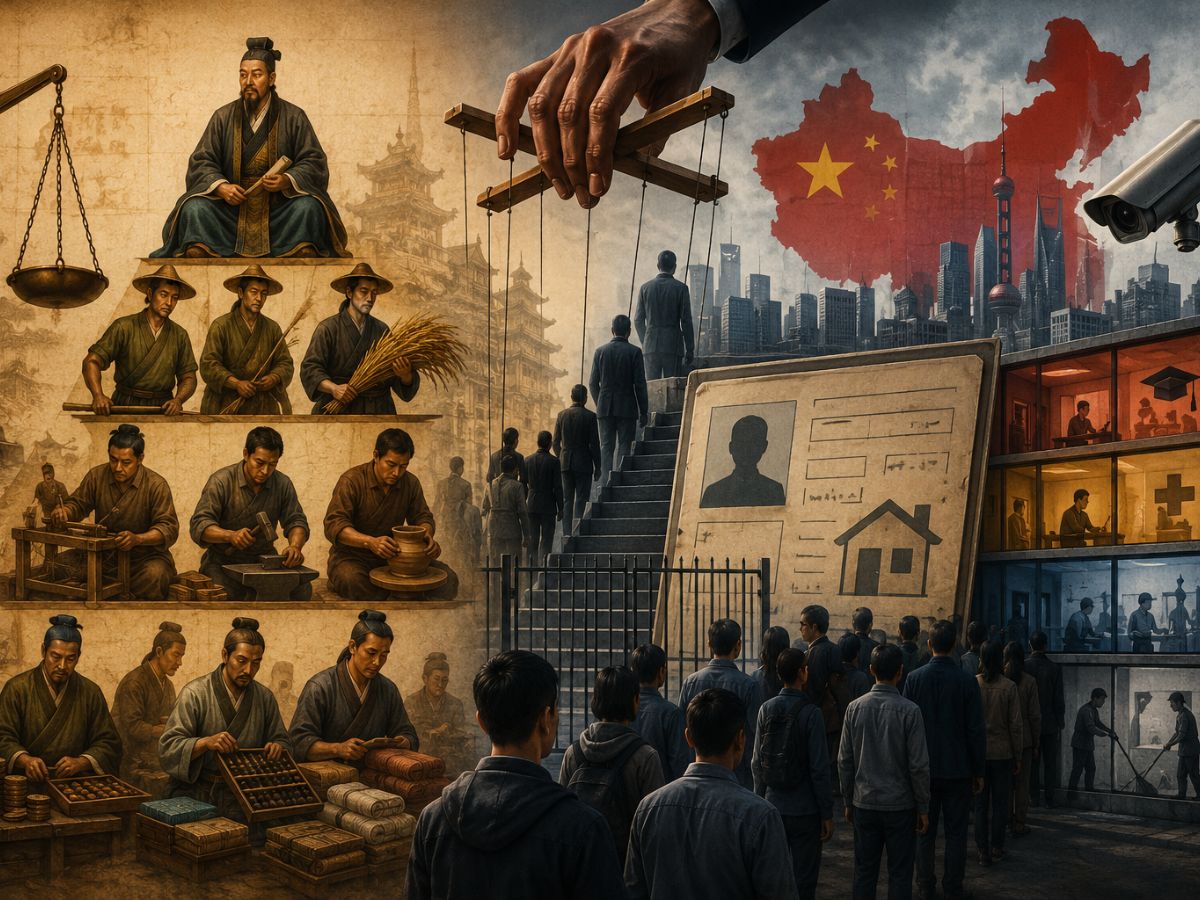
Does China Have Its Own Caste System? Social Media Is Comparing Beijing’s Hukou, Shi-Nong-Gong-Shang With India

Social media is discussing an unusual thing about India’s eastern neighbor, China. Not its economy. Not the manufacturing Beijing possesses. Not even the repressive Communist regime of Xi Jinping. The Indian social media users are seeking answers to the question that does China has a caste system like India. The debate gained traction on and Redditt after users compared the social structure of the two countries. Users claim that the individual opportunities in China are not shaped on merit but by birth. Observers point out the Hukou household system of China. It is a rigid social system in which access to education, employment, healthcare, state welfare doles, and social and economic benefits are determined based on the inherited hierarchy.
Comparing Chinese Hukou System With India’s Caste System
Over the last week, Indian social media was flooded with posts that drew parallels between the Chinese hukou system and India’s caste system. Analysts pointed out how the people belonging to the upper levels of the system exploit and oppress the lower classes in China.
While comparing the two systems, some users argued that Chinese hukou is not a social institution like India’s caste system. They believe that it is an economic and administrative classification helping the government to deliver the social welfare programs. Unlike, India’s caste system is a social system which divides the whole society into four layers based on purity.
there’s a hilarious thing happening on India vs. China Twitter rn where Indians have convinced themselves that China has a caste system like India does but the caste system they’ve “discovered” is just a 3,000 year old list of occupations from imperial China.
and they’re trying… pic.twitter.com/jPt8dmyrf1
— pagliacci the hated 🌝 (@Slatzism) June 14, 2026
What Is Shi-Nong-Gong-Shang?
The social media discussion did not limit itself to the hukou system. Users pointed out the ancient Chinese social hierarchy system known as Shi-Nong-Gong-Shang. While the hokou is a modern administrative registration system for Chinese households, Shi-Nong-Gong-Shang belonged to imperial China, which is a social system unlike the former. It developed during the Zhou dynasty and the Warring States period. It was later formalised by Han dynasty historian Ban Gu in the Book of Han (111 CE). The society was divided on the basis of a hierarchy-based occupation system. People were divided into four groups, which included
Designation wise the senior guy is 3 levels higher than the young lad.. but the senior belongs to lower nong caste and junior to higher shi caste
Caste system in china is soo brutal to the way that even the military designations doesn’t matterpic.twitter.com/e53Xn0c4Ei
— HEISENBERG (@sudalai_twitz) June 19, 2026
Shi – scholars and officials – putting them on top of the social structure as the custodians of morality and governance.
Nong – farmers – they were put second in the line as farmers were considered important for the society.
Gong – artisans and craftsmen – they were given the third place in the social hierarchy for producing goods and tools.
Shang – merchants and traders were put last as the Chinese Confucian intellectuals despised profit-seeking.
Chinese mouthpiece Global Times on Friday reported on the debate, saying that Chinese commentators “believe the claim reflects the ignorance of some Indian netizens about Chinese historical culture.”
Also Read: Taiwan Accuses China of Pressuring Kenya to Block Taiwanese Experts From Attending Our Ocean Conference
Zubair Amin is a Senior Journalist at NewsX with over seven years of experience in reporting and editorial work. He has written for leading national and international publications, including Foreign Policy Magazine, Al Jazeera, The Economic Times, The Indian Express, The Wire, Article 14, Mongabay, News9, among others. His primary focus is on international affairs, with a strong interest in US politics and policy. He also writes on West Asia, Indian polity, and constitutional issues. Zubair tweets at zubaiyr.amin
The post Does China Have Its Own Caste System? Social Media Is Comparing Beijing’s Hukou, Shi-Nong-Gong-Shang With India appeared first on NewsX.

Comments are closed.