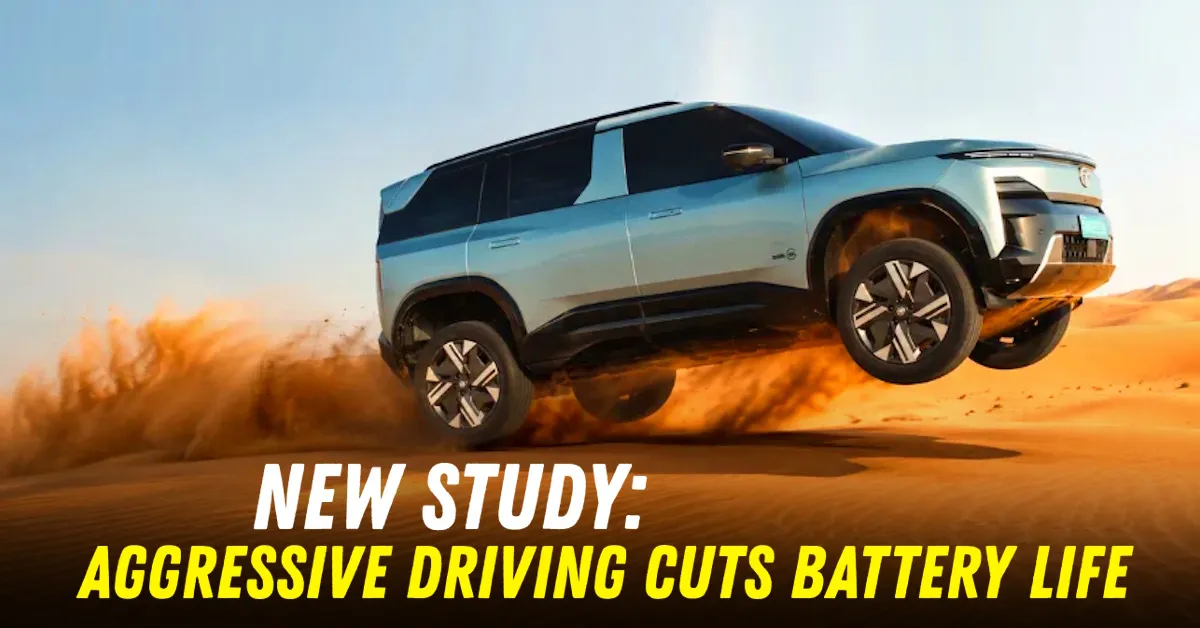
One of the attractions of an electric car is that there is no engine to nurse. No cold revving, no turbo cool-down and no mechanical gearbox taking repeated hard launches. That can create the impression that driving style matters mainly to range, not long-term life. A new study suggests the battery may care more about your right foot than we thought.
Researchers analysing one year of operating data from 15 battery-electric cars found a strong link between aggressive driving and predicted battery degradation. Their model estimated 53.22 per cent capacity fade after 1,000 equivalent cycles for the most aggressive driving style, versus 21.15 per cent for the most economical style.
That does not mean an aggressively driven EV will definitely lose half its battery capacity. The figures are model-based projections from a small dataset, not a 1,000-cycle road test of every EV chemistry. But the direction of the finding is difficult to ignore.
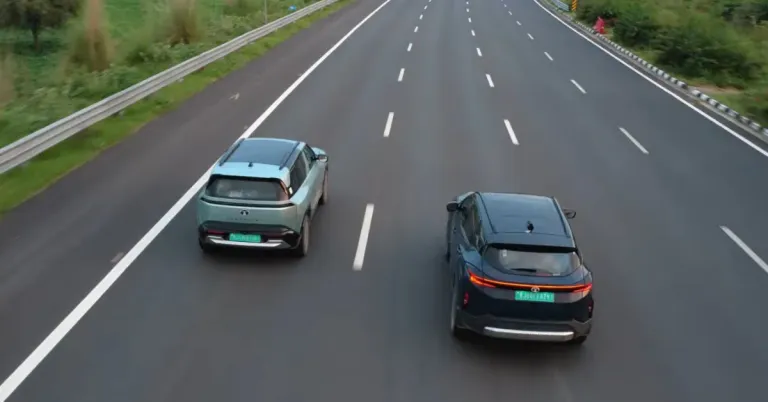
An EV produces its performance by pulling current from the battery. The harder the acceleration, the higher the power demand and, generally, the higher the discharge current.
In the study, the most aggressive group recorded an RMS battery current of 66.02 amps, compared with 20.56 amps for the economical group, despite broadly similar average speeds. Aggressive acceleration and deceleration created much larger current swings.
That matters because repeated high current and rapid fluctuations create additional electrochemical and thermal stress inside lithium-ion cells. Separate 2026 research using real vehicle load profiles has also found that higher-frequency power fluctuations accelerate capacity loss and increase internal resistance, with loss of active material at the anode identified as an important mechanism.
Rapid deceleration is part of the picture too. Regenerative braking sends energy back into the battery. Strong acceleration followed by strong regen therefore makes the battery repeatedly switch between substantial discharge and charge loads.
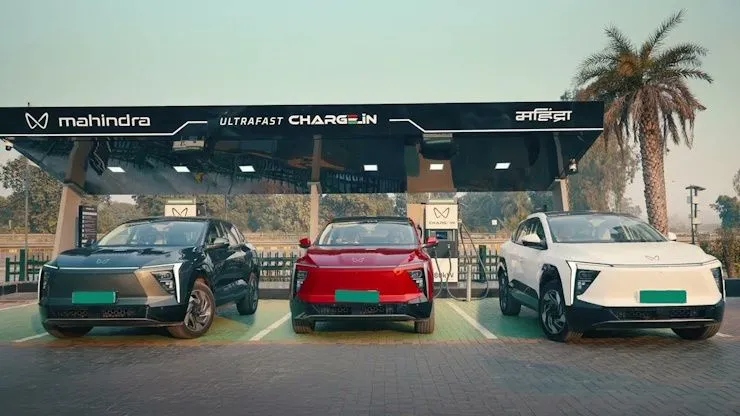
The finding is particularly relevant in a market where EVs routinely operate in high ambient temperatures and dense stop-go traffic. Heat is already a known battery-aging stressor. Add repeated full-throttle bursts, hard braking and frequent high-power DC charging, and an owner can stack several stresses together.
Modern battery-management and cooling systems are designed to control temperature and power, so this is not an argument for driving an EV timidly. It is an argument against making maximum acceleration an everyday habit.
The effect will also vary enormously by car. A small Tiago EV and a 200 kW-plus performance EV place very different demands on their packs. Battery chemistry matters too. LFP and nickel-based cells do not age identically, and manufacturers reserve different usable buffers and use different cooling strategies.
The useful advice is surprisingly similar to what good drivers have always done with petrol and diesel cars: accelerate smoothly when there is no reason to do otherwise, anticipate traffic and avoid unnecessary speed changes.
For an EV, that has an immediate benefit because it improves efficiency and range. This research suggests it could also have a long-term benefit by reducing battery stress.
Charging habits still matter. High state of charge for long periods, extreme temperatures and excessive fast charging can all contribute to degradation. Driving style is one more variable, not the only one.
There is another reason not to panic over the headline numbers. One thousand equivalent full cycles is a huge amount of use. For an EV delivering 300 km from a full usable cycle, that represents roughly 3,00,000 km of energy throughput.