
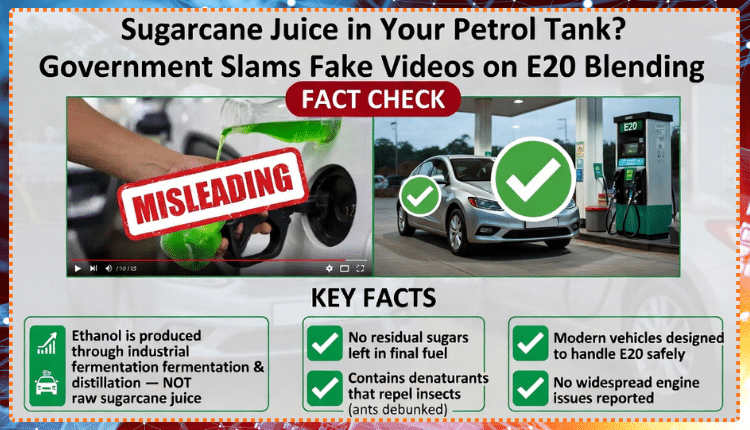

The Ministry of Petroleum and Natural Gas has come out strongly against a fresh wave of misleading videos and posts circulating on social media that are raising unnecessary fears about ethanol-blended petrol (E20).
In an official statement, the Ministry described the campaign as “sensationalism for viewership” and reassured citizens that the Ethanol Blending Programme is “scientifically validated and closely monitored” at every stage.
Launched in 2003 and scaled up to 20% ethanol blending (E20) from 2023, the programme has already saved India more than ₹1.4 lakh crore. in foreign exchange by reducing crude oil imports. It has also boosted farmer incomes by creating steady demand for sugarcane, maize, broken rice, and other agricultural feedstocks.
The Ministry directly addressed the most viral claims:
- Sugarcane juice in petrol? Completely false. Ethanol undergoes industrial fermentation, distillation, and rigorous quality testing. The final fuel bears no resemblance to raw sugarcane juice.
- Ants swarming fuel tanks? Debunked by Bharat Petroleum. Fuel-grade ethanol contains no residual sugars and includes denaturants that actually repel insects. There is no scientific basis for ants being attracted to E20.
- Water absorption damaging engines? Modern vehicles are designed with safeguards against water ingress for any fuel. No widespread engine failures or breakdowns linked to E20 have been reported since its introduction.
- Insurance invalidation? Also incorrect, as confirmed by stakeholders.
The government emphasised that higher ethanol blends are a global success story — Brazil runs on E27 as standard, while the US, Japan, and others have long embraced ethanol blending for energy security and lower emissions.
“Ethanol blending enhances India’s energy security, reduces carbon emissions, and supports the transition to cleaner mobility,” the Ministry stated, reaffirming its commitment to a safe, transparent, and consumer-friendly rollout backed by science and continuous stakeholder consultation.
As India pushes towards energy independence, the Ethanol Blending Programme stands as a win-win for farmers, the environment, and the economy — and the government is determined not to let misinformation derail it.
Comments are closed.