
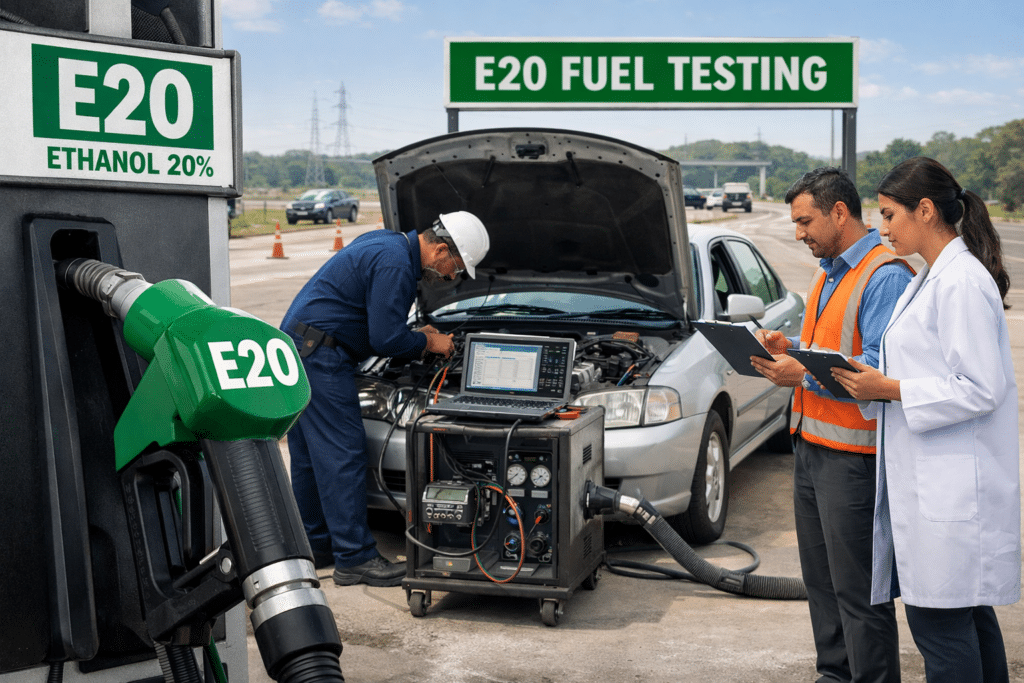

The Ministry of Petroleum and Natural Gas, along with the Ministry of Heavy Industries and the Ministry of Road Transport and Highways, organised a press conference in New Delhi, where leading experts from the energy and automobile sectors addressed the media on the E20 ethanol-blended petrol programme.
It was highlighted that ethanol blending has been a measured, scientifically driven, step-by-step process, and vehicle owners were reassured that E20 fuel poses no cause for concern.
The press conference was addressed by Ms. Vartika Shukla, Former Chairman and Managing Director, Engineers India Limited (EIL); Shri Vikram Gulati, Country Head & Executive Vice President, Toyota Kirloskar Motor (TKM); Shri Rahul Bharti, Senior Executive Officer, Corporate Affairs, Maruti Suzuki; Shri Ashutosh Varma, Chief Business Officer, Hero MotoCorp; Shri Prasad Krishnan, Senior Vice President, TVS Motor Company; Shri Puneet Anand, Associate Vice President, Hyundai Motor India; and Shri Manpreet Singh Bindra, Circle Head – Sales (North & East), Urbanite Business, Bajaj Auto Limited.
Shri Vikram Gulati, Country Head & Executive Vice President, Toyota Kirloskar Motor, said the automotive industry is among the most strongly regulated sectors, with vehicles undergoing rigorous testing and certification by independent, globally accredited agencies before and after market introduction. He described ethanol as a high-performance, clean fuel, in use since the early 1900s and even in Formula racing. He added that the decision to move to E20 was taken only after rigorous testing on older vehicles, and clarified that the recently launched E85 dispensing stations are meant exclusively for flex-fuel vehicles, marking the direction of future policy.
On questions regarding the independence of testing agencies, Shri Gulati clarified that testing protocols are not set in India alone; India is party to UNECE, testing procedures are internationally standardised, and testing agencies are accredited, globally compliant and also undertake testing for exported vehicles. He stated that these protocols cannot be compromised.
Shri Rahul Bharti, Senior Executive Officer, Corporate Affairs, Maruti Suzuki, gave a “statement of confidence” to customers, stating that vehicles designed for E10 have been tested with E20 fuel across all parameters, with no areas of concern. He informed that of the 2.84 crore cars serviced by Maruti Suzuki in FY 2025-26, more than 1.5 crore were over three years old and hence not E20-certified, and no E20-related issues of corrosion, wear and tear or damage to component life were reported from the field.
On mileage, Shri Bharti stated that the calorific value of E20 is lower than that of E10 by about 3 to 3.5 per cent, and the mileage impact is limited to this extent. Illustrating, he said that for a car giving 20 km per litre, the impact works out to roughly 0.6 km per litre, whereas factors such as tyre pressure, driving pattern, correct gear usage, acceleration, braking and maintenance cause far greater variation in mileage. This loss in mileage is more than compensated by better acceleration, better anti-knocking and far lesser pollution in case of ethanol against pure petrol.
He clarified that vehicles are designed with factors of safety well beyond E20 compliance, and that no retrofitment kit is being offered in the market, with such solutions confined to R&D at present.
Ms Vartika Shukla, Former Chairman and Managing Director, Engineers India Limited (EIL), said that the ethanol blending programme was structured through deliberation with all stakeholders and is supported by scientific evidence and extensive testing by automotive manufacturers, in line with global best practices. She noted that E20 fuel conforms to the BIS standard and BS-VI emission norms and is uniformly available across retail outlets in the country. She added that several countries have used ethanol blends for many years.
Shri Ashutosh Varma, Chief Business Officer, Hero MotoCorp, said that as one of the world’s largest two-wheeler manufacturers, the company has analysed extensive service data and found no incidence of higher damage in vehicles running on E20 compared to earlier fuels.
The panel concluded by reaffirming the industry’s collective confidence in the E20 programme and its commitment to addressing consumer queries with transparency.
E20 Ethanol Blending: 10 Viral Myths Debunked – The Real Story Behind India’s Fuel Revolution
Comments are closed.