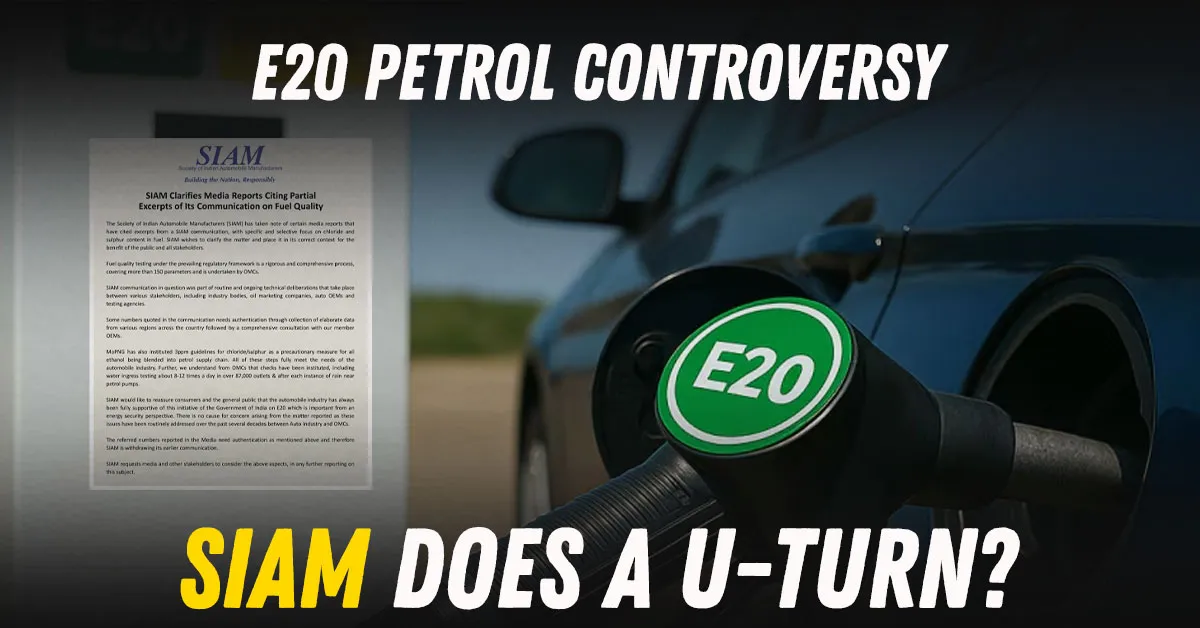
Debates surrounding the nation-wide rollout of E20 (20% ethanol-blended) petrol are still ongoing in India. A recent CNBC report had shed light on how the Society of Indian Automobile Manufacturers (SIAM) flagged serious quality issues with E20 fuel, in one of its official communications. The body has now come up with a clarification on the same, and has in effect, withdrawn the previous statement.
The newest communication from SIAM states that it has taken note of certain media reports citing excerpts from one of its recent official communications. These reports, it says, has a specific and selective focus on Chloride and Sulphur content in fuel. The clarification note intends to place this in its correct context.
The note states that fuel quality testing is a rigorous and comprehensive process, under the prevailing regulatory framework. This process covers more than 150 parameters and is undertaken by oil marketing companies. It then states that the previous communication ‘was part of routine and ongoing technical deliberations that take place between various stakeholders’. These include industry bodies, oil marketing companies, automakers and testing agencies.
The clarification note also mentions that some numbers quoted in the communication need authentication through collection of elaborate data from various regions, and a comprehensive consultation with member OEMs.
As for the Chloride and Sulphur content, the Ministry of Petroleum and Natural Gas has instituted 3ppm guidelines as a precautionary measure. These steps, the not says, fully meet the needs of the auto industry. Additionally, oil marketing companies has been instituting checks including water ingress tests 8-12 times a day in over 87,000 outlets and after each instance of rain near bunks.
It then says that the automobile industry has always been fully supportive of the government’s E20 initiative, and that there is no cause of concern. In its latest communication, SIAM has officially withdrawn its previous statement, saying that the numbers quoted need authentication.
CNBC has now taken down the original story. According to the original report, SIAM had raised serious concerns about the quality of E20 petrol in India. The body allegedly highlighted contamination issues. This conflicts with how the government and automakers are promoting ethanol-blended petrol as safe-to-use fuel. SIAM’s communication reportedly pointed to rising cases of component failures linked to poor fuel quality, especially due to chloride and moisture contamination.
The body backed these concerns with technical observations in its communication. According to reports, it noted a clear increase in vehicle component failures that are directly linked to fuel quality issues. One of the most serious issued flagged was high chloride contamination in E20 petrol. Components like fuel injectors, fuel pumps, EGR valves, and exhaust system parts were being affected. All these come into direct contact with fuel or emissions, and are thus highly sensitive to contamination.
SIAM’s field investigations reportedly found that this damage is largely due to corrosion and wear caused by chloride presence. The communication even had numbers for sampled chloride levels. The industry body reportedly noted that such levels have increased significantly after the nationwide introduction of E20 petrol. Chloride contamination can lead to both immediate failures and long-term damage. In its now-withdrawn communication, SIAM also recommended strict limits for chloride content.
Excessive moisture content was cited as another major problem. This could lead to phase separation and make the fuel contaminated and useless. Phase separation is the process in which the ethanol in E20 petrol separates from the blend and binds with water molecules forming a separate ethanol-water layer, at the bottom of the tank. This, if drawn into the engine, can cause poor performance and vehicle breakdowns.
In the communication, SIAM reportedly urged authorities to identify the root cause of both moisture and chloride contamination, and asked for stronger quality checks at petrol bunks.
The real worry in SIAM’s previous communication is not the levels of Chloride or Sulphur but the rising number of part replacements, after the nationwide E20 implementation. The sudden increase in warranty replacements/repairs means that something is off. Something has changed.
Since the only big change is the implementation of E20 petrol policy, it could be the E20 petrol itself of contamination linked to E20 in some way, that could be causing the issue. The poor quality and contamination is mostly likely the cause, as has been reported in many recent cases. Infrastructure limitations in safely storing and dispensing E20 fuel in rainy season remains a major worry.