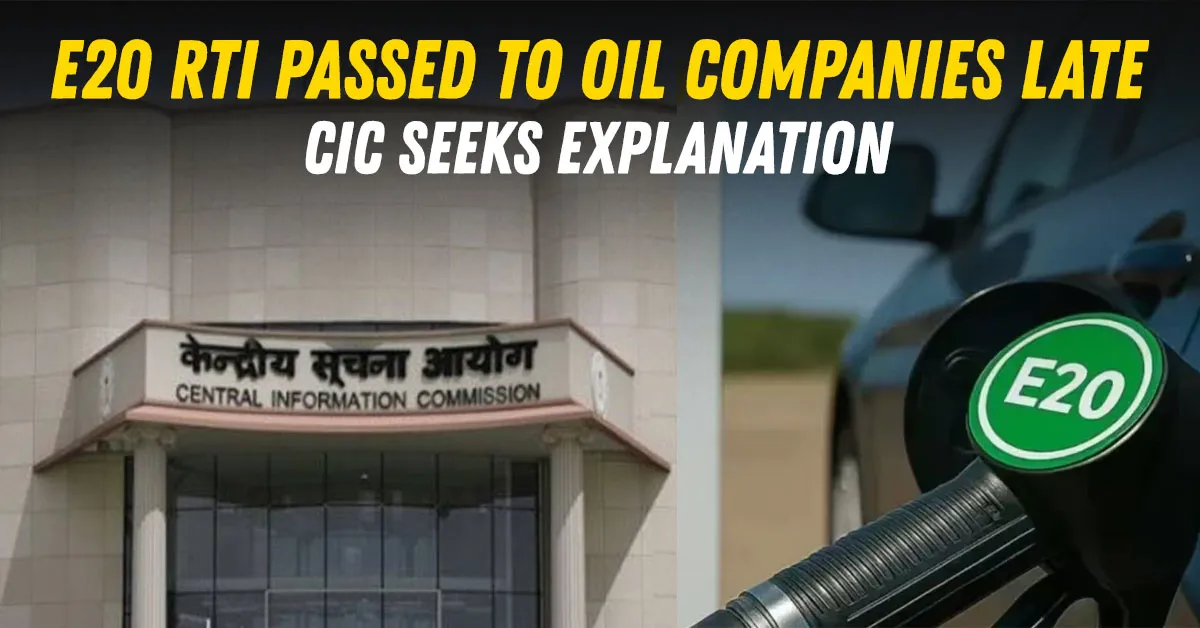
The Central Information Commission (CIC) has asked a Petroleum Ministry public information officer to explain why an RTI application containing detailed questions on ethanol-blended petrol was not transferred to the oil marketing companies within the five-day limit required by law. The order does not rule on whether E20 is safe or unsafe. It deals with how the information request was handled.
The RTI was filed on August 11, 2025 by Manoj K. Sharma. It asked when oil companies began blending ethanol into petrol, the percentage and volume being mixed, whether the blend varied between pumps or cities, and what rules governed any such variation. It also asked how customers were informed about the ethanol content of the fuel they were purchasing.
The application went further. It sought scientific and independent evidence behind the blending policy, including material relating to the compatibility of ethanol-blended petrol with cars manufactured between 2010 and 2025. That makes the information request directly relevant to concerns that have repeatedly surfaced among owners of older petrol vehicles as E20 became the normal nationwide fuel grade.
The Ministry ultimately transferred Points 1 to 6 of the RTI to Indian Oil, Bharat Petroleum and Hindustan Petroleum because it said those companies held the requested information. For Point 7, it supplied a web link to the Roadmap for Ethanol Blending in India 2020-25.
The first appellate authority had found that the Ministry responded on August 27, 2025, which was within the general 30-day period for an RTI response. The CIC looked at a narrower issue. Section 6(3) of the RTI Act says that when information is held by another public authority, the relevant part of an application must be transferred as soon as practicable and in no case later than five days after receipt.
The Commission found that the then CPIO had not met that transfer deadline. During the hearing, the Ministry cited its move from Shastri Bhavan to Kartavya Bhavan, technical difficulties in shifting computers and the ongoing Parliament session as reasons for the delay.
Information Commissioner Khushwant Singh Sethi directed the concerned CPIO to submit a detailed written explanation for the delay. It must be sent to the Commission and uploaded to its compliance portal within 15 days of receiving the order. The complaint was then disposed of.
A separate appeal concerning the same RTI had already been heard by the CIC on August 31, 2026. The September 7 order therefore focuses specifically on the Ministry’s handling of the transfer rather than reopening every substantive ethanol question.
That distinction matters because the government has already stated that average ethanol blending reached 20 percent in the current ethanol supply year. Official data shows the programme moved from about 12 percent in 2022-23 to 14.6 percent in 2023-24, around 19.2 percent in 2024-25 and 20 percent in 2025-26. The government has also said no decision has been taken to raise the nationwide standard beyond E20.
The RTI questions themselves show why pump-level information remains relevant. Owners may know that E20 is the national standard, but the applicant specifically asked whether the actual quantity could vary across locations, how petrol-pump staff were educated about ethanol content and what disclosure customers should receive at the point of sale.
The CIC has not answered those questions in this order, nor has it rejected the government’s technical case for E20. What it has done is hold the Ministry to the transfer timetable written into the RTI Act.