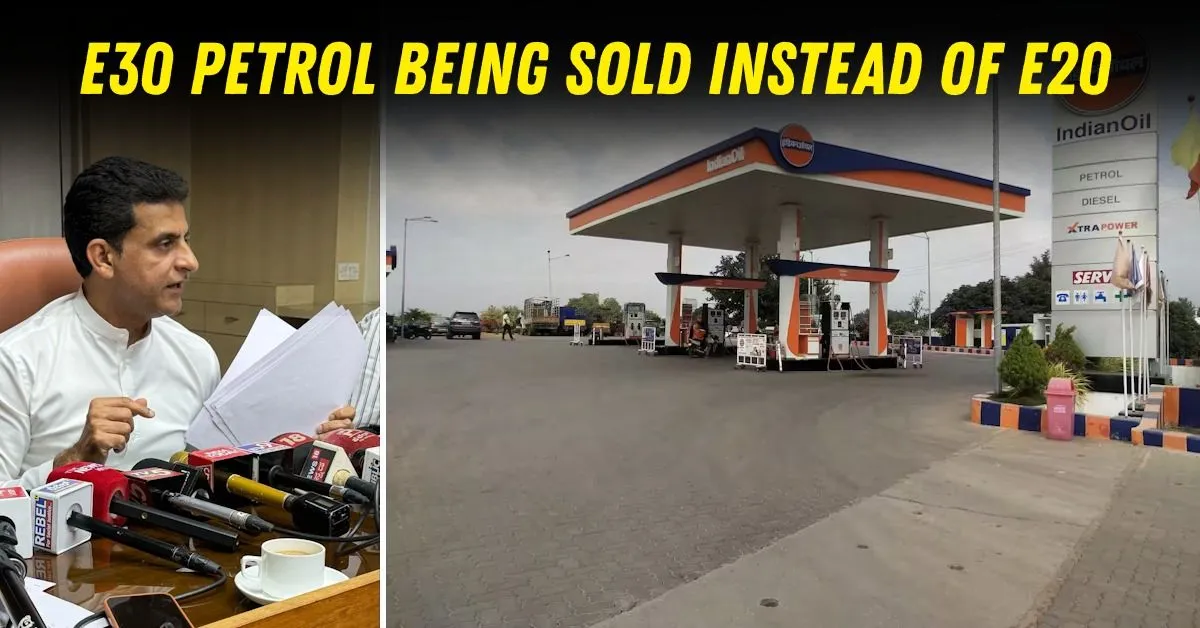
Ethanol blending was one of the major issues that many motorists were, and still are, facing in India. Many people have shared their concerns about ethanol blending and the lack of transparency in this process. The Karnataka government recently conducted an inspection to test ethanol blending levels in petrol, and the results were actually shocking. The test results showed that the petrol being sold to customers had ethanol blends higher than 20 percent, with the highest level recorded being 31.2 percent.
Rizwan Arshad, Minister for Food, Civil Supplies & Consumer Affairs, Karnataka, revealed the results of the tests during a press conference. The minister had recently posted on his social media page about the initiative, where the government, for the first time, decided to collect samples from multiple petrol pumps and conduct tests.
During the press conference, Minister Rizwan Arshad shared the findings. He said that out of 805 petrol pumps inspected across the state by the Legal Metrology Department, 748 outlets were found to have failed accuracy checks, with dispensing units showing short delivery or calibration deviations.
While minor variations within narrow limits received warnings and recalibration notices, 101 petrol stations were booked under the Legal Metrology Act for severe, intentional under-dispensing that far exceeded permissible limits. The government collected fines worth Rs 6.66 lakh from these petrol pumps during the initial phase of the inspection.
Apart from the accuracy checks, the government also tested samples from multiple petrol pumps, and the tests revealed irregularities in blending and quality standards, including samples where the ethanol content was way above the prescribed limits. This pointed towards irregular blending ratios, improper storage, or phase separation issues at the retail end rather than standard, uniform E20 fuel delivery.
The highest ethanol blend that the authorities found in the samples was as high as 31.2 percent. This is actually a shocking result, as earlier tests conducted by petroleum companies had shown different results and assured that ethanol blending in the samples they tested was well within the legal limits.

During the press conference, Rizwan Arshad raised strong objections to the central government’s moves proposing biennial or private agency verification of fuel dispensers, arguing that state-run, unannounced inspections are essential to prevent consumer fraud and fuel adulteration. This would actually force outlets to maintain fuel quality and decrease the chances of adulteration.
He also added that the findings point towards serious violations of consumer rights, as customers are not getting the correct quantity of fuel for the price they are paying. It also raises concerns related to vehicle safety, as most older vehicles and engines are not compliant with higher ethanol blends. This could lead to accelerated wear of rubber and plastic parts, fuel pumps, corrosion of fuel lines, and reduced mileage.
The government has now asked all petrol pumps to display official calibration certificates and a public toll-free grievance helpline number, 1800 599 100. It has also announced plans for a public online dashboard detailing the compliance and calibration status of over 5,900 fuel stations operating in Karnataka.
A few months ago, there was a report from SIAM in which it had flagged serious quality issues with E20 fuel. SIAM specifically flagged high chloride and moisture contamination in E20 fuel. It urged the government to tighten fuel quality standards, introduce mandatory chloride limits in fuel specifications, and strengthen quality checks at petrol pumps. The report was later taken down for multiple reasons.