
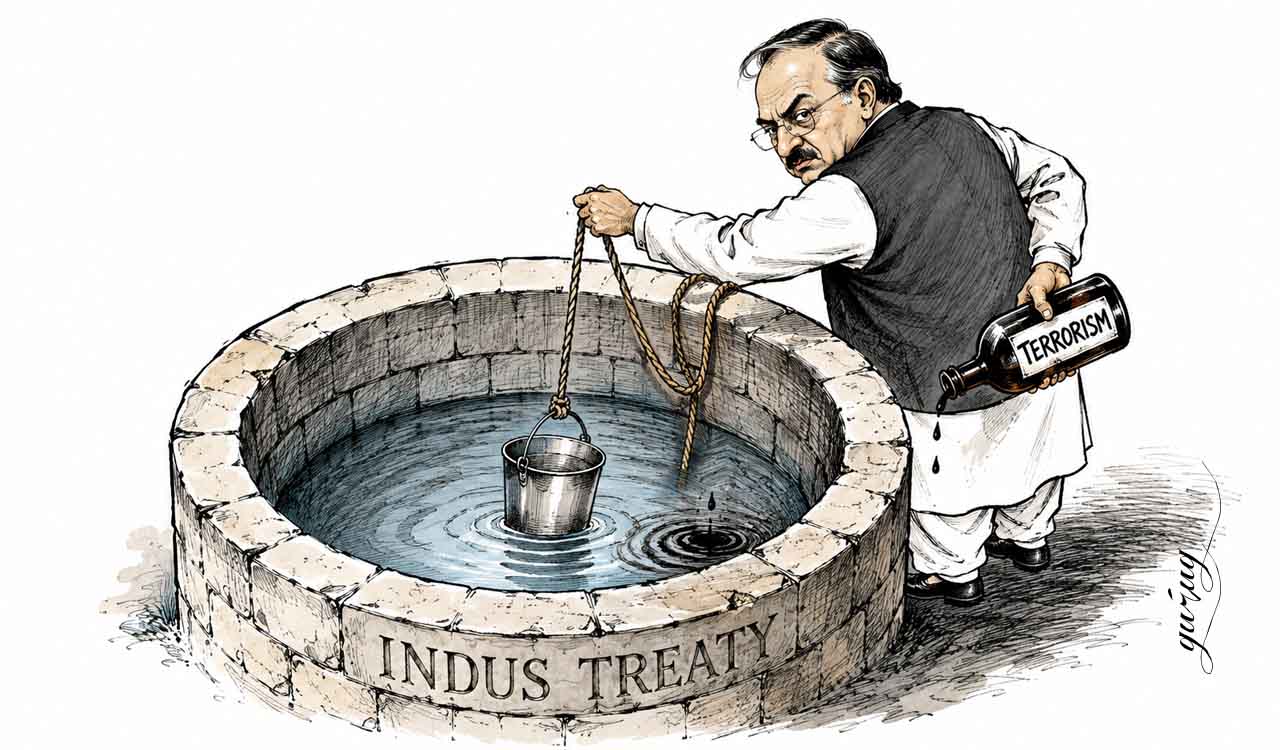

Instead of issuing threats, Musadik Malik should reflect on why India suspended the Indus Waters Treaty and on Pakistan’s own actions
Published Date – 9 July 2026, 10:57 PM
Illustration: GuruG
Pakistani Minister Musadik Malik’s threat to ‘cut off the hands’ of anyone interfering with his country’s share of Indus waters is just an empty bravado born out of his monumental ignorance of the ground realities. Instead of resorting to unprovoked aggression, Malik would be well advised to reflect on the reasons that prompted India to keep the decades-old Indus Water Treaty (IWT) in abeyance and why Islamabad can no longer hoodwink the international community by playing the victim card. India suspended the treaty following a cross-border targeted terrorist strike in Jammu & Kashmir’s Pahalgam last year that killed 26 civilians. New Delhi has firmly maintained that the water-sharing pact will remain suspended until Islamabad demonstrates verifiable action to dismantle the state-sponsored infrastructure of cross-border terrorism operating from its soil. The treaty, brokered by the World Bank, has governed the distribution and use of the Indus River and its tributaries between India and Pakistan since 1960. India’s argument is straightforward: a treaty signed more than six decades ago in a spirit of goodwill cannot be treated as sacrosanct by one party while the other party’s territory is repeatedly used to export terrorism against it. Holding the IWT in abeyance was framed not as an act of aggression but as the withdrawal of one of the few remaining goodwill gestures India was still extending to Pakistan despite its diabolic record. New Delhi has justifiably labelled the treaty as ‘one-sided’ and suggested that various provisions need reassessment.
Beyond the immediate terrorism trigger, analysts point to structural reasons why the treaty needs a fundamental review, not just a pause. It allocates water based on hydrological conditions prevailing in the 1960s. Glacial melt, erratic monsoons, and increasing flood-and-drought volatility in the Himalayan catchment were never anticipated. A framework locked into rigid, decades-old technical parameters cannot manage a river system that is behaving differently today. The Indus system of rivers comprises three Eastern Rivers — Ravi, Beas, and Sutlej and their tributaries — and three Western Rivers — Indus, Jhelum, and Chenab and their tributaries. As per the treaty, India controls about 20% of the total waters of the Indus system, while Pakistan gets about 80%. It is argued that the treaty is unfair to India, given the country’s larger geographical area, population, and growing water needs. Also, given the political and military tensions between New Delhi and Islamabad, some analysts argue that the treaty gives Pakistan a strategic advantage over India. They claim that India should have more leverage over the western rivers, particularly in times of conflict or heightened tensions. New Delhi had already sought formal modification of the treaty in 2023, citing Pakistan’s persistent objections to India taking up the routine hydropower projects. Moreover, a treaty of pure water-sharing cannot be separated from the security environment in which it operates. Goodwill agreements presume goodwill from the other party. But Pakistan has betrayed the spirit of the treaty by exporting terrorism to India.

Comments are closed.