It may seem unusual that India, a country where hundreds of millions of citizens lacked access to formal banking as recently as 15 years ago, could build a payment infrastructure that many of the world’s wealthiest economies have yet to match
Published Date – 9 September 2026, 11:38 PM
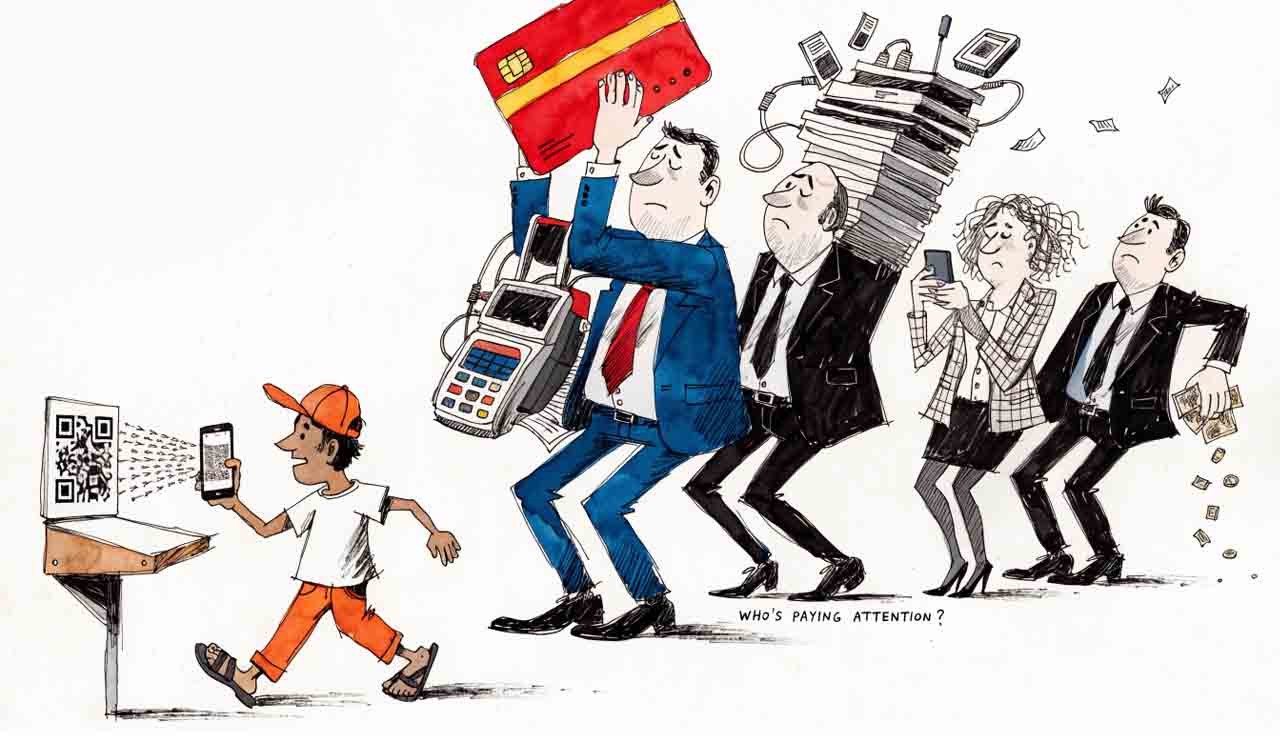
Illustration: GuruG
The story of global online payment systems presents a strange paradox. Developed countries such as the United States, Britain, and France lag behind a developing country like India in adopting digital payment methods. A country that was once highly cash-dependent has overtaken many wealthy, advanced nations in adopting instant, mobile-based payments. Ironically, the US invented the internet and gave the world the credit card, with its financial institutions dominating global capital markets. The UK, on the other hand, is the hub for the global financial world. But it does not have anything remotely resembling India’s Unified Payments Interface (UPI). More importantly, India is not merely using more cards or more internet banking; it has created an interoperable, real-time payments infrastructure that has fundamentally changed how ordinary people transact. The ubiquitous presence of QR code scanners across the country—from small street vendors to large retailers—tells the story of the country’s digital transformation. The widespread adoption is driven by the simplicity, affordability, and adaptability of QR codes, making them a convenient tool for both businesses and consumers. India is now ranked number one globally in real-time payment transaction volume, accounting for nearly half of all real-time digital payments in the world. In August 2026, UPI processed 24.51 billion transactions worth Rs 29.82 lakh crore, according to the National Payments Corporation of India (NPCI).
What began as an experiment in making Indian retail payments cheaper and interoperable has become one of India’s most important pieces of digital infrastructure. In contrast, American payments remain structurally expensive, institutionally fragmented, and deeply dependent on card networks. The United States does not have a single regulatory body equivalent to India’s Reserve Bank-NPCI institutional architecture that could mandate interoperability and drive adoption across thousands of financial institutions simultaneously. Cash is still king in Germany, which is Europe’s largest economy and home to world-class engineering and manufacturing companies. Digital wallet adoption has been slower in France, Britain, and Nordic countries. It may seem unusual that India, a country with hundreds of millions of citizens without formal banking access as recently as 15 years ago, could build a payment infrastructure that the world’s wealthiest economies have yet to match. A key reason for this success was the creation of NPCI as a dedicated and focused entity under RBI oversight with a specific mandate of building interoperable retail payment infrastructure. American, British, French, and German payment regulation is divided among multiple bodies with overlapping jurisdictions and competing priorities. While digital adoption is a big success story for India, several challenges remain. Among them are the rural-urban and gender digital divides, cybersecurity and data-privacy enforcement, welfare-authentication exclusion errors, and language and institutional gaps.