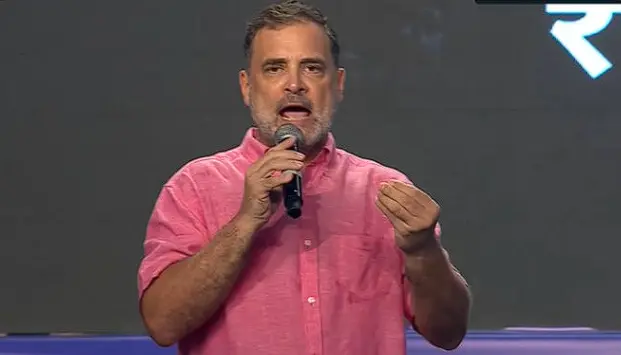
Lucknow: Congress leader and Leader of Opposition in the Lok Sabha Rahul Gandhi on Saturday told a large student gathering in Prayagraj that India’s youth are being pushed into a system where education is getting costlier but stable employment is shrinking, and warned that over dependence on social media is deepening the distraction.
Addressing the ‘Chhatron Ki Goonj’ programme at KP Ground, Gandhi said India’s nearly 40 crore young people are the country’s biggest strength but are being failed by a system that does not convert this demographic advantage into economic opportunity.
‘Only 12 Out Of 1,000 Get Permanent Jobs’
Citing what he described as a stark picture of India’s employment scenario, Gandhi said: “Only 12 out of 1,000 get permanent jobs.” He added that the remaining young people are increasingly pushed towards informal work, gig employment and other forms of insecure livelihood, as reported by The New Indian Express.
“Today, education certificates have no meaning in India because they cannot give you a job,” Gandhi said, describing the situation as a “chakravyuh” in which students spend years preparing for examinations, pay high coaching fees and eventually struggle to find secure employment.
“The system is taking your money, your time and your energy, but it is not giving you a job,” he said, arguing that the problem is not a lack of willingness among young Indians to work, but the absence of enough quality jobs.
‘Reels Are The Addiction Of The 21st Century’
Gandhi also revived his sharp criticism of the social‑media economy. “Reels are the addiction of the 21st century,” he said, describing Instagram and Facebook reels as a distraction that keeps youth from questioning the government on jobs, education and healthcare.
He has previously said that when young people make or watch reels, the financial benefits largely accrue to technology and telecom companies rather than directly filling their pockets, and has contrasted reels with the need for “employment”.
Paper Leaks And Stalled Recruitment
The Congress leader attacked what he described as a broken examination and recruitment system. “Paper leaks, stalled recruitments, years of waiting, and no one held accountable,” Gandhi said, referring to the grievances of students and job aspirants.
Ahead of his Prayagraj visit, Gandhi had said: “There’s no shortfall in your hard work — the fault lies in the intent of that system which doesn’t reward your efforts.” He has also claimed that around 7.5 crore young people were affected by paper leaks over the past decade and alleged that 152 paper leaks had occurred during this period. These figures are Gandhi’s claims and were not independently established in the available reports.
AI And The Future Of Jobs
Artificial intelligence was another major concern raised by Gandhi. He warned that while AI could transform India’s economy, it could also worsen the employment crisis if the benefits of technological development were not distributed among ordinary Indians.
Gandhi argued that India’s young population generates an enormous amount of data and that this data should be treated as an economic asset belonging to Indians. He framed his speech around three words — “dard, data and daulat” — pain, data and wealth — saying these were central to understanding the problems facing India’s young population.
From Education To Employment
Gandhi also attacked the rising cost of education and coaching, saying that families were spending large sums to educate their children without any guarantee of employment.
The problem, he said, was not simply unemployment but the absence of a pathway connecting education with secure livelihoods. He blamed demonetisation and GST for hurting small industries and alleged that inadequate access to bank credit was preventing small and medium businesses from generating employment. He also criticised the privatisation of public-sector enterprises.
‘Change System With Love, Not Violence’
Gandhi ended his message to students with a call for collective action, but cautioned them against hatred and violence. “You cannot hate or be violent,” he told the gathering.
“We will never resort to hatred or violence; [we] will change the system with love and affection,” Gandhi said.
He described recent student protests as a sign that young people were beginning to challenge what they believed was an unfair system. “Youths lit a light in darkness, and in doing so, changed the country,” he said.
In his concluding appeal, Gandhi urged students to remain alert, informed and united in demanding accountability from those in power. “Do not lose hope, do not stop asking questions,” he told the gathering, adding that sustained pressure from the youth was essential to bring meaningful change in education and employment policies.