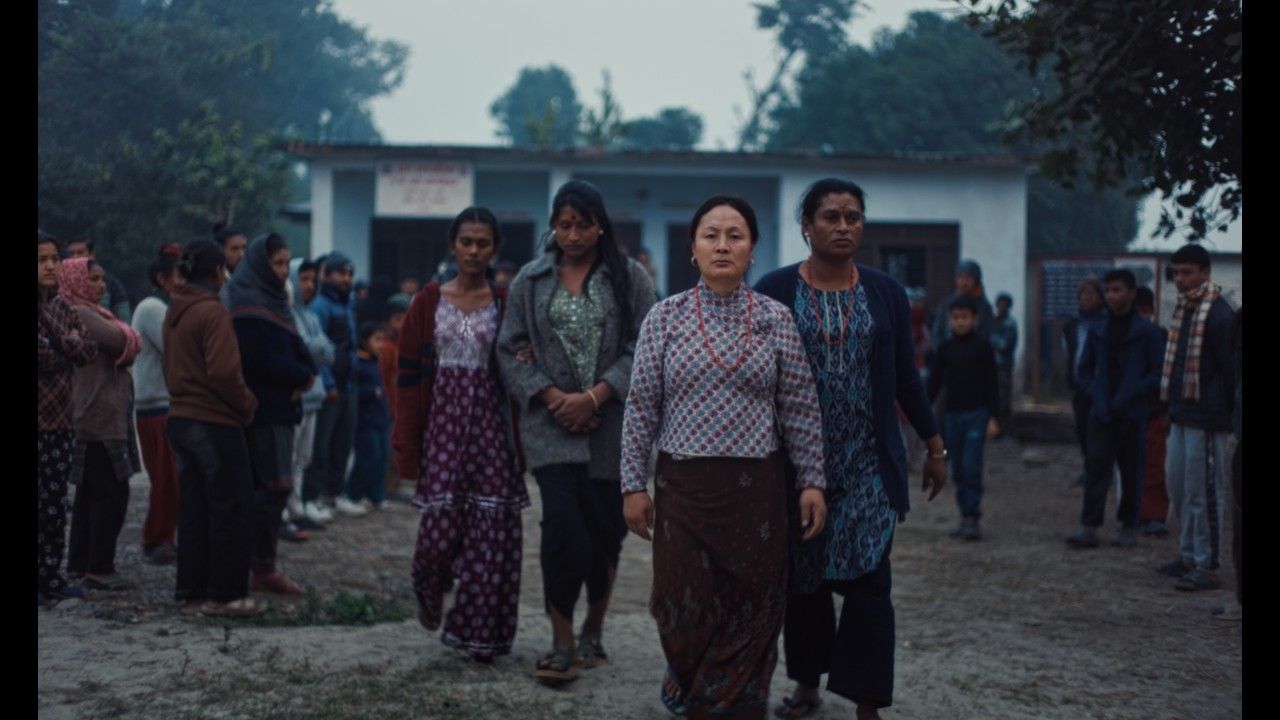
Clapping by transgender people is often used as a form of ridicule, particularly in India, Nepal and other South Asian countries. The gesture has become a familiar stereotype, imitated to mock a community whose presence society acknowledges but whose voices it rarely cares to hear. When Nepali filmmaker Abinash Bikram Shah conceived Elephants in the Foghe had a different idea. He wanted that very clap to become a source of power for his characters, not an instrument of ridicule.
That decision gives the film one of its most striking artistic elements. The clap becomes its rhythm, recurring through the narrative and gathering force as the story progresses. In the climactic sequence, it acquires an almost orchestral quality, turning a gesture of mockery into a powerful assertion of identity and collective existence.
Screened at the International Film Festival of India (IFFI) in Goa, Elephants in the Fog was among the films that emerged as audience favourites. Its appeal lies in the subtle way it connects the lives of a marginalised community with another form of existence that is increasingly under threat in the same geographical space: that of wild elephants.
One outcaste pitted against another
Set in a forest bordering a village in Nepal, the film follows Pirati, played by Pushpa Thing Lama, a transgender woman who heads a family of Kinnar (transgender) women. Many have been rejected by their biological families and society. Together, they have created a chosen family, held together by relationships that are at once affectionate, complicated and deeply dependent on one another.
Also read: Chakkakomban: Chasing elephants won't end Kerala's crisis
By tradition, the Cheeks women visit households during weddings and childbirth, singing and blessing families on occasions considered auspicious. But their place in the village takes a different turn after dark. They join an otherwise all-male, predominantly macho village patrol, taking up torches and drums to guard the fields against marauding elephants. They are part of the village’s social fabric, but their acceptance remains conditional.
It is in this parallel between human-animal conflict and social alienation that Shah finds the film’s most interesting metaphor.
Two narratives, one story of alienation
The electric fence erected along the forest to protect the villagers’ harvest is a constant reminder of the uneasy relationship between the village and the elephants. The animals, driven into human spaces and perceived as a threat, become the subject of fear and resistance. The Cheeks women, too, inhabit a world where their presence is often treated as something that needs to be contained or kept at a distance.
Shah does not make this comparison explicit or turn it into a simplistic equivalence. Instead, the two narratives gradually begin to speak to each other. Both the elephants and the transgender women are viewed through the lens of social anxiety, their existence negotiated through the needs and fears of others.
Also read: IFFI 2026: Why politically charged cinema is missing from the festival’s selection
The connection becomes particularly evocative in the climactic sequence, where the lives of the Cheeks community and the wild elephants converge in a striking visual and emotional synthesis. The film brings the two forms of alienation into the same frame, leaving the audience to consider who gets to occupy a space and who is considered an intruder.
What inspired the film?
Speaking after the IFFI screening, Shah explained that the film originated during the COVID lockdown in 2020. He had come across TikTok videos of a transgender family, whose members were dancing and enjoying themselves despite the hostility expressed in the comments.
“What struck me was that the comments weren’t nice, but that didn’t stop them from making videos,” he recalled.
When he met the community after the lockdown, he was welcomed into their homes. What particularly interested him was the family they had created after being rejected by their biological families.
Also read: IFFI's Indian Panorama opens with 'Dhurandhar'; Madhur Bhandarkar cites film's popularity
“They are most of them were rejected from their home, from their society. Now they are in a family,” he said.
Although their relationships were rooted in the traditional guru-chela structure, the women preferred to describe themselves through the more intimate relationship of mothers and daughters. Shah wanted to explore this alternative understanding of family rather than make a film that merely documented discrimination.
Non-actor transgenders breathe life into film
The casting adds considerable authenticity to this approach. Shah chose performers from the transgender community, all of whom were non-actors. They received basic training, but the director said that trust between the performers and himself was the more important element.
He was particularly conscious of the stereotypical portrayal of transgender women in Indian cinema, where they are frequently reduced to comic characters or exaggerated caricatures.
Director and screenwriter Abinash Bikram Shah and the film’s lead actor Pushpa Thing Lama at the screening of the film at IFFI, Goa. Photo: @PIB_India/X
Pushpa Thing Lama is the film’s biggest revelation. Already known as an LGBTQI activist, she delivers an extraordinary performance as Pirati. Her portrayal has a quiet authority, combining the responsibilities of a family matriarch with the vulnerabilities of a woman who has experienced exclusion herself. There is no theatrical exaggeration in her performance. Her expressions, silences and everyday interactions give Pirati a remarkable depth.
For Pushpa, the film is also an opportunity to take the voice of a community that is routinely ignored to a wider audience.
“Nobody wants to hear the voices of the Kinnar community. There are so many people living in the shadows. Society does not even want to see them or hear them,” she said after the screening.
Invoking the idea of diversity in Hindu religious traditions, she referred to a verse she associated with the Rig Veda to underline that diversity is part of nature.
“We exist!” she declared.
Not a sermon, just a true portrait
That assertion could well be the film’s underlying message. But Abinash Bikram Shah avoids turning it into a sermon. Instead, he lets the characters’ lives, their relationships and their everyday negotiations with the village convey the point.
Also read: SC urges Centre to protect existing transgender rights amid 2026 law amendment concerns
The film’s audience response at IFFI was a testament to the power of this storytelling. Elephants in the Fog works as an intimate portrait of a chosen family, but its artistic achievement lies in the way it brings together two seemingly disparate worlds and finds a shared language of displacement, survival and coexistence.
By the time the film ends, the clap has acquired a meaning that cannot easily be dismissed. It is not asking to be heard. It is announcing that it has always been there.