

It’s raining unicorns this year. Less than a month after proptech startup Square Yards became the country’s 131st unicorn, AI software creation platform Emergent has entered the coveted club of Indian unicorns. With this, it has become India’s sixth unicorn of 2026 and the third homegrown AI startup to wear the crown after Krutrim and Sarvam.
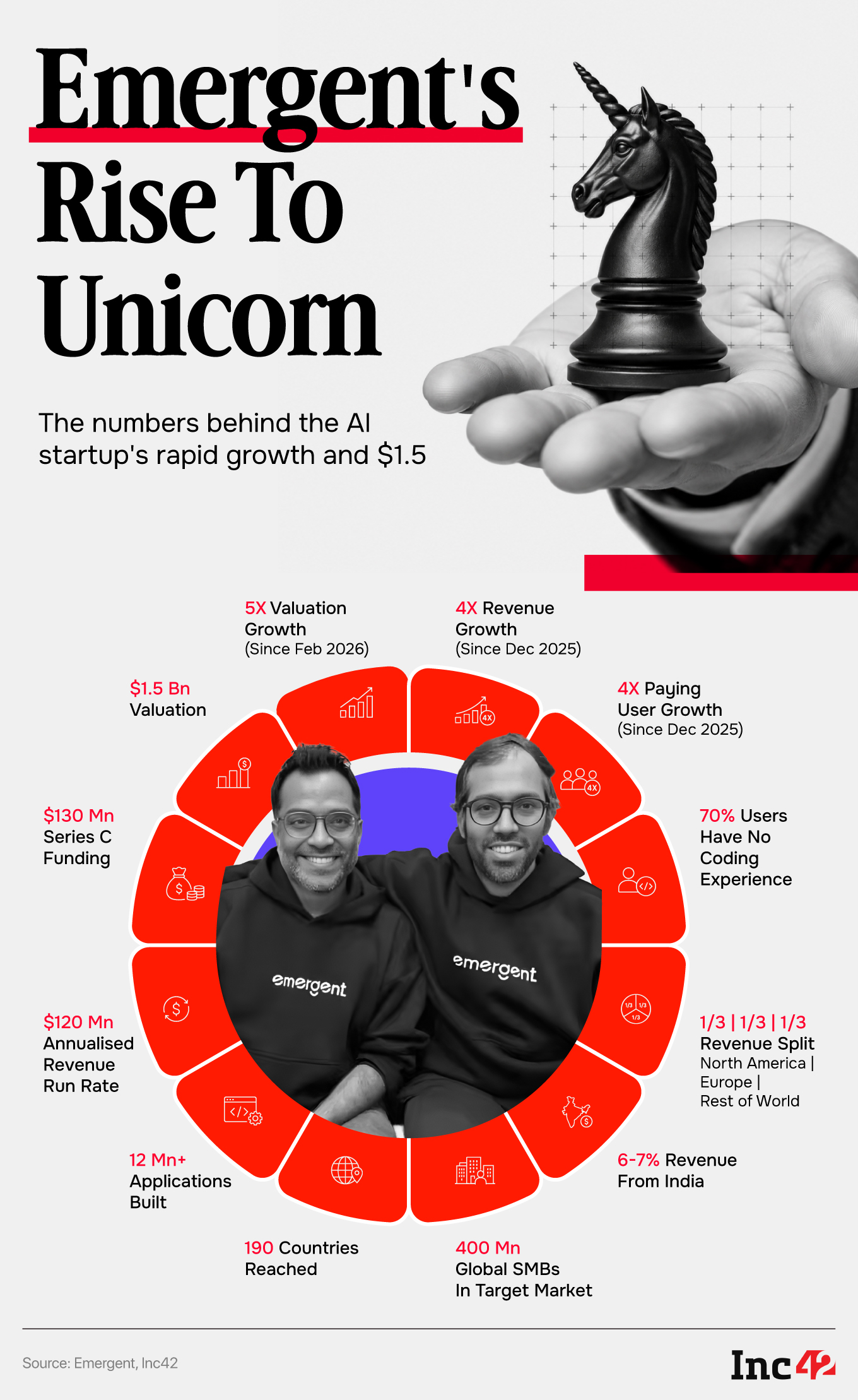
Emergent has raised $130 Mn in its Series C funding round led by Creaegis, with MNI Ventures – Claypond Capital and Sentinel Global as co-lead investors. Khosla Ventures, SoftBank Vision Fund 2, Lightspeed and Y Combinator also participated in the round that catapulted its valuation to $1.5 Bn, taking the total funding to $230 Mn.
This is Emergent’s third major funding round over the past year. Five months ago, it raised $70 Mn in its Series B round from SoftBank’s Vision Fund 2 and Khosla Ventures. Its first funding round comprised an infusion of $7 Mn by Y Combinator and Together Fund. This was followed by a $23 Mn Series A round led by Lightspeed in September 2025.
Emergent has also emerged as one of the fastest startups to join the unicorn club, achieving a $1 Bn valuation within two years of incorporation.
Founded in 2024 by Dunzo cofounder Mukund Jha, along with his brother Madhav Jha, Emergent allows entrepreneurs and small businesses to build production-ready web and mobile applications using autonomous AI agents.
The fresh flow of funds will be deployed across hiring, open-source AI research and global expansion. According to Mukund, more than 12 Mn apps have already been created on its platform by users across 190 countries, with nearly 70% of its users having no prior coding experience.
Growth Story That Sealed The Deal
Unlike many AI startups raising capital primarily on future potential, Mukund said the latest funding follows a sharp improvement in business metrics.
Speaking with Inc42, he said Emergent has recorded a 4X increase in both revenue and paying users since its previous funding round. Customer acquisition costs have declined, while gross margins have improved and customer retention remains strong.
The founder did not disclose any of these numbers.
He, however, said that the vibe coding startup has reached an annualised revenue run rate of approximately $120 Mn, up around 20% QoQ. Jha added that about one-third of the startup’s revenues currently come from North America, another one-third from Europe and the remaining from the rest of the world. India currently contributes around 6-7% of its total revenue.
Despite growing enterprise interest, Emergent continues to derive the bulk of its business from small businesses. Enterprise customers account for less than 5% of its overall revenue.
“There are roughly 400 Mn small businesses in the world today. They account for nearly half of global GDP and almost 70% of employment. Yet this segment has largely remained underserved when it comes to software, and we want to become the operating system for small businesses,” Mukund said, adding that they plan to expand further into the enterprise segment only after strengthening their PMF.
While the startup has not finalised an internal allocation for the proceeds, Mukund said a significant portion will go towards strengthening engineering talent and accelerating go-to-market efforts across international markets.
Emergent is also scaling its San Francisco operations aggressively from its current eight-member team, while evaluating expansion into Europe alongside scaling hiring in India.
From Building Apps To Automating Businesses
Emergent’s broader ambition extends beyond helping users generate applications through prompts. The startup began as a coding agent before pivoting towards enabling non-technical users to build full-stack software through conversational AI. Its latest product evolution moves further into business automation.
Emergent is expanding from what it calls “prompt-to-app” towards “prompt-to-operations”, allowing businesses to create AI agents capable of handling operational workflows rather than simply generating software.
Its recently launched Wingman platform enables users to automate scheduling, lead generation and business operations without requiring software engineering expertise.
“We are moving from just building software to helping businesses build agents and automate large parts of their operations. We want to become the autonomous layer for every SME,” Mukund said.
Commerce applications, marketplaces and business management software currently represent the largest use cases on the platform, followed by AI-native applications such as chatbots, voice agents and customer support tools.
Supporting this scale has required Emergent to build much of its AI infrastructure internally. According to Mukund, more than 95% of the company’s code is now written using AI agents, while its software stack, including orchestration, model routing, deployment infrastructure and memory systems, has been built in-house.
The company currently relies heavily on Anthropic’s models alongside OpenAI, Gemini and open source alternatives but plans to increase its investment in open-source AI as reasoning capabilities continue to improve and customers seek lower operating costs.
“We are investing heavily in open source because it reduces dependence on any single model provider while helping lower costs for customers. Open source models are now reaching a level where many production workloads can start moving towards them,” he said.
Emergent’s latest funding round comes amid a sharp surge in AI investments in India. AI startups raised $676 Mn across 57 deals in the first half of 2026, more than four times the $162 Mn raised across 30 deals during the same period last year, according to the Indian Tech Startup Funding Report, H1 2026.
The funding also comes amid growing investor interest in AI-powered coding platforms, driven by their rapid adoption. Last month, Inc42 exclusively reported that vibe coding startup Rocket is also in talks with US-based Susquehanna International Group (SIG) to raise a fresh funding round. Earlier this year, AI startup Sarvam became India’s 130th unicorn after raising $234 Mn at a post-money valuation of $1.5 Bn.

Comments are closed.