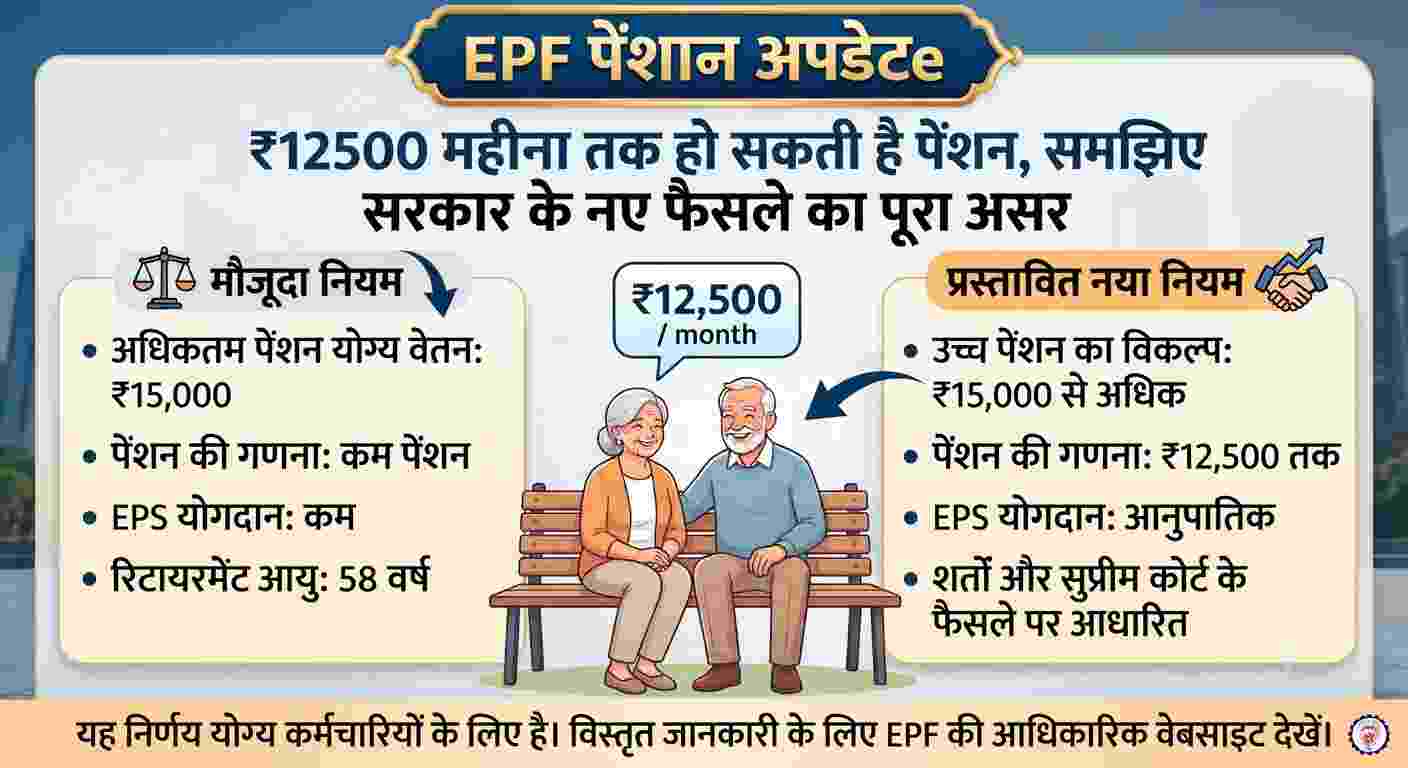
The biggest relief news so far has emerged on the social security front for crores of salaried employees and workers working in the organized sector across the country. A revolutionary change is being seen in the pension structure after the policy approval to increase the wage ceiling for mandatory contribution under the Employees Provident Fund Organization (EPFO) from ₹ 15,000 to ₹ 25,000 per month. The direct and biggest positive impact of this decision has been on the Employees' Pension Scheme 1995 (EPS-95), under which the maximum monthly pension can now directly reach ₹12,500 per month, crossing the old limit of ₹7,500. This is the first time since 2014 that the Central Government has taken such a major policy decision to align the social security of the organized workforce with modern inflation and the real cost of living. Lakhs of private sector employees working in major industrial and commercial centers like Delhi, Mumbai, Bengaluru, Noida, Gurugram, Lucknow, Pune, Hyderabad and Ahmedabad had been demanding for a long time to increase this limit. Till now the situation was such that even if the basic salary of an employee was ₹ 50,000 or even ₹ 1,00,000, legally his pension contribution was limited to an upper limit of ₹ 15,000 only. Due to this, even after working hard for decades, the amount of pension received at the time of retirement remained very limited. This step of the government has not only expanded the scope of social security, but has also laid a solid foundation to provide a respectable financial support in old age to middle-class families working in the modern digital economy. Exact formula and calculation of maximum monthly pension of ₹ 12,500 The pension received under the Employees' Pension Scheme (EPS-95) is not an arbitrary figure, but is based on a fixed and transparent formula of the Employees' Provident Fund Organisation. To calculate monthly pension as per EPS rules the pensionable salary is multiplied by the total pensionable service years and then the resulting number is divided by 70. Here pensionable salary means the average basic pay plus dearness allowance for the last 60 months (5 years) immediately preceding the employee's retirement, subject to the statutory maximum salary limit. At the same time, only a maximum of 35 years of service is recognized in pensionable service, in which employees who have contributed continuously for 20 years or more get an additional bonus weightage of 2 years from the government. Under the old system, when the maximum salary limit was ₹15,000, the maximum pension for any employee who had completed 35 years of complete service was calculated on the basis of ₹15,000 times 35 divided by 70, resulting in a maximum amount of ₹7,500 per month. Now that this limit has been revised to ₹25,000, the mathematics has completely changed. Under the new rules, dividing ₹25,000 by 35 by 70 directly comes out to a fixed pension of ₹12,500 per month. If an employee has completed 20 years of service, then with a weightage of 2 years his pensionable service will be considered as 22 years and his monthly pension at the new pay scale will increase from ₹4,714 to approximately ₹7,857 per month, which directly represents a net increase of 66.6 per cent. What effect will this decision of the government have on your monthly salary slip and in-hand pay? On one hand, there will be a huge jump in the pension received after retirement, on the other hand, there will be some reduction in the monthly take-home salary i.e. in-hand pay. Under EPF rules, 12 percent contribution of any employee is directly deducted from his basic salary and deposited in the Provident Fund. Till now, the PF deduction of those employees whose basic salary was more than ₹ 15,000, but the company kept it within the statutory limit, was deducted at ₹ 1,800 per month. After the salary limit has increased to ₹ 25,000, now this deduction at the rate of 12 percent will be a maximum of ₹ 3,000 per month, which means that an additional ₹ 1,200 will be deducted from the employee's pocket every month and his in-hand salary will be reduced by the same amount. There has also been a major change in the level of company or employer's contribution. Out of the total 12 percent contribution given by the company, 8.33 percent goes to the Employee Pension Fund (EPS) and the remaining 3.67 percent is deposited in the EPF account. In the old system, the company's maximum contribution to the pension fund was only ₹ 1,250 per month, which will now increase to ₹ 2,082.50 per month on the basis of ₹ 25,000. This means that an additional amount of ₹832.50 will be transferred to the employee's pension account every month from the company's share. Although this will result in a slight reduction in the monthly amount going into the EPF lump sum fund, in return the employee will get a large, secure and guaranteed pension fund for life. Mixed response from local industries, MSMEs and corporates From the leather and engineering clusters of Kanpur, Agra and Ghaziabad in Uttar Pradesh to the Tirupur textile industry in Tamil Nadu and the Surat textile hub in Gujarat, the decision is having a wide-ranging impact on the balance sheets of industry. Organizations of Micro, Small and Medium Enterprises (MSME) say that the salary cap of ₹ 25,000 will put additional financial burden on employers for matching contribution of employees. Especially at companies that have a large workforce and hire employees in the salary slab of ₹15,000 to ₹25,000. Industries believe that this may increase their operating costs by 2 to 3 percent. On the other hand, big corporate houses and modern multinational companies have welcomed this decision wholeheartedly. Human resource experts and trade unions argue that youth in India's fast-growing economy desperately needed better retirement benefits to retain jobs. Guaranteeing higher pension will increase the confidence of the youth working in the private sector, the tendency to switch jobs will be curbed to some extent and the feeling of financial stability will be strengthened in the workforce. Organized sector unions are considering this as a bold and progressive step towards implementing the Social Security Code. Will the existing pensioners get the benefit of this increase? After this new amendment, it is natural for more than 75 lakh existing EPS-95 pensioners of the country to have a question whether their pension will also increase to ₹ 12,500 from tomorrow. As per the guidelines of the Ministry of Labor and Employment, this new calculation will be directly applicable only to those employees who are currently in service and who will deposit their contributions at the revised limit. Since the pension amount is calculated on the basis of the average pensionable salary of the last 60 months, the full and maximum pension benefit of ₹12,500 will be available to those employees who continuously deposit their and the company's contribution at the new limit of ₹25,000 for the next five years. For those employees who are going to retire in the next one or two years, their pension will be decided on pro-rata basis in which the average of both the old and new contributions will be calculated. For ex-employees who have already retired, their pension has been permanently fixed on the basis of the rules in force at the time of their service and the then pay limit. They will not get any automatic or retrospective benefit of this amendment. However, the parallel demand that senior pensioners organizations have been making for a long time – increasing the minimum monthly pension from ₹ 1,000 to ₹ 3,000 or ₹ 7,500 and linking it to Dearness Relief (DR), is being considered separately by the government. Along with this, the limit of free life insurance cover available under the Employee Deposit Linked Insurance (EDLI) scheme will also automatically increase due to increase in salary limit, which will provide more financial security to the families of employees in times of distress.