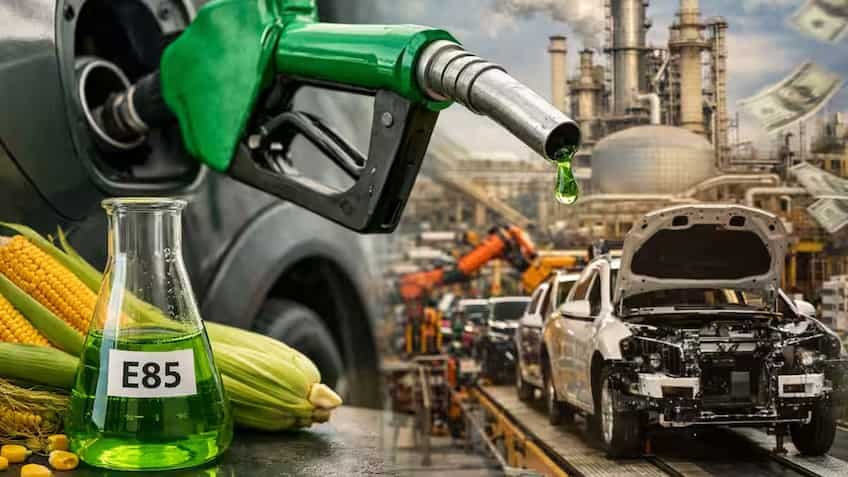
In order to provide relief to common consumers from inflation during the festive season and to ensure availability of sugar in the domestic market, the Ministry of Consumer Affairs, Food and Public Distribution of the Central Government has taken a major policy decision. The government has imposed a complete ban on making ethanol from sugarcane juice, sugar syrup and B-heavy molasses for the upcoming ethanol supply year. Sugar mills and distilleries will now be allowed to use only C-Heavy Molasses, so that the maximum sweetness of the cane can be used only for sugar production. The government has clarified that the national target of 20 percent ethanol blending (EBP Programme) in petrol will not be allowed to be disrupted and for this the supply from distilleries based on maize, FCI surplus rice and damaged food grains will be increased at full speed. This big decision has completely changed the equations of the sugar industry, from the Sugarcane Commissioner's office in Lucknow, the capital of Uttar Pradesh, to the major sugar belts of Lakhimpur, Sitapur, Muzaffarnagar, Shamli and Maharashtra.
According to the Food Ministry, the country's gross sugar production in the current crushing season and the upcoming 2025-26 season is estimated to be around 310 lakh tonnes. The imbalance in monsoon rains has affected the yield in major sugarcane producing areas of Maharashtra and Karnataka. If ethanol continues to be produced on a large scale from sugarcane juice and B-heavy molasses as before, then about 35 to 40 lakh tonnes of sugar would have been diverted into ethanol, which could have created a huge shortage of sugar in the domestic market and retail prices could have crossed ₹45 to ₹50 per kg. In view of the upcoming festive demand (Diwali, Chhath and upcoming wedding season), the government has decided to give priority to food security over energy security.
In the new tender issued by Oil Marketing Companies (OMCs) and Food Ministry for the upcoming Ethanol Supply Year (ESY 2026-27), the diversion quota of sugar and sugarcane juice has been set at zero (Zero Sugar Diversion).
-
Sugarcane Juice/Syrup: There will be a complete ban on this.
-
B-Heavy Molasses: Since B-heavy molasses has a high sugar content and can be processed into sugar, its use has also been banned.
-
Green signal for C-heavy molasses: Sugar mills will be able to make ethanol from the final by-product left after sugar production, which is called C-heavy molasses. This will not have any adverse effect on sugar production.
After the ban on sugarcane based raw material, grain-based distilleries will be operated at full capacity to maintain the ethanol supply in the country. At present, about 70 to 75 percent of the country's ethanol is already being supplied through grain-based distilleries.
-
Big boost to maize: The central government has fixed the purchase rate of oil companies for ethanol made from corn at ₹ 71.86 per liter, which is the highest incentive rate. Due to this, maize producing farmers of Uttar Pradesh, Bihar, Madhya Pradesh and Karnataka are getting better prices for their produce.
-
FCI's surplus rice: Rice present in excess of buffer stock in the warehouses of Food Corporation of India (FCI) is being allocated for ethanol manufacturing at the rate of ₹ 58.50 per liter.
-
Broken and Spoiled Grains (DFG): Distilleries have been given complete freedom to use spoiled wheat, broken rice and coarse grains like jowar-millet.
Officials of the Ministry of Petroleum and Natural Gas say that despite the temporary ban on sugar-based feedstock, there will be no negative impact on the ambitious target of mixing 20 percent ethanol (E20 Fuel) in petrol. Many new grain-based multi-feedstock distilleries have been set up across the country during the last three years, whose production capacity has significantly reduced the dependence on sugarcane. Oil marketing companies have estimated the requirement of a record 1,050 crore liters of ethanol for the coming year, a large part of which will be met from grains.
The Indian Sugar Mills Association (ISMA) and private distillery operators have given a mixed reaction to this decision of the government:
-
Impact on financial liquidity and payments: Mill owners say that those who had set up dedicated distillery units to make ethanol only from sugarcane juice, the utility of their plants will be affected. Also, the quick cash flow from ethanol facilitated the payment of sugarcane dues to the farmers.
-
Protecting the interests of sugarcane farmers: However, the government has clarified that with retail prices of sugar remaining stable and mills concentrating their entire crushing on making sugar, there will be no disruption in payments to farmers. The Center has recently fixed the Fair and Remunerative Price (FRP) of sugarcane at ₹355 per quintal for the crushing season, direct payment of which will be ensured.
This policy change will directly benefit the common families and food processing industries of the country:
-
Stability in sugar prices: There will be ample supply of sugar in the open market, which will prevent hoarding and black marketing during the festive season.
-
Control over sweets and bakery products: With sugar prices remaining stable, there will be no sudden jump in the cost of bakery, packaged beverages, soft drinks and traditional sweets during the festive season.
-
Balancing Environment and Fuel Safety: India will continue to move towards green energy goals without jeopardizing its domestic food security.